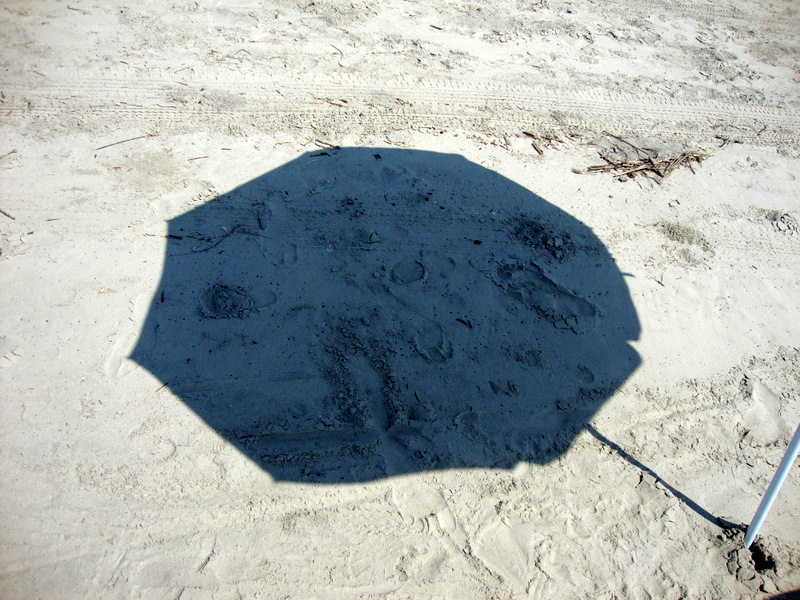
This beach umbrella casts a fairly octogonal shadow! If I knew more about astronomy, I suppose I could have used this shadow to compute the time of day.
Related Posts
This beach umbrella casts a fairly octogonal shadow! If I knew more about astronomy, I suppose I could have used this shadow to compute the time of day.
Related Posts
 This is a nice profile on Dan Feyer, the winner of the 2010 American Crossword Puzzle Tournament.
http://www.nytimes.com/2010/12/07/science/07profile.html
Feyer, who is a music director in New York City, excelled at math as well as music in school. This combination of talents, math and music, is not uncommon, and both of these skills sets seem to appear with great frequency among crossword puzzle enthusiasts.
Indeed, as the article points out, Jon Delfin, a 7-time winner of the tournament, is also a musician, and many other winners and crossword constructors are math and computer science types. As one puzzler points out, the connection between math, music, and crossword puzzles is pattern finding. In addition, the three fields also rely on the manipulation of symbols that often contain no inherent meaning themselves.
This all makes perfect sense to me. I am an avid crossword puzzle solver, I have competed in the tournament many times, and I have even constructed several puzzles of my own, including this one that incorporates many mathematical ideas:
https://mrhonner.com/2011/06/02/crossword-puzzle-a-touch-of-math-2/
Unfortunately, constructing a good crossword puzzle takes as much time and effort as constructing a good math test!
One of the many art installations on Governor’s Island, New York.

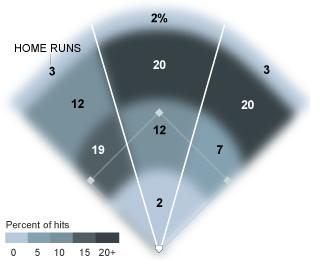 In celebration of Derek Jeter’s 3,000th major league hit, the New York Times ran a really cool infographic displaying the relative frequencies of where those 3,000 hits went.
In addition to tracking where all of Jeter’s hits have gone, two graphics also compare his first 1,500 hits to his second 1,500 hits: not surprisingly, the second 1,500 consists of fewer home runs and fewer hits to left field. A similar graphic shows Alex Rodriguez’s hit patterns.
There are several other interesting data displays here, including year-by-year histograms for all 28 MLB players with 3,000 hits.
 Through Math for America, I am part of an on-going collaboration with the New York Times Learning Network. My latest contribution, a Test Yourself quiz-question, can be found here:
https://learning.blogs.nytimes.com/2011/07/11/test-yourself-math-july-11-2011/
This problem is based on the number of home-schooled children in the U.S.