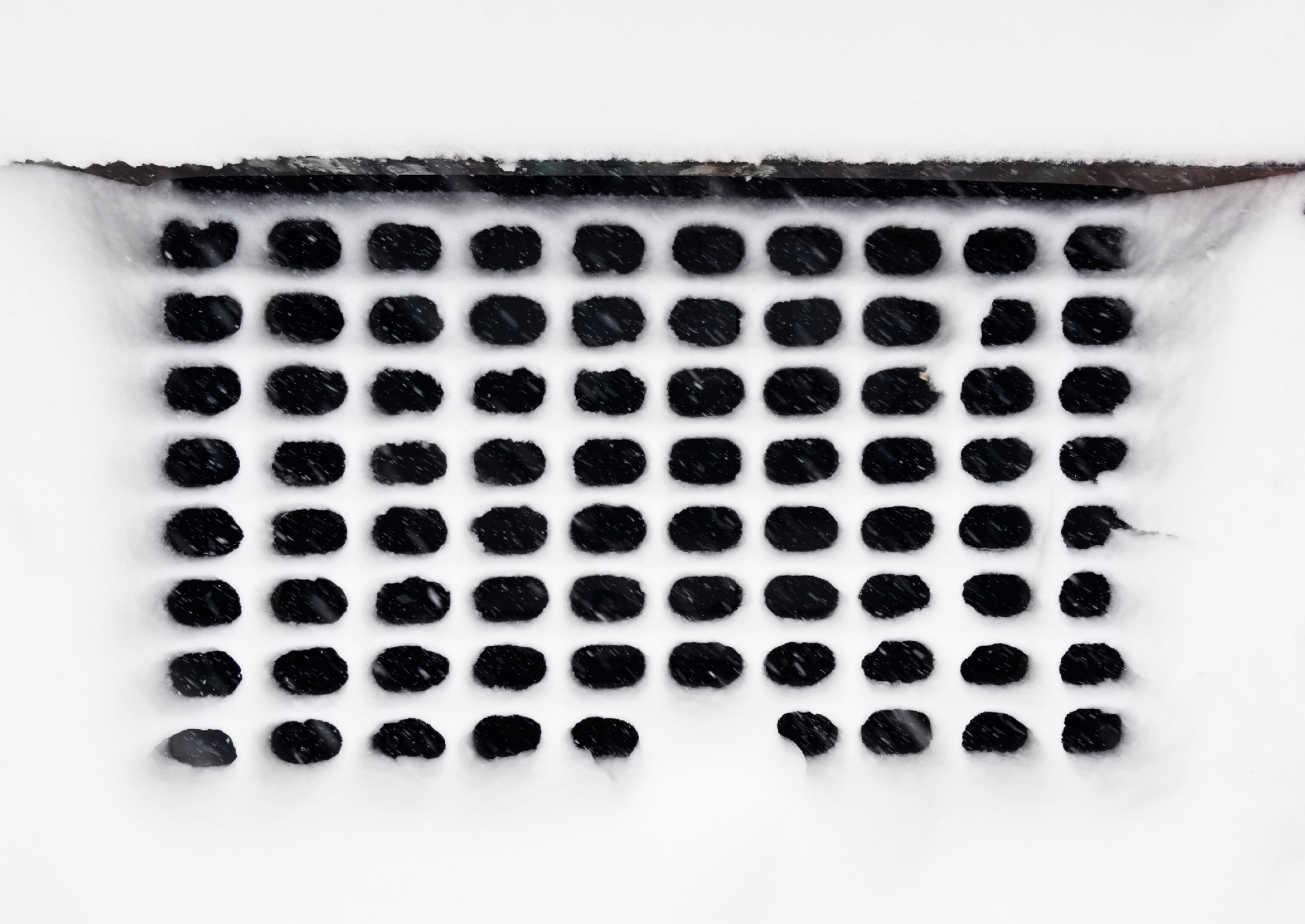
A snow day snow array! I thought of punching out that one stubborn entry, but let it be in the spirit of wabi-sabi. It’s like the Great British Baking Show’s missing raspberry.
Related Posts
A snow day snow array! I thought of punching out that one stubborn entry, but let it be in the spirit of wabi-sabi. It’s like the Great British Baking Show’s missing raspberry.
Related Posts
I’ve always found it cool that if you double the smaller acute angle in a 3-4-5 triangle you get the larger acute angle in a 7-24-25 right triangle. You can see this as a consequence of the double angle formula for sine. If is the smaller acute angle in a 3-4-5 triangle, then
In fact, if the sine and cosine of an angle are both rational, then so will be the sine and cosine of twice that angle. This gives a way to turn Pythagorean triples into new Pythagorean triples!
For example, suppose is an acute angle in a right triangle with
. Then
By the Pythagorean identity
And so
which of course also follows directly from algebra.
For example, using this process
Originally posted on Mastodon.
Related Posts
Here are some highlights from what has been another busy professional year.
In September I published a new series in the New York Times that turns Steven Strogatz’s wonderful “Math, Revealed” essays into teaching and learning resources. I got to write about favorite topics like taxicab geometry, triangular numbers, the golden ratio, and packing problems. Best of all, I got to collaborate directly with Strogatz himself! It was an honor to work with him, even if this doesn’t officially make my Erdős number four.
I’ve been thinking and writing about AI in education and math this year. I wrote about how students are using AI, how it is impacting the college admissions process, about experts calling AI-errors “sophisticated”, and how it’s affecting me as a book author. I’ve been through a few hype-bubbles in my time, and am generally skeptical by nature, but there’s no denying the impact these technologies will have in how we learn, teach, and even do math.
I’m wrapping up my 20th, and final, year as a Math for America Master Teacher, and I was proud to run one more workshop for teachers through MfA. “A One-Problem Tour of Statistics” was the story of what I learned by writing Painless Statistics, but also an homage to the kinds of math problems that you keep going back to. It was a fun and satisfying end to a string of nearly 30 workshops I’ve run in my time at MfA.
The applied mathematics and modeling program I run at my school had unprecedented success in 2025. We had a team win the NCTM Award in the 2024 High School Mathematical Contest in Modeling (HiMCM) and finish in the top ten worldwide in the 2025 International Mathematical Modeling Challenge (IMMC). Another team won the MAA Award in the 2025 MCM, finishing among the top of over 12,000 entries worldwide, nearly all of which were college teams! We also had a team earn an “Outstanding” designation — the highest honor — in the 2025 SCUDEM competition, a college-level differential equations modeling competition. I was very proud to be profiled on the COMAP website for “teaching, modeling, and mentoring at the highest level”!
This past summer I was invited to present to the Alliance for Decision Education on my work with student forecasting, after our students made impressive showings in two individual forecasting competitions in 2024 and 2025. I also appeared on MoMath’s QED and spoke with mathematician-in-residence David Reimann about math and math education.
It’s been a good year professionally, and I’m looking forward to more to look back on in 2026!
Related Posts
Draw the lines you see.
I enjoy drawing, and I’m pretty good at drawing mathy things — like surfaces and shapes and diagrams — but beyond that I really have no idea what I’m doing. I’ve always wanted to improve, so when I saw a “Drawing for Teachers” course in the Math for America catalog I was excited to sign up.
The course was terrific. It was facilitated by three teachers, each with different backgrounds in art and different experiences teaching non-art subjects. Each session was filled with theory, history, exercises, and happily, lots of time to draw. It was the best kind of learning experience, one that affects you in many ways. I left with techniques to help me practice, fun activities to try at home, connections that inspire my teaching, and ideas to think deeply about.
But I keep coming back to one particular piece of advice I got from the facilitators. “Draw the lines you see.” I’ve said this to myself many times over past few months as I sit down to sketch. Doing so accomplishes two important things.
First, it centers a basic principle of drawing: everything is made of lines. I suppose this is the kind of observation that is obvious when you know what you’re doing, but as a novice it’s both helpful and practical to be reminded of. That moment I pick up a pencil and commit to trying to draw an object is often overwhelming and intimidating. There’s always a part of me asking “How am I ever going to draw this?” Now I have an answer. Draw the lines you see.
Second, this advice warns me about the common trap I never knew I was falling into. I often draw what I think I see, rather than what I actually see. I think I know what a bird looks like, so after I start drawing it, I stop looking at the bird in front of me and draw the bird I’m thinking of. The problem is I don’t really know what a bird looks like, at least not in enough detail to draw it accurately. My brain dutifully fills in the gaps, and before I know it my bird looks like a flying shark. “You draw with your eyes” was another good piece of related advice from the facilitators.
As eminently practical as this advice has been for drawing, I find it guiding me in other ways. The other day my son politely asked me to try playing the piano accompaniment as it sounds in the recording, not in the bouncy, internal rhythm that I naturally bend all music to. And when reading a book on physics and for the millionth time drifting away from what was written because I’d heard it all before and it didn’t make sense to me, I paused a moment, re-focused on the author’s words, and surprise! It made sense.
Draw the lines you see. Play the music you hear. Think on the words you read. All obvious in retrospect, I suppose, but maybe that’s just the nature of good advice.
Related Posts
I read around 30 books in 2025, a number I’m proud of but know could be higher. Here are some of the books I’m still thinking about at year’s end.
“Infinitesimal” is the story of the heretical idea that a line segment could be divided into infinitely many parts. Literally heretical, as the Catholic church repeatedly decreed that infinite divisibility went against the natural order, and that accepting, promoting, and teaching it was heresy. The concept of indivisibilty is like a character in Amir Alexander’s story, and we follow its path through ancient times, Reformation, Counter-Reformation, and beyond. It’s a compelling and exciting book about math, science, and history, and the way divisibility influences, and is influenced by, the world around it is a reminder that math and science, as human endeavors, are always deeply intertwined in issues of human culture.
A similarly good book I read this year was “Vector”, by Robin Arianrhod. Who would have thought that the idea that you can do math on objects that have both magnitude and direction could have been so controversial? This is another sweeping mathematical history involving quaternions and physics and ultimately the theory of relativity. And as with infinitesimals, the story of the vector is a good reminder that today’s common sense is often yesterday’s culture war. (My pithy review of this book: It should have been titled “Tensor”.)
I read “How Children Learn”, a classic in American education. Written by John Holt in 1967, this sequel to “How Children Fail” feels like a historical preview of many modem education movements, like homeschooling, unschooling, constructivism, “discovery” learning, and the like. The book reads like a measured but outraged reaction to the stultifying, authoritarian schools and classrooms that I presume were commonplace in American education at that time, and sadly, may still be. It’s filled with insightful observations about learning and schooling – trust children to figure things out, follow their curiosity, let them play and experience before forcing a new model of thinking upon them – but it’s also filled with the kind of fallacious conjectures and post hoc explanations common to popular social science books.
“Kon Tiki” was the most inspiring book I read this year. It’s the first-person account of Thor Heyerdahl’s 1947 voyage that proved people really could have migrated from South America to Polynesia by floating on rafts across the Pacific Ocean. Curiosity and a sense of adventure were all it took for six relative strangers to risk their lives to prove possible what no one believed could be true. The story documents the plan, the raft, and life at sea, and is filled with scientific and technical observations that come up as discoveries are made and obstacles overcome. It was nice to be reminded of a time when humble inquiry about the world and cooperation across borders seemed so casual and normal.
The book that might have had the most direct impact on me this past year was “Language of the Spirit”, Jan Swafford’s engaging overview of the history of Western classical music. Written by a scholar but not in a scholarly way, the book is filled with stories, theory, connections, and lots of listening recommendations. Every chapter produced a few new playlists, and I’m still listening and learning. (According to a knowledgeable friend, apparently I’m a modernist!)
As usual I balanced out non-fiction with a good amount of sci-fi. I read several Adrian Tchaikovsky books this past year, but each one left me feeling like I read his best one first. I enjoyed “A Closed and Common Orbit” and “Record of a Spaceborn Few”, entries in Becky Chambers’s Wayfarer series (bookwyrm reviews here and here). I also read the last book in Iain Banks’s Culture series, “The Hydrogen Sonata”. I had been putting it off for years, not wanting to exhaust the last unexplored bit of that universe. I’m trying out Banks’s “The Algebraist” right now, and while it’s not the same, I’m enjoying it. And I love the title!
One last book that had a profound impact on me was Richard Feynman’s “Six Easy Pieces”. I’m on what feels like an intermittent, lifelong quest to understand why I don’t understand physics, and this book profoundly re-organized my thinking. So often I feel like physics is referencing things that don’t seem to exist, and I think Feynman’s explanation of energy really clarified it for me. Energy is not a thing. It’s the name of a mathematical invariant. Of course there’s more to it than that, but that’s enough for me for now. And of course, this leads to more on the list to read for next year!
As always, thanks to the Brooklyn Public Library for the endless supply of learning, and to the bookwyrm community for always putting new and interesting books in front of me.
Related Posts