Google Public Data Explorer

Google’s Public Data Explorer is a great, free resource for students and teachers interested in data science and statistics.

http://www.google.com/publicdata/home

The site allows you to create custom graphs of available data sets, making it easy to experiment with different representations and explore the meaning of data.

There are several data sets available to play around with.   The OECD Factbook alone provides a wealth of raw data on education, energy, employment, population and migration, and many other categories.  There are also data sets available from the U.S. Census and the U.S. Bureau of Economic Analysis.  There appears to be support for using your own data sets, as well.

The data can be represented in a variety of ways:  histograms, line graphs, and even dynamic time series are all available.  It’s a great way to play around with data, and to build skill and intuition in data analysis, interpretation, and representation.

Proofs Without Words

This is a great collection of favorite Proofs Without Words from the community at MathOverflow.net:

http://mathoverflow.net/questions/8846/proofs-without-words

MathOverflow is geared toward research-level mathematics, so many of the examples deal with very advanced ideas.  However, there are some lovely and accessible proofs of the sum of the first n squares, the sum of the first n cubes,  the AM-GM inequality, and various Fibonacci identities.

And since it’s MathOverflow, the comments include a healthy debate about whether you can actually prove something with only a diagram!

11/11/11 — Equilateral Triangle Day!

While others celebrate the number 11 on this special day, I prefer to honor the Equilateral Triangle.

Last year, on 10/10/10, I celebrated the symmetry of the equilateral triangle.  This year, I offer a favorite Proof Without Words.  Well, a proof with some words.  In any event, we will use equilateral triangles to prove that the following infinite series

\frac{1}{4} +  \frac{1}{16}  +  \frac{1}{64}  + \frac{1}{256}  +  . . .

is \frac{1}{3}.

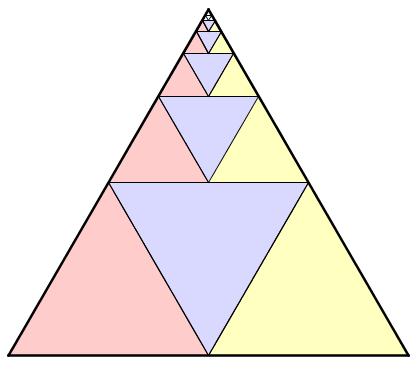
Consider the following diagram.

Notice that the largest blue equilateral triangle is \frac{1}{4} the area of the entire equilateral triangle.  The next largest blue triangle is \frac{1}{4} of \frac{1}{4}, or \frac{1}{16} of the entire triangle.  The next largest blue triangle is \frac{1}{64} of the original triangle, and so on.

So, the sum of the blue triangles is

\frac{1}{4} +  \frac{1}{16}  +  \frac{1}{64}  + \frac{1}{256}  +  . . .

Let’s call this S.

Now, here’s the magic:  the sum of the red triangles is also S!  This is true because for every blue triangle, there is a congruent red triangle right next to it.  Similarly, the sum of the yellow triangle is also S.

When you put all the blue, red, and yellow triangles together, you get the original triangle, whose area is 1.  Thus, 3S = 1, and so

S = \frac{1}{3}

Therefore, we have

\frac{1}{4} +  \frac{1}{16}  +  \frac{1}{64}  + \frac{1}{256}  +  . . .  = \frac{1}{3}

Happy Equilateral Triangle Day!

Related Posts


Follow

Get every new post delivered to your Inbox

Join other followers: