Scratch@MIT Conference, 2016

Scratch MIT logoI’m excited to be participating in this summer’s Scratch@MIT conference.

The conference, held at MIT Media Labs, brings together educators, researchers, developers, and other members of the Scratch community to share how they use Scratch, the free, block-based, web-based programming environment, in and out of classrooms.  The theme of this year’s conference is Many Paths, Many Styles, which aims to highlight the value of diversity in creative learning experiences.

I’ll be running a workshop on Mathematical Simulation in Scratch, which will introduce participants to some of the ways I’ve been using Scratch in my math classes.  I’m looking forward to sharing, and learning!  And I’m grateful to Math for America, whose partial support has made it possible for me to attend.

The 2016 Scratch@MIT conference runs from August 4th through 6th.  You can find more information here.

Related Posts
 

Regents Recap — June 2016: What Do They Want to Hear?

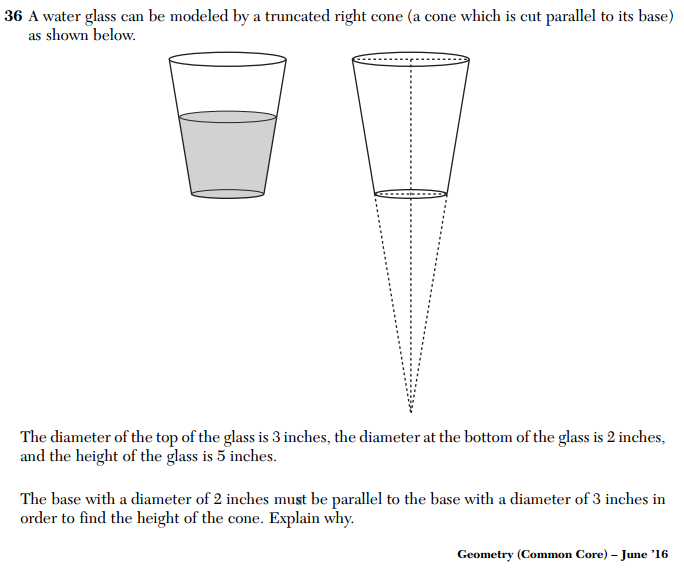
I read this problem several times and still did not understand what it was asking for.  It is the first part of problem 36 from the June 2016 Common Core Geometry Regents exam.

2016 June GEO 36“The base with a diameter of 2 inches must be parallel to the base with a diameter of 3 inches in order to find the height of the cone.  Explain why.”  Explain why?  What do they want to hear?

Is the expectation that students will say something like “Height is only well-defined when measured between two parallel objects”, or “If the bases aren’t parallel, the height will vary depending on where the measurement is taken, thus height is only a meaningful measurement when the bases are parallel”?  As usual, the rubric was no help, simply awarding points if A correct explanation is given.

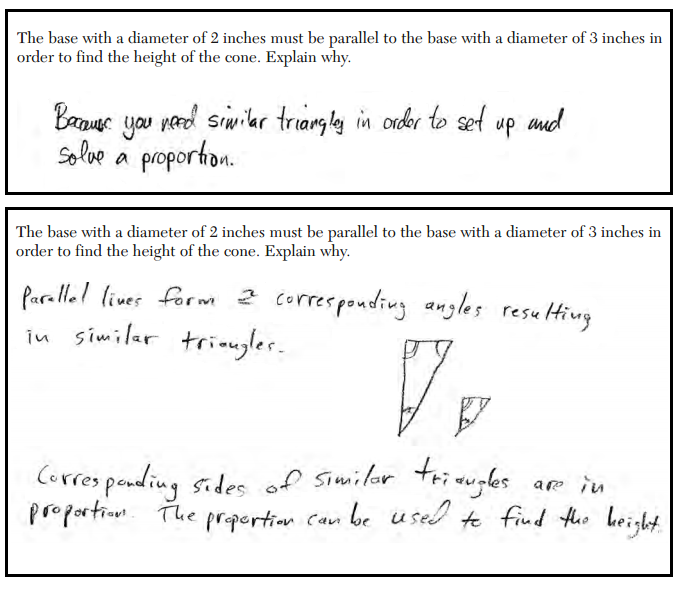
But the model student work says it all.  Here are two examples of complete and correct solutions.

2016 June GEO 36 -- Student Work ComboThese are not explanations of why the two bases must be parallel.  These are descriptions of how you might compute the height given that the two bases are parallel.  This argument essentially says “The bases are parallel because in order answer this question I need to apply a technique that requires that the bases be parallel.”

Not only is this not an explanation, it’s a kind of argument we want to teach students not to make.  Validating these responses works against what we should be trying to do as math teachers.

These high stakes exams shouldn’t encourage teachers to promote invalid mathematical thinking.  Unfortunately, as the posts below suggest, it’s happening far too often.

Related Posts


Regents Recap — June, 2016: Simplest Form

“Simplest form” is a dangerous phrase in math class.  Whether a form of an expression is simple or not depends on context.  For example, while \frac{3}{8} and \frac{21}{56} are representations of the same number, the first fraction is likely to be seen as simpler than the second.  But if the goal were, say, to determine if the number was greater than \frac{17}{56}, then the expression on the right might be considered simpler.
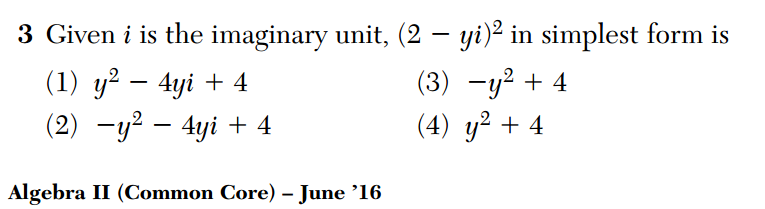
Despite the wide and varied uses of the phrase “simplest form”, I have never heard it used in the context of complex numbers.  So I was surprised by this Common Core Algebra 2 Regents exam question.2016 June CCA2 3

I don’t know what the author of this question means here by “simplest form”.  I asked around, and someone suggested that the natural interpretation of “simplest form” here is a + bi.  That seems reasonable, but since none of the answers are in a + bi form, the author of this question could not have meant that.  [It is also worth noting the implicit assumption here that y is a real number, an issue that has come up before on these exams].

What’s most bothersome about this imprecise use of language is that it is completely irrelevant to this question.  Whatever “simplest form” means here, it is of no consequence:  there is no answer choice which is otherwise correct but in some improper form.

The question should simply ask which expression is equivalent to the given expression.  The use of “simplest form” here not only obfuscates the mathematics of the problem, but models imprecise use of mathematical terminology.  We should expect our high stakes exams to do better.

Related Posts

Empire State Excellence in Teaching Award

I was quite surprised at our school’s graduation ceremony this week when New York State Lieutenant Governor Kathy Hochul unexpectedly presented me with the Empire State Excellence in Teaching Award.

bths graduation 2016

The award was created by Governor Cuomo to recognize outstanding K-12 teachers across New York.  Teachers from all ten regions of the state will be honored, serving as teacher ambassadors for New York and receiving opportunities and support for continued professional growth.

It was especially meaningful for me to be recognized with our senior class at graduation, though I was definitely a bit stunned to find myself on stage in front of 5,000+ people at the Barclay’s Center!  I appreciate the indulgence of all the students, families, faculty, and guests, and a special thanks to Lt. Gov. Hochul, who made the trip from Buffalo to Brooklyn to personally present the award.

Lt. Gov. Hochul’s announcement of the award is here, and a short news article about the presentation can be found here.

Related Posts

Follow

Get every new post delivered to your Inbox

Join other followers: