The 2017-18 Conjecture

Like many mathematicians and teachers, I often enjoy thinking about the mathematical properties of dates, not because dates themselves are inherently meaningful numerically, but just because I enjoy thinking about numbers.

A new year means a new number to think about. And one interesting fact about our new year, 2018, is that it is semiprime.
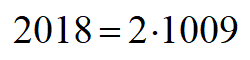
A number is semiprime if it is the product of exactly two prime factors: for example, 15 = 3 * 5 is semiprime, as is 49 = 7 * 7, but neither 13 nor 30 are. Semiprime numbers are also referred to as biprime2-almost prime, or pqnumbers.

Semiprimes are very interesting in and of themselves, particularly in cryptography, but what caught my attention is that the previous year, 2017, is a prime number. That means we have a semiprime number, 2018, adjacent to a prime number, 2017. How unusual is this?

I played around a bit and ended up writing some simple programs to find and analyze semiprimes. Among the first 500,000 integers, there are roughly 108,000 semiprimes and 41,500 primes. Of the 108,000 semiprimes, only about 2,500 (or 2.3%) are adjacent to a prime number. This seems low to me: there are 83,000 prime-adjacent spots among the first 500,000 integers, representing 18% of the spots semiprimes could occupy. But only about 2.3% of the 108,000 semiprimes end up in those spots. That seems unusual. * [See Update]

In thinking about what happens further out along the number line, I couldn’t help but wonder if there are infinitely many prime-semiprime pairs like 2017 and 2018. I certainly don’t know the answer, but I thought I would start the new year boldly, with a conjecture:

The 2017-18 Conjecture

There are infinitely many pairs of consecutive integers one of which is prime and one of which is semiprime.

I think this problem’s resemblance to the Twin Prime Conjecture led me to both imagine this conjecture and also suspect it’s true. As with virtually everything in mathematics, I’m sure someone has thought of this before, and I would love a reference if anyone can provide it.

Thinking ahead, I was excited to notice that next year will also be a semiprime!
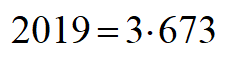
But it appears that the Twin Semiprime Conjecture is already an existing open question, which means I have less than a year to come up with a new conjecture for 2019.

Happy New Year! 2018 has already inspired to me to do some number theory, tackle some computing challenges, and think about some new ideas for the classroom. It’s a good mathematical start to the new year, and here’s hoping 2018 only gets better.

UPDATE, 1/18/2018

In a comment, Brent pointed out that I undercounted the number of semiprimes adjacent to a prime. A recalculation is consistent with Brent’s numbers: among the 108,000 semiprimes up to 500,000, around 4,900 of them are adjacent to prime number. Thanks, Brent!

Related Posts
 

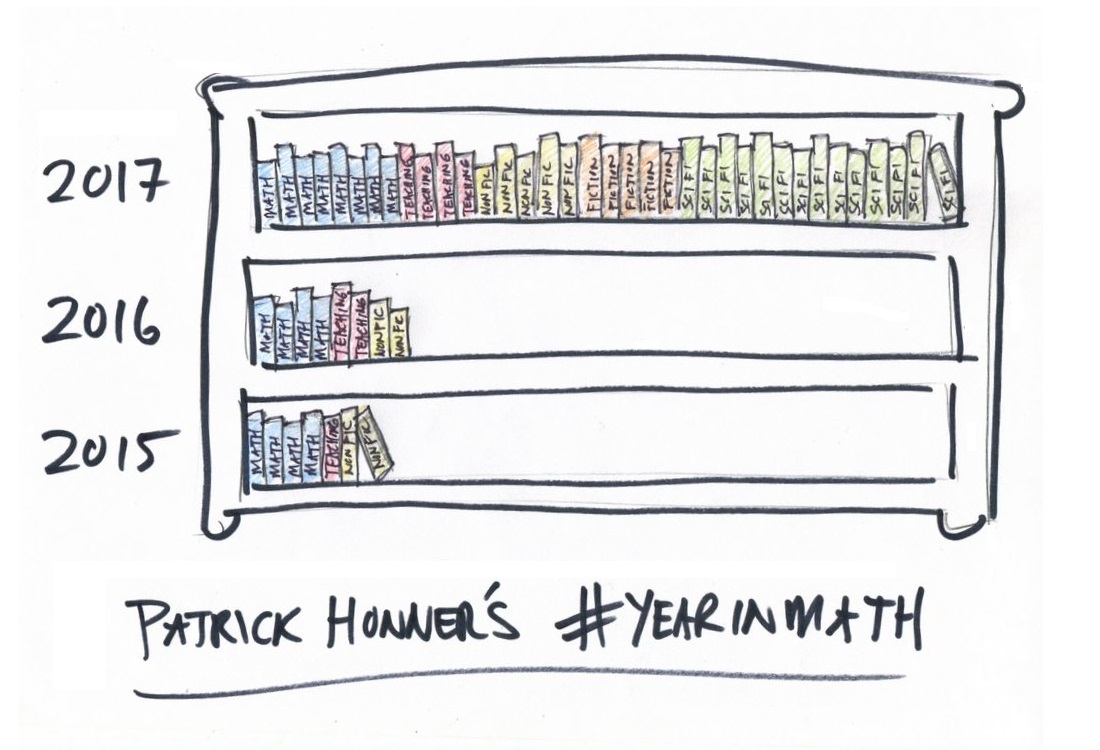
2017 — My Year in Math

Dan Meyer recently shared a fun and telling graph describing his year in math. Inspired by Dan’s idea, and by a Math for America workshop with data visualization innovator Mona Chalabi, I created my own Year in Math entry. Though the real inspiration, I guess, came from the world events that made me want to read more books and less internet.

You can find more takes on the Year in Math theme on Twitter.

I think this could make for a fun student project. I hope the students agree!

The (Math) Problem with Pentagons — Quanta Magazine

My latest column for Quanta Magazine is about the recent classification of pentagonal tilings of the plane. Tilings involving triangles, quadrilaterals, and more have been well-understood for over a thousand years, but it wasn’t until 2017 that the question of which pentagons tile the plane was completely settled.

Here’s an excerpt.

People have been studying how to fit shapes together to make toys, floors, walls and art — and to understand the mathematics behind such patterns — for thousands of years. But it was only this year that we finally settled the question of how five-sided polygons “tile the plane.” Why did pentagons pose such a big problem for so long?

In my column I explore some of the reasons that certain kinds of pentagons might, or might not, tile the plane. It’s a fun exercise in elementary geometry, and a glimpse into a complex world of geometric relationships.

The full article is freely available here.

Investigating the Math Behind Biased Maps

My latest piece for the New York Times Learning Network gets students investigating the mathematics of gerrymandering.  Through applying geometry, proportionality, and the efficiency gap, students explore the notion of a “workable standard” for identifying and evaluating biased electoral maps.

Here is an excerpt:

Math lies at the heart of gerrymandering, in which the shapes of voting districts and distributions of voters are manipulated to preserve and expand political power.

The strategy of gerrymandering is not new… However, new, sophisticated mathematical and computer mapping tools have made gerrymandering an even more powerful way to tilt the playing field. In many states, where the majority party has the authority to rewrite the electoral map, legislators essentially have the power to choose their voters — to create districts in any shape or size that will weaken their opponents and increase their dominance.

In this lesson, we help students uncover the mathematics behind these biased electoral maps. And, we help them apply their mathematical knowledge to identify and address the problem.

In fact, the questions students will work through are similar to those the Supreme Court is now considering on whether gerrymandering can ever be declared unconstitutional.

The article was co-authored with Michael Gonchar of the NYT Learning Network, and is freely available here.

Related Posts


Follow

Get every new post delivered to your Inbox

Join other followers: