Books I Read in 2025
I read around 30 books in 2025, a number I’m proud of but know could be higher. Here are some of the books I’m still thinking about at year’s end.
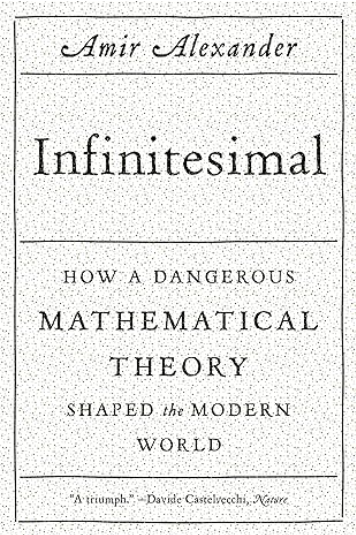
“Infinitesimal” is the story of the heretical idea that a line segment could be divided into infinitely many parts. Literally heretical, as the Catholic church repeatedly decreed that infinite divisibility went against the natural order, and that accepting, promoting, and teaching it was heresy. The concept of indivisibilty is like a character in Amir Alexander’s story, and we follow its path through ancient times, Reformation, Counter-Reformation, and beyond. It’s a compelling and exciting book about math, science, and history, and the way divisibility influences, and is influenced by, the world around it is a reminder that math and science, as human endeavors, are always deeply intertwined in issues of human culture.
A similarly good book I read this year was “Vector”, by Robin Arianrhod. Who would have thought that the idea that you can do math on objects that have both magnitude and direction could have been so controversial? This is another sweeping mathematical history involving quaternions and physics and ultimately the theory of relativity. And as with infinitesimals, the story of the vector is a good reminder that today’s common sense is often yesterday’s culture war. (My pithy review of this book: It should have been titled “Tensor”.)
I read “How Children Learn”, a classic in American education. Written by John Holt in 1967, this sequel to “How Children Fail” feels like a historical preview of many modem education movements, like homeschooling, unschooling, constructivism, “discovery” learning, and the like. The book reads like a measured but outraged reaction to the stultifying, authoritarian schools and classrooms that I presume were commonplace in American education at that time, and sadly, may still be. It’s filled with insightful observations about learning and schooling – trust children to figure things out, follow their curiosity, let them play and experience before forcing a new model of thinking upon them – but it’s also filled with the kind of fallacious conjectures and post hoc explanations common to popular social science books.
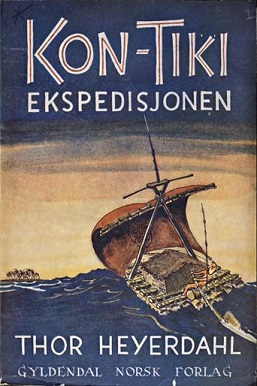
“Kon Tiki” was the most inspiring book I read this year. It’s the first-person account of Thor Heyerdahl’s 1947 voyage that proved people really could have migrated from South America to Polynesia by floating on rafts across the Pacific Ocean. Curiosity and a sense of adventure were all it took for six relative strangers to risk their lives to prove possible what no one believed could be true. The story documents the plan, the raft, and life at sea, and is filled with scientific and technical observations that come up as discoveries are made and obstacles overcome. It was nice to be reminded of a time when humble inquiry about the world and cooperation across borders seemed so casual and normal.
The book that might have had the most direct impact on me this past year was “Language of the Spirit”, Jan Swafford’s engaging overview of the history of Western classical music. Written by a scholar but not in a scholarly way, the book is filled with stories, theory, connections, and lots of listening recommendations. Every chapter produced a few new playlists, and I’m still listening and learning. (According to a knowledgeable friend, apparently I’m a modernist!)
As usual I balanced out non-fiction with a good amount of sci-fi. I read several Adrian Tchaikovsky books this past year, but each one left me feeling like I read his best one first. I enjoyed “A Closed and Common Orbit” and “Record of a Spaceborn Few”, entries in Becky Chambers’s Wayfarer series (bookwyrm reviews here and here). I also read the last book in Iain Banks’s Culture series, “The Hydrogen Sonata”. I had been putting it off for years, not wanting to exhaust the last unexplored bit of that universe. I’m trying out Banks’s “The Algebraist” right now, and while it’s not the same, I’m enjoying it. And I love the title!
One last book that had a profound impact on me was Richard Feynman’s “Six Easy Pieces”. I’m on what feels like an intermittent, lifelong quest to understand why I don’t understand physics, and this book profoundly re-organized my thinking. So often I feel like physics is referencing things that don’t seem to exist, and I think Feynman’s explanation of energy really clarified it for me. Energy is not a thing. It’s the name of a mathematical invariant. Of course there’s more to it than that, but that’s enough for me for now. And of course, this leads to more on the list to read for next year!
As always, thanks to the Brooklyn Public Library for the endless supply of learning, and to the bookwyrm community for always putting new and interesting books in front of me.
Related Posts
0 Comments