I found this attempt to quantify the decline in quality of M. Night Shyamalan’s movies very amusing:
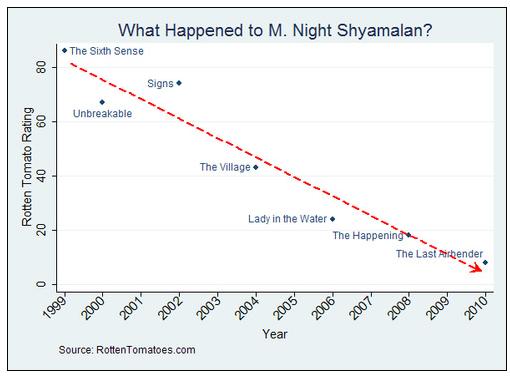
Using the rotten tomatoes rankings is a very interesting idea. I wonder what other kinds of analyses could incorporate that data.
I found this attempt to quantify the decline in quality of M. Night Shyamalan’s movies very amusing:
Using the rotten tomatoes rankings is a very interesting idea. I wonder what other kinds of analyses could incorporate that data.
For the second consecutive day, I unexpectedly crossed paths with an acquaintance. In both cases, the encounter occured outside my daily routines, the person was someone I know only minimally, and we were both en route to different destinations when we happened to notice each other.
There are a lot of interesting results associated with objects moving around randomly in a given space, but as is usually the case with mathematics, the situations are idealized to eliminate some of the complicating real-world issues. Imagine a dot moving back and forth on the number line, or randomly around the Cartesian plane, for example.
I’m not really sure how unlikely it is for me to have two serendipitous encounters on back-to-back days, but the following questions are probably significant: how dense is the population? How many people do I know? How attentive am I? How popular is my destination? There are probably many more other important and complicating factors.
In any event, it’s certainly unlikely that it will happen again today.
I feel like I’ve had this experience many times in my life: I’m biking down the road, or walking along at a brisk pace, and out of the corner of my eye I catch a glimpse of a person I think I know. As I turn back to take another look, a well-positioned telephone pole or lamp post gets in between me and the unknown.
Somehow, the geometry and physics of the situation perfectly conspire to always keep the pole between me and the mystery person.
Click on the image below for a demonstration
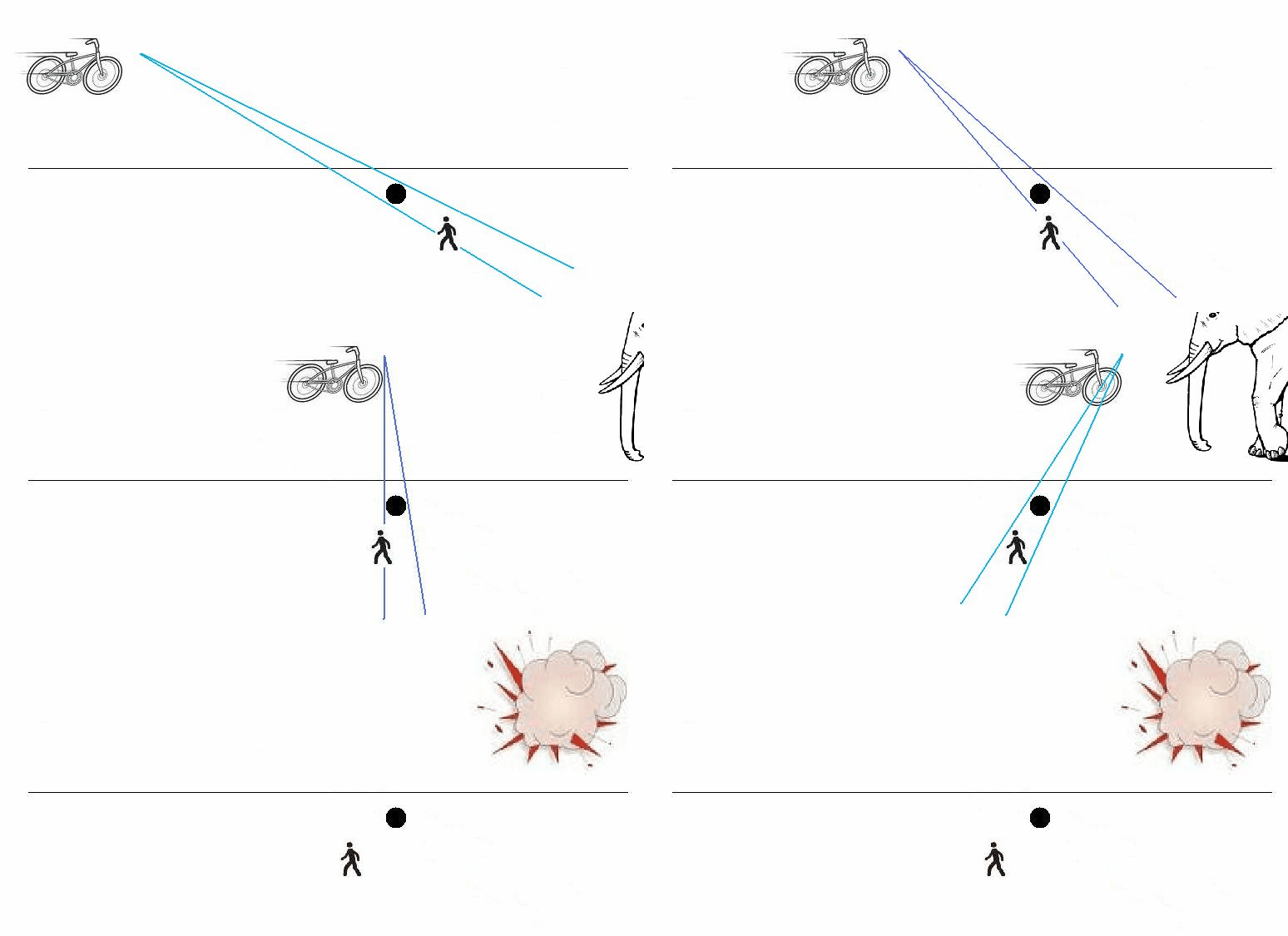
A thorough analysis of the problem would be interesting, taking into consideration the different initial velocities, the different positions, the radius of the pole, different paths, and the like.
 Martin Gardner, who died on May 22, 2010, shared the beauty, mystery, and most of all, the fun of mathematics with the world. I remember watching the episode of “The Nature of Things” linked below, captivated by the reach of mathematics and the passion and ingenuity of these mathematicians–mathematicians who loved magic, juggling, computer games, and debunking con-artists.
The passion of Martin Gardner reached many people; there’s no denying the impact this television show had on me.
 Through Math for America, I have been contributing to the New York Times Learning Network. Here is my latest contribution:
http://learning.blogs.nytimes.com/2010/07/29/test-yourself-july-29-2010/
This problem is based on New York Yankees pitcher Mariano Rivera as his remarkable record as a closer.