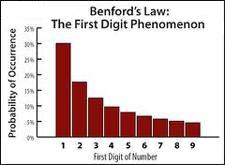
Benford’s Law

Benfords LawThis is an article about the discovery of new sets of data that seem to obey Benford’s Law–a curious mathematical characteristic of the numbers we collect from the world that is really more conjecture than law.

http://www.newscientist.com/article/mg20827824.700-curious-mathematical-law-is-rife-in-nature.html

It seems that in scores of data sets collected from natural phenomena, the numbers we see tend to start with the digit 1 far more often than, say, with the digit 6.  Indeed, statistical analysis shows that when you look at population numbers, death rates, street addresses, lengths of rivers, stock prices, and more recently, depths of earthquakes and brightness of gamma rays, the observed numbers start with the digit 1 about 30% of the time.  The occurences of other digits as the leading digit fall as you go up the scale.

Apart from being a natural curiosity, Benford’s Law has proven to have some very useful applications.  Scientists can use Benford’s Law to help predict phenomena and look for trends in data, as the rule gives number-crunchers an idea of what they might be looking at from the start.

Additionally, Benford’s Law has been successfully used to identify all kinds of numerical fraud–tax fraud, voter fraud–because when people are faking numbers, they tend to evenly distribute leading digits.  Benford’s Law tells the data-police that if approximately 1/9 of the numbers they are looking start with 1, then something fishy is going on.

Keep that in mind next April.

Math Lesson: Predicting the Vote

newspaperI am very excited to have my first Lesson Plan published by the New York Times Learning Network.  I wrote a mathematics lesson built around profiling the upcoming presidenital election, using data and analysis from Nate Silver’s 538 Blog at the Times.

The lesson is titled “Predicting the Vote: Analyzing Election Data”, and can be found here:

http://learning.blogs.nytimes.com/2010/10/18/predicting-the-vote-analyzing-election-data/

Trying to write a lesson plan for general use was much more challenging than I imagined, but it was an interesting and educational experience for me.  Hopefully it will produce some interesting educational experiences for others.

The Final Word in Triangle Appreciation

As has been previously noted, October has been a nice month for triangle appreciation.  Today, 10/19/10, offers us one more polygon to ponder.

Consider the 10-19-10 triangle.

10-19-10 triangle

It’s a fairly ordinary triangle, as triangles go.  It’s a little short compared to the other triangles we’ve looked at recently, but there’s nothing wrong with that.

What’s special about the 10-19-10 triangle is that it’s our last chance this month to enjoy triangularity.  Tomorrow, the Triangle Inequality steps in.  You can’t have a 10-20-10 triangle, because once the third side hits 20, you need all of the 10s to get from point A to point B.  There’s no wiggle room for the triangle’s interior.

10-20-10 Triangle

Although I must admit, I do find much to admire in this degenerate triangle.

Related Posts


The First Word Calculator

word calculatorThis is a pretty awesome widget from the folks at Wolfram Alpha:  a word calculator!

http://blog.wolframalpha.com/2010/10/15/celebrating-dictionary-day-with-new-word-data/

It does the basic things you’d expect, like give you definitions, pronunciations, synonyms, and the like.  But it also gives you cool things like word frequency (“frequency” is the 3209th most common word) and hyphenations (me-di-e-val has 8 letters and 4 syllables)

And, when I typed my name in, I learned that 599,125 people are named Patrick, and our most common age is 46.

WolframAlpha’s mission is to make the world’s information computable–not just searchable.   I guess the lesson here is that everything is computable in some way.

Benoit Mandelbrot

b mandelbrotBenoit Mandelbrot died this week at the age of 85, leaving a giant mark on the worlds of mathematics and science.  Mandelbrot coined the term fractal, writing the seminal book on the topic in 1982–The Fractal Geometry of Nature.   By rejecting the generally accepted, if never actually articulated, notion that things were smooth, Mandelbrot challenged everyone’s notion of shape, distance, and dimension.

As is often the case, Mandelbrot was considered crazy at first, but he dies with almost legendary status.  We will likely be talking about fractals and Mandelbrot sets hundreds if not thousands of years from now, the way we talk about the Pythagorean Theorem and Euler’s Number today.

And as is also often the case, Mandelbrot’s brilliant and revolutionary ideas can be traced to a simple question that he chose to think of differently:  how long is the coast of Britain?

The answer, he was surprised to discover, depends on how closely one looks. On a map an island may appear smooth, but zooming in will reveal jagged edges that add up to a longer coast. Zooming in further will reveal even more coastline.

“Here is a question, a staple of grade-school geometry that, if you think about it, is impossible,” Dr. Mandelbrot told The New York Times earlier this year in an interview. “The length of the coastline, in a sense, is infinite.”

From Mandelbrot’s NYT’s obituary.

Follow

Get every new post delivered to your Inbox

Join other followers: