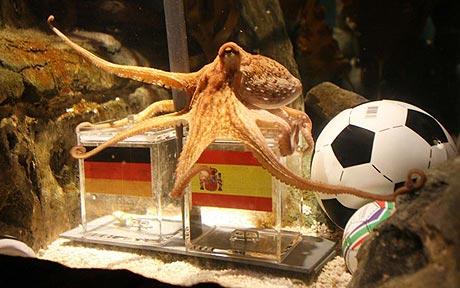
Paul the Octopus, 2008-2010

octopus2_1675213cPaul the Octopus, whose prognosticating skills captured the imaginations of World Cup viewers everywhere, died this week at the age of 2.5.  He died of natural causes.

Paul defied probability by correctly predicting the results of all of Germany’s seven World Cup matches.  After making it through the tournament with a perfect record–during which he received death threats and had a stamp printed in his honor–Paul retired from predicting.   Rediscovering his British roots, Paul was appointed an official ambassador for England’s 2018 World Cup bid, a post he held until his untimely demise.

Apparently there have been many copy-cats, so to speak, including “a saltwater crocodile named Dirty Harry, who predicted Spain’s World Cup final win and called the result of Australia’s general election by snatching a chicken carcass dangling beneath a caricature of Prime Minister Julia Gillard”.  But Paul will always have a special place in our hearts.

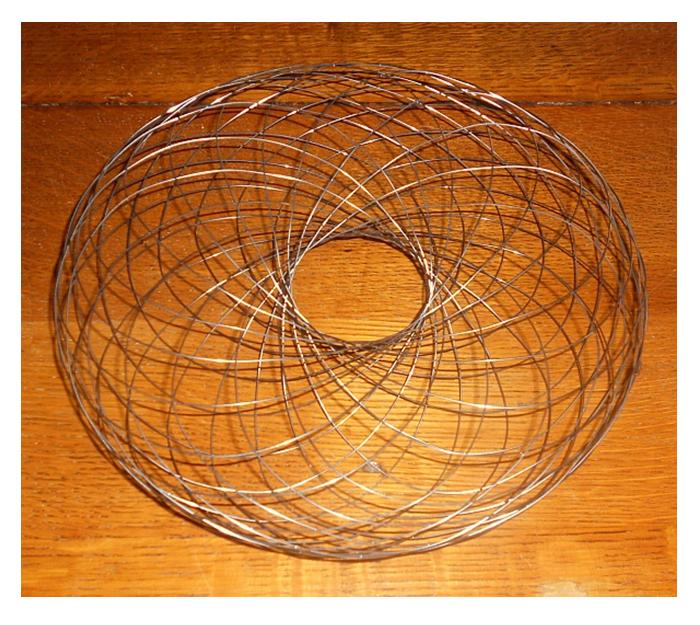
Wireframe Torus

wireframe torusThis is a cool example of wire-sculpture:  a single piece of wire woven into the shape of the torus.

http://makezine.com/2010/10/24/math-monday-wire-torus-challenge/

(I doubt you can play pool on this one, though.)

The author of the blog post, George Hart, is the proprietor of the soon-to-be Math Museum, and it seems he is something of a sculptor himself.  According to the article, this piece was on display at a conference held by the European Society for Mathematics and the Arts.

Poking around their website and admiring the the multitudinous mathart is a pleasant way to pass a little time.

Coffee and Cream

I was recently reminded of an excellent math problem involving mixtures.

Imagine yourself sitting in front of a cup of coffee and a cup of cream.

coffee and cream solution 1Suppose you take a spoonful of cream, pour it into the coffee, and stir it up. Now once that’s thoroughly mixed, you take a spoonful of the mixture and pour it back into the cream. Then you mix that up.  After all of this, is there more coffee in the cream, more cream in the coffee, or equal amounts in both?

I encourage you to think about the problem before perusing the several solutions below!

Related Posts


Paddling Upstream

canoeThe Canoe in the River problem is an algebra classic.  You know how it goes:  “Paddling upstream, it takes Betty Boater 6 hours to travel up the river to Point Apex.  It takes only 3 hours for the return trip downstream to Point Bellows.  If the distance between Point A. and Point B. is 15 miles, what would Betty Boater’s speed be in still water?” 

Below is wonderful retelling of the Canoe in the River problem created by Dan Meyer.  Using a video camera, an ipod, a quiet morning in a mall, and some great editing, this problem is brought new life in this modern and engaging context.

dmeyer -- boat in river

Check it out at http://blog.mrmeyer.com/?p=7649.  Meyer seems to be focused on modernizing mathematics curricula, and the more stuff he does like this, the better.

And for Betty Boater’s speed, click here.

The Perfect Parallelepiped

In general, it’s unusual for a rectangle to have sides and diagonals whose lengths are all integers (i.e., whole numbers).  Consider the following three rectangles, all of width 3:

diagonals

Looking at the different lengths, we see one place where the diagonal length is an integer, but in the other cases, the diagonal length happens to be a non-terminating, non-repeating decimal (i.e., irrational).  Indeed, the diagonal length will be an integer exactly when the length and width are part of a Pythagorean triple, but compared to the alternative, this is uncommon.  (While there are infinitely many occurrences of this, we can still meaningfully consider it uncommon).

Now, imagine the situation in three dimensions.  A rectangular prism (think of a cardboard box) has 12 sides, 12 face diagonals, and four space diagonals.  It would be extremely unusual for all of those 28 lengths to be integers.  Even if we didn’t limit ourselves to rectangular prisms, but we allowed for the box to be slanted in all directions (that is, a parallelepiped), it would still be a numerical miracle for all those lengths to be integers.

Well, meet the perfect parallelepiped!

a perfect parallelepiped

This was discovered by a couple of mathematicians at Lafayette College in Pennsylvania, using brute-force computer trials.  It looks like they found some others, too.   So thank you, Clifford Reiter and Jorge Sawyer, for giving me an extra credit problem for my next exam!

Related Posts

Follow

Get every new post delivered to your Inbox

Join other followers: