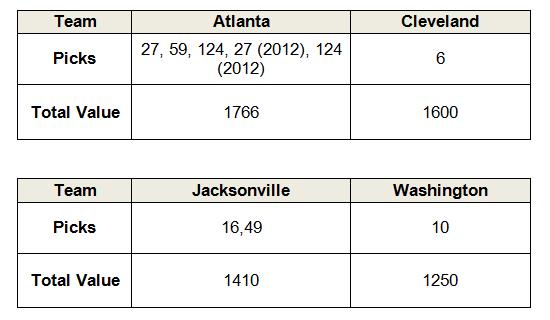
 I recently discussed some mathematics involved in the NFL Draft: teams use a Trade Value Chart to rate the value of the different picks in the draft, and how the picks are “priced” leads to some interesting consequences, which I covered in this post.
The value of pick number 33 has fostered some interesting conversation, brought about by changes in the way the draft is run. Originally conducted over two days with Round 2 immediately following Round 1, the NFL in 2010 reorganized the draft to take place over three days. Now, Round 1 takes place on a Thursday night and then Round 2 begins a full day later. (The change was presumably made to increase TV ratings, and it seems to have worked).
Now the first pick in Round 2 is the 33rd overall pick. Noted football writer Peter King speculated last year that this new format would increase the value of pick 33, offering the following argument: with a full day to re-evaluate the remaining players after Round 1 ends, demand for the 33rd pick would grow as teams realized that coveted players were still available. Increased demand would therefore increase the value of the pick.
The argument sounds reasonable, but ultimately I don’t think the value of this pick changes significantly. I’ll offer both mathematical and practical counter-arguments.
First, the mathematical counter: let’s start by noting that in any sensible rating of draft picks, the value of the picks should strictly decrease as the pick number increases. For example, pick 21 should never be more valuable than pick 20. Every player available at pick 21 is also available at pick 20, and at pick 20, there will be one additional player available. In short, pick 20 gives you all the value of pick 21, plus a little more.
If the new format did increase the value of pick 33, it couldn’t raise the value above that of pick 32. If you accept the values in the Trade Value Chart, this means the value of pick 33 (580 points) could not rise to more than the value of pick 32 (590 points), which means the most the pick could increase in value is around 1%.
Now, the practical counter: NFL teams invest a lot of time, money, and resources into draft preparation. It doesn’t seem likely that any team would be caught off-guard by which players are available at pick 33. They should be just as prepared for that scenario as they are at pick 32, or pick 1, for that matter.
If a team does find itself scrambling between Round 1 and Round 2, dramatically re-valuing pick 33, then I’d that the team wasn’t properly prepared overall to begin with. I would also suggest that team call me in for an interview!
Related Posts
 This website aims to evaluate the accuracy of various weather-prediction services while providing its own forecast: