 There’s a lot of mathematics going on in the NFL Draft. Here’s one example.
In the National Football League’s player draft, every franchise is allotted one pick per round to select draft-eligible players for their team. The initial draft order is determined by the prior year’s standings, with the last year’s worst team (by record) picking first each round.
The opportunity to select a player is a valuable asset, and picks are often traded among teams before, or during, the draft. Teams might look to trade up to obtain an earlier pick (in order to select a coveted player), or trade down to get extra picks in the later rounds (turning one high pick into two or more low picks).
An interesting mathematical question is “What is Draft Choice N worth?” It’s easy to say that the first overall pick is worth “a lot”, and the second pick overall is worth “slightly less”, but how can position in the draft really be quantified?
It turns out that football analysts have created a trade value chart that essentially standardizes the value of picks . For example, a team holding the 7th overall pick, valued at 1,500 points, might expect to receive the 21st pick (800 points) and the 26th pick (700 points) in return, were they to trade their pick. This conventional valuation helps establish fair prices for trades, as it would in any commodities market.
So what are the picks worth? I pulled the numbers from the trade value chart and created this graph.
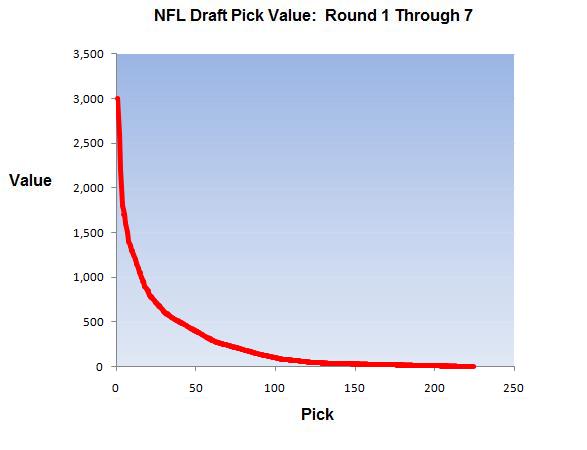
The drop-off in value is steep: for example, the 1st overall pick is considered twice as valuable as the 7th overall pick; the 7th pick is twice as valuable as the 23rd pick, which is twice as valuable as the 52nd pick. There is no simple formula, but the graph above definitely suggests exponential decay:
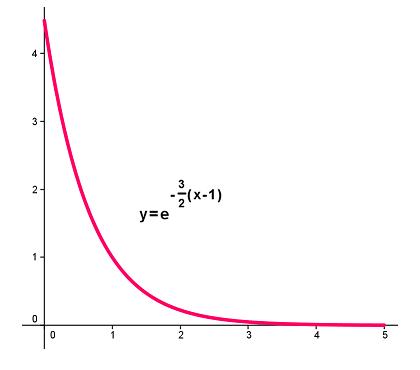
It’s not clear why the model for draft pick valuation should resemble exponential decay (which describes radioactive decay and cooling to ambient temperatures, among other things), but the resemblance is clear.
It’s important to understand that this is merely a practical guide to draft position valuation. The real value of a draft choice depends not just on position, but on many other factors as well: the overall quality of available players, the needs of your team, the needs of your competitors, and contract issues, to name a few.
If you could figure out a more meaningful, or accurate, way to quantify these picks, you could probably help an NFL franchise get a leg up on the competition!
Related Posts
 Through Math for America, I am part of an on-going collaboration with the New York Times Learning Network. My latest contribution, a Test Yourself quiz-question, can be found here: