Rating the Ballparks

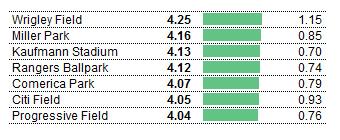
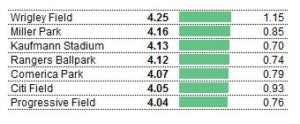
baseball-stadium-rankingsIn an attempt to rate the various Major League Baseball stadiums around the country, Nate Silver looked at the user ratings from online review site Yelp.  Noting that every ballpark has at least several hundred user reviews, Silver compiled the data from Yelp’s 1 to 5 rating system to create an ordering of the stadiums.  Once complete, the list creates a natural starting point to investigate questions like “Is ballpark satisfaction correlated with team performance?” and “How valuable is a retractable-roof stadium?”

Silver also provides the standard deviation for the ratings for each ballpark and explains the significance.  Standard deviation is a measure of the dispersion of data, so a higher deviation means more extreme ratings.

A great, fun little project!  What else can we rate using available user ratings?

Read the full article here.

The Perils of Teacher Blogging

hands typingI find my blog to be a very useful teaching tool.  It’s full of resources for students to explore, and after doing so they often follow up in class with interesting questions and comments.  The blog helps extend our mathematical conversations beyond the classroom.  Sometimes, it works too well.

In a recent discussion on probability, we considered the following question:

Suppose you randomly choose a positive integer.  What is the probability that the number you choose is divisible by five?

The students thought about the question and discussed their ideas.  I asked for their thoughts.  The usual good answers came out (0, \frac{1}{5}, \frac{1}{2}, 1) as well as at least one bad one (infinity!?).  I asked students to explain their reasoning, and an eloquent student sitting in the back volunteered to defend his answer.

“The answer is zero,” he said.  “Although there are infinitely many multiples of five and infinitely many total integers, the probability is zero because a small infinity divided by a big infinity is zero.”

“A small infinity divided by a big infinity is zero?” I responded, trying to appear as perplexed as possible.  “That sounds kind of crazy to me.  What does that even mean?”  I tried to stir up the anti-zero sentiment in the room.

The student persisted.  “According to you, a small infinity divided by a big infinity is zero.”

“That doesn’t sound like something I’d say,”  I said, which is what I say when students remember something I wish they hadn’t.  I usually get away with it.  Not this time.

“You didn’t say it,” replied the student.  “You wrote it on your blog.”

In a rare moment, I had no response.  What could I say?  I did write it on my blog.  I had nowhere to hide.

The class celebrated this clear and decisive victory.

Math Lesson: Charting Population Growth

My latest contribution to the New York Times Learning Network is a math lesson designed to get students thinking quantitatively about the increase in population growth around the world.  Here is an excerpt.

A typical feature of population growth is that the rate of increase itself increases over time. Visually, this means that the line segments get steeper from left to right. When the slopes of each line segment are computed for each 10-year interval, students can look for a pattern in how the slopes, i.e. the rates of population growth, change. For example, students might notice that, every ten years, the slope of the line segments increase by 0.5 million people per year: this means that the rate of change of population increases by 0.5 million people per year.

Once a pattern is identified, students can then extend their graph beyond 2010 by drawing a line segment from the 2010 data point whose slope fits this pattern. By extending this new line segment so that it covers 10 years on the horizontal axis, this will create a population projection for the year 2020. By repeating the process, students can create population projections for 2030, 2040 and beyond.

Using a recent revision on world population growth by the United Nations population bureau as a starting point, students choose a country to profile.  By using available population data, students create piece-wise linear graphs to model that countries population growth, and look for trends in order to make population projections.

You can find the full article here.

Follow

Get every new post delivered to your Inbox

Join other followers: