The Write Angle for Teaching Math: Keys to Success

Math WritingFinding ways to get students to write about mathematics has played a pivotal role in my development and growth as a math teacher.  Mathematical writing challenges students to express their ideas clearly and efficiently; it forces students to stop thinking of mathematics as merely equations and answers; and it opens up a new and unexpected dialogue between math teacher and student.

I have always found great value and pleasure in writing.  It is a valuable skill, a necessary tool of scholarship, and a powerful creative outlet.  And now I see its value as a math teacher.  The more my students write, the more useful and interesting we all find it.

In this post, I’ll discuss some strategies for making writing part of the culture of the math classroom.

Here are a few simple things that make writing in math class work for me and my students.

Keys to Success

1)  Short and Sweet

Keep the assignments short and well-defined, especially at the beginning.  Don’t ask students to write pages and pages; sometimes a short paragraph or even a thoughtful sentence says it all!  Students may be hesitant to write at first, so making it easy on them can help get the process moving.

2)  Feedback

As with all student work, meaningful feedback goes a long way.  Make sure the students know that you are reading their work, even if you aren’t grading everything.  Correct as much grammar as you are comfortable with, but don’t necessarily feel obligated to grade it like a literature teacher might.  This is likely to be an “extra” assignment anyway, for both the students and you!  Keep it fun.

3)  Shareout and Peer Review

With every assignment, honor those pieces that really moved you by picking a few and sharing them with the class.  Have small groups exchange papers and then share their favorites aloud.  It only takes a few minutes, but sharing rewards students for taking a risk in their writing, and regular peer review helps everyone get better over time.

Get Writing!

There are a lot of ways to get students writing in math class.  It isn’t easy, and it takes time for everyone to get comfortable with it, but it’s an investment worth making.  Establishing a culture of writing has dramatically impacted my classroom:  it gives my students a different way to interact with mathematics, and it gives me a different look into how my students think about math.

For more resources, see my Writing in Math Class page.

Fun With Self-Referential Tests

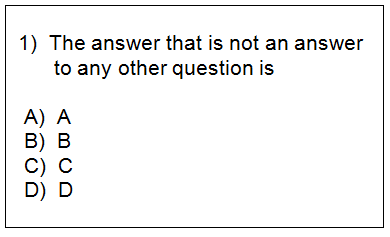
A few years ago, I stumbled upon James Propp’s Self-Referential Aptitude Test.  I was immediately hooked, and spent hours navigating the interconnected logic puzzle that posed questions like “The answer to number 8 is ” and “The first question whose answer is C is “.

The experience was so challenging, frustrating, and ultimately rewarding, that it didn’t take long to realize it was a perfect exercise for students.

I ended up creating some simpler examples that gently introduce the student to the idea of a self-referential test, a test where questions and answers refer to other questions and answers.  By playing around with these easier versions, students develop a sense of how to reason their way through using various problem-solving strategies.

After working through the more challenging versions, the final project for students is to create their own self-referential tests, which we then all enjoy solving.  This is the perfect kind of project, in that it allows students to exercise their creativity while pondering substantial and significant mathematical questions like “What constitutes a solution to this test?” and “Are we sure that this puzzle has a solution?”, as well as fundamental mathematical ideas like logical consistency.

To get you started, I offer two simple versions of the test.

Five Question version: Simple Self-Referential Test 1

Ten Question version: Simple Self-Referential Test 2

Enjoy!  And if you do, try making your own!  It’s great fun, and a great student project.  And keep in mind, questions like “Does this test have a solution?” and “Does this test have a unique solution?” are always interesting to consider.

And you can find James Propp’s original Self-Referential Aptitude Test here.  Be warned:  you might find it very frustrating!

Google and Conditional Probability

Conditional probability is one of my favorite topics to teach.  Whereas normal probability calculations simply compare favorable outcomes to total outcomes, conditional probability allows us to consider the impact of certain knowledge on the likelihood of those outcomes.

For example, the probability of rolling a 6 on a six-sided die is 1/6, but if it is known that the number showing is greater than 3, then the conditional probability that a 6 is rolled is 1/3.

There are many applications of conditional probability, but a recent “Math Encounter” from the Museum of Math made me aware of an application of conditional probability that all of us see on a regular basis:  Google search autocomplete.

Suppose I type in the search term “under”:

Here, Google is trying to autocomplete my search query.  In essence, Google is trying to guess the next word I’m going to type.  How does it make its guess?  It computes a conditional probability!

Google has a lot of data on when words follow other words.  When I enter “under” into the search bar, Google looks for the word/phrase with the highest conditional probability of being next.  Here it turns out to be “armour”; the word with the second highest conditional probability is “world”, and so on.

Naturally, as more information is provided, the conditional probabilities change.

 A fascinating, and perhaps surprising, application of a powerful mathematical idea!

The Write Angle for Teaching Math: How to Get Students Writing in Math Class

Math WritingFinding ways to get students to write about mathematics has played a pivotal role in my development and growth as a math teacher.  Mathematical writing challenges students to express their ideas clearly and efficiently; it forces students to stop thinking of mathematics as merely equations and answers; and it opens up a new and unexpected dialogue between math teacher and student.

I have always found great value and pleasure in writing.  It is a valuable skill, a necessary tool of scholarship, and a powerful creative outlet.  And now I see its value as a math teacher.  The more my students write, the more useful and interesting we all find it.

In this post, I’ll discuss some strategies for getting students writing in math class.

How to Get Students Writing in Math Class

1)  One-page solutions

Have students choose a good math problem they like and write up a solution in one page.  Have them narrate their process and explain the choices they make.  They can also write about mistakes someone else might make, or offer an alternate solution if possible, or suggest a new problem that’s related but slightly harder.  Problems from math competitions (like the New York Math League or the American Mathematics Competition) are usually great places to start.

2)  Create New Questions

Have students choose a good math question and write up three new questions based on the original.  If the original problem asks to find the sum of consecutive integers from 1 to 10, some new questions might be “What is the sum of the consecutive integers from 1 to 100?”, “What is the sum of consecutive integers from 1 to n?”, and “What is the sum of the squares of the integers from 1 to 100?”  Make sure that the students understand that the assignment is to create the question, not answer it; not being required to answer the question takes the pressure off, and it frees them to be more creative.  Again, math contest questions are great places to start.

3)  Mathematical Poetry

Have students write short mathematical poems, like haikus, quatrains, limericks, or even sonnets.  Ask them to explain a math concept, pose a math problem, or describe a geometric object in verse.  And keep it short!  Insisting that the students only use 17 syllables or four lines to describe their mathematical topic not only forces them to refine their thoughts, but it also makes the assignment so easy that it’s nearly impossible not to do it!

4)   Writing Prompts

Have students respond to prompts like:  “What is your favorite number?”; “What’s the best shape?”; “Describe a mathematical epiphany you’ve had”; “Write an original math joke”; or “Write a mathematical aphorism”.  Create your own prompts, or better yet, have students suggest them!

For more resources, see my Writing in Math Class page.

Testing Maximum Performance

This is an interesting article by Jonah Lehrer of the Wall Street Journal about the limits of standardized testing.

https://www.wsj.com/articles/SB10001424052748704471904576230931647955902

Lehrer discusses the results of a study from the 1980s in which psychologist Paul Sackett attempted to measure the speed of supermarket cashiers.  A short “check-out test” was developed which involved scanning a small number of items.  The test was administered, and resulted in a list of the fastest cashiers.

What is interesting is that when Sackett compared the results of the test with long-term data collected by the electronic scanning systems, there was a surprisingly weak correlation between the results of the speed test with the data from regular usage.  That is to say, there was no real connection between being fast on the test and being a fast on a day-to-day basis.

Sackett’s misconception, and perhaps one held by many, is that there is a natural correlation between maximum performance (that on a short test) and typical performance (that is, under normal, day-to-day circumstances).   Tests like the SAT, the GRE, and other high stakes tests, are tests of maximum performance.  Our educational system relies on these  more and more, but are we sure they measure what we assume they measure?

Lehrer points out that individual success is determined more by character traits like perseverance and self-control,  but of course, it’s hard to capture that in a timed, multiple choice exam.

Follow

Get every new post delivered to your Inbox

Join other followers: