Math Lesson: NCAA Rankings

ncaa trophyMy latest contribution to the NYT Learning Network is a mathematics lesson build around the way NCAA basketball teams are ranked.

http://learning.blogs.nytimes.com/2011/03/14/whos-no-1e-investigating-the-mathematics-of-rankings/

Quantitative rankings are ubiquitous these days, and they are playing an ever-increasing role in teaching.  Colleges have been “ranked” by publications for years, but now public schools are being assigned grades and even teachers can be ranked according to complicated, and often controversial, formulas.

In this lesson, students are tasked with creating their own rankings of the sports teams.

Looking only at winning percentage, therefore, may not be a fair assessment of who is better than whom: if Team X plays in a relatively weak conference, and Team Y plays in a relatively strong conference, it will be easier for Team X to record wins. This is similar to the idea of ranking students based on unweighted G.P.A.’s: such a system may well reward students who take relatively easy classes and put students with more challenging programs at a disadvantage.

So, student pairs should explore approaches to addressing this issue by attempting to quantify a team’s strength of schedule, thereby creating a ranking system that will take into consideration the quality of each team’s opponents.

These rankings only make as much sense as the underlying mathematics.  Hopefully, through investigating the way the NCAA ranks basketball teams, teachers and students can learn to deconstruct these ranking systems and better evaluate their utility .

12 Ways to Use the NYT to Develop Math Literacy

Here’s my latest contribution to the New York Times Learning Network:  a collection of ideas for math activities that are built around content from the New York Times.

http://learning.blogs.nytimes.com/2011/02/28/12-ways-to-use-the-times-to-develop-math-literacy/

The activities run the gamut of the paper, and include examples in Finance, Real Estate, Dining and Sports, among others.  Here’s an example:

1. Find Your Dream Home

How much would you pay for 1,000 square feet of living space inNew York City? What about Los Angeles? Use the Real Estatesection of The Times to compare and contrast the cost of housing in different parts of the country, or even different parts of the world.

Or find a home for sale in your area, find an up-to-date interest rate (for that, you might try ERate), and use the mortgage calculatorlocated next to the real estate listing to compute your monthly payment over the term of the loan. How much would you have to earn per year to afford your dream home? How long would it take to save up enough for your down payment?

Why Top Students Don’t Want to Teach

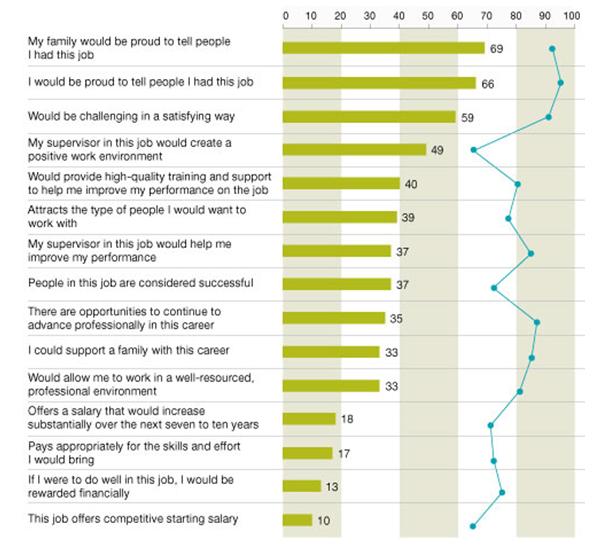
chart -- why students dont want to teachThis is a very interesting report from the business consulting firm McKinsey about why top students in U.S. colleges don’t want to become teachers.

http://www.mckinsey.com/industries/social-sector/our-insights/attracting-and-retaining-top-talent-in-us-teaching

For example, of the 1500 students surveyed (all of whom were considered top-third in their schools), only 33 percent thought that they could support a family with this career.  And only 37 percent said that people in this job are considered “successful”.

It’s small consolation that two-thirds felt that they, and their families, would be proud to tell people that they were teachers.

Pascal’s, and Rascal’s, Triangles

Pascal’s Triangle is one of the most well-known mathematical constructions in human history.  Named after Blaise Pascal, the triangle is rich in patterns and famous number sequences.  The first five rows are shown below.

Pascal triangle five rows

There are many ways to produce Pascal’s Triangle, but the typical way is to define every number as the sum of the two numbers above it:  the one above on the right and the one above on the left.  If there isn’t a number, then just use zero.  For example, 4  = 1 + 3, and 6 = 3 + 3.

The ubiquity of Pascal’s Triangle makes it even more remarkable that a group of three junior high school students have recently collaborated on a paper published in the College Mathematics Journal that uses the famous triangle to find a new number pattern!

Apparently the story begins with one of the students confounding their teacher by insisting that the fifth row of the triangle should be

rascal numbers

Despite the teacher’s attempts to “correct” them, the students produced a valid recursive relationship for the new triangle, which they describe as ( East * West + 1 ) / North.  They then went on to link their definition to a known sequence in the Online Encyclopedia of Integer Sequences and Voila!, mathematical immortality!

As if the story of three eighth-graders publishing a paper in a college mathematics journal isn’t cool enough, the students collaborated entirely via the internet:  one lives in Washington State, one in Alberta, Canada, and one in Indonesia!

A truly inspiring and remarkable story, and an object lesson in encouraging students to pursue their “wrong” answers!

More on College Rankings

college rankingsThis article in the New York Times discusses a controversy surrounding a recent ranking of colleges that put Egypt’s University of Alexandria among the top 200 universities in the world.  An informed observer describes the school as “not even the best university in Alexandria“.

http://www.nytimes.com/2010/11/15/education/15iht-educLede15.html

How did this school achieve such a high ranking?  In a subcategory measuring the impact of research, which counted for approximately 33% of the school’s overall score, the University of Alexandria placed fourth in the world, ahead of Harvard and Stanford.  Sound fishy?  Seems as though most of the research citations came from one professor who published 320 articles in a journal he, himself, was in charge of.

Trying to come up with quantitative measures for colleges (or high schools, or teachers) is tricky business.  Not only is it hard to agree on what to measure, but it’s tough to figure out how to measure it.

And once the rating culture sets in, gaming of the system, as seen in this particular case, will inevitably follow.  “Tell me how I will be measured, and I will tell you how I will behave“.  I’m not sure who said this originally, but an engineer friend shared it with me many years ago, and it always comes to mind in these situations.

Hopefully in the future, more schools will follow the example of Reed College and refuse to participate in these rankings.

Follow

Get every new post delivered to your Inbox

Join other followers: