Regents Recap — June 2014: Are They Reading?

Here is another installment in my series reviewing the NY State Regents exams in mathematics.

I have been reviewing New York State Math Regents exams for several years now, and I occasionally wonder if anyone involved in the production of the exams pays attention to what I say.

Well, last year I wrote about a problem on the Geometry exam that asked students to graph a compound locus but then incorrectly penalized them if they didn’t graph each individual locus.  The supervisor at the grading site didn’t take our complaints seriously, but It seems the exam authors eventually realized that this was wrong.

This is from the 2014 Geometry exam.

2014 Regents Geom -- locus

Notice how this question explicitly asks the student to graph both individual loci.

I doubt that my post instigated the change, but it is nice to see errors on these exams addressed every once in a while.

Regents Recap — June 2014: Lack of Scale

Here is another installment in my series reviewing the NY State Regents exams in mathematics.

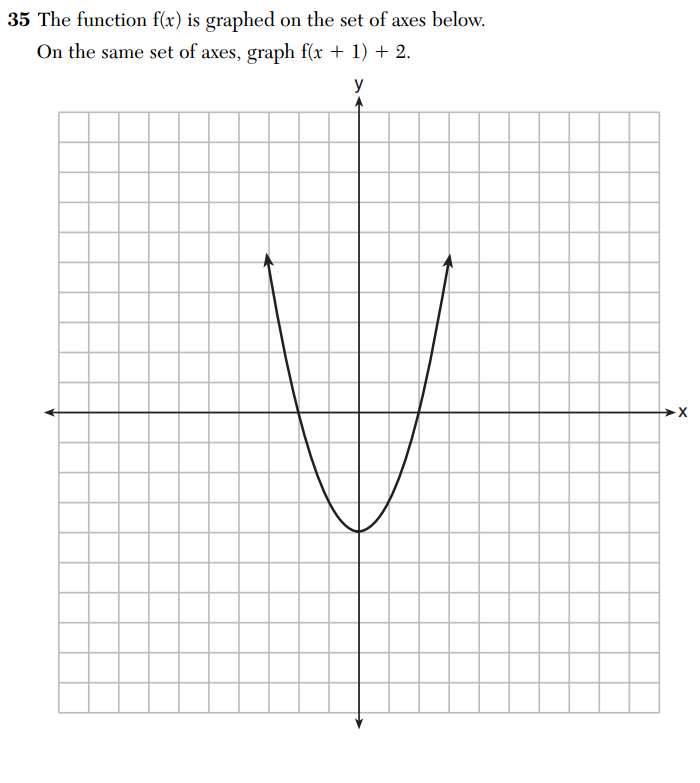
The following question appeared on the June, 2014 Algebra 2 / Trig exam.

2014 alg 2 trig 35 -- lack of scaleGraphs without scales are common on Regents exams (I’ve written about this before).  Personally, it’s not a huge deal to me–I’m a lazy grapher, myself.  However, a colleague of mine regularly complains about this, and she made an excellent point regarding the grading of this particular problem.

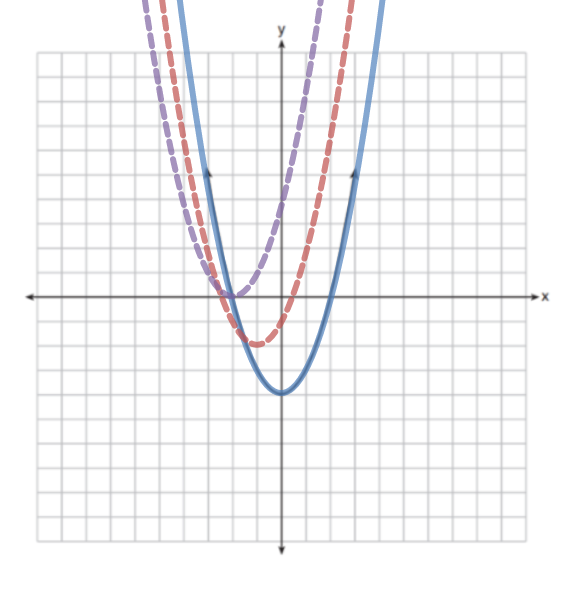
The solution to this problem involves translating the graph one-unit to the left and two units up.  But since no scale is given on the graph, it’s not clear what one unit to the left would be.  If we assume the box on the graph indicates one unit, then the red graph below would be appropriate.  But if we assume a box to represent half-a-unit, the purple graph would be correct.

unscaled graphs -- possibilitiesIf no scale is explicitly given, it seems like both graphs should be considered correct and receive full credit.  But the rubric doesn’t address this possibility, and it’s unlikely students were given the benefit of the doubt.

Regents Recap — June 2014: High School Statistics

Here is another installment in my series reviewing the NY State Regents exams in mathematics.

Elementary statistics plays an increasing role in high school math curricula, but the ways these concepts are often tested raises some concerns.  After all, the manner in which ideas are tested can reflect how the ideas are being taught.

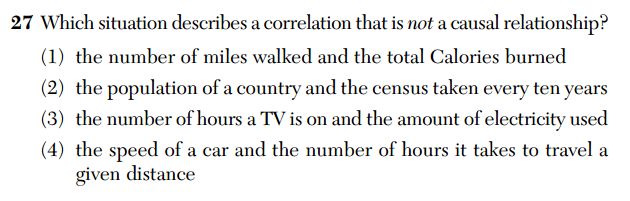
Here’s a question from the 2014 Integrated Algebra exam:  which of the following is not a causal relationship?

2014 ia regents 27

Causality is notoriously difficult to establish, but I’ll set aside my philosophical objections for the time being.  My primary concern here is with (2) being the correct answer.

First, correlation is a relationship between two quantities.  What quantity is population correlated with in answer choice (2)?  “The taking of the census” is an event, not a quantity.  This may seem like nitpicking, but what quantity are we supposed to assume in its place?  It seems natural to assume “the census taken” to mean “the number of people recorded on the census”, but then how could there be no causal relationship?  What causes a number to be written down for “population”, if not the actual population?

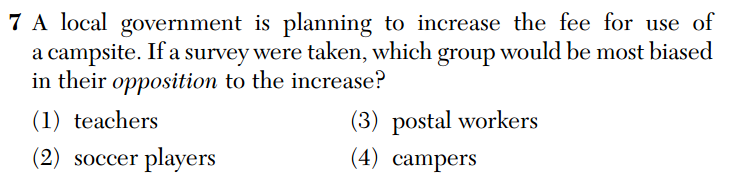
Here’s another question from the 2014 Integrated Algebra exam.

2014 ia regents 7

It’s important to talk about bias in surveys, but no substantial thought is required to answer this question:  three of the answer choices have absolutely nothing to do with campsites.  And for the record, the question should really be phrased like “which group is most likely to be biased against the increase?”.

And this is a problem typical of the Algebra 2 / Trig exam.

2014 a2t regents 28I know it’s pretty much standard usage, but no finite data set can be normally distributed.  The correct terminology here would be something like “the heights can be approximated by the normal distribution”.

I’m aware that some may see these complaints as minor, but as I’ve argued before, I think it is extremely important to model precision and rigor in mathematical language for students.  We expect this from our teachers and our textbooks; we should expect it, too, from our tests.

Regents Recap — June 2014: These Are Not Parabolas

Here is another installment in my series reviewing the NY State Regents exams in mathematics.

I have written extensively about the unfaithful graphs presented on Regents exams:  non-trigonometric trig functions, non-exponential exponential functions, “functions” that intersect their vertical asymptotes multiple times.  I really don’t understand what is so hard about putting accurate graphs on tests.

Here is this year’s example.  These are some of the ugliest “parabolas” I have ever seen.  I can’t look at these without being mathematically offended.

regents 2014 -- ugly parabolas

Not one of these graphs are parabolas.  Take a closer look at (3), by far the ugliest purported parabola.  Look at how unparabolic this is.  It lacks symmetry, and appears to turn into a line at one point!

the ugliest parabola

If this were truly a parabola, we would be able to fit an isosceles triangle inside with vertex on vertex.

the ugliest parabola plus triangle

Not even close!

It’s a fun exercise to show that the others can’t possibly be parabolas either, which I will leave as to the reader.

Related Posts

Regents Recap — June 2014: Which Graph is Steeper?

Here is another installment in my series reviewing the NY State Regents exams in mathematics.

The following question appeared on the June, 2014 Algebra 2 / Trig exam. Regents 2014 -- which graph is steeperTo start, steeper is not a well-defined term, not in an Algebra 2 / Trig class, anyway.  I’m not against using the word in everyday mathematics conversations, but I’m not a fan of putting it on an official exam like this.  After all, I think these exams should model exemplary mathematical behavior.  But that’s not the real issue here.

Even if we accept what steeper means, it can not be said that either graph is steeper than the other. Take a look:  here, y = 2^{x} is graphed in red and y = 5^{x} is graphed in blue.

steeper graphs

It seems pretty clear that the blue graph is steeper than the red on the right hand side, it also seems pretty clear that the red graph is steeper off to the left.

To be precise, the derivative of y = 2^{x} is greater than the derivative of y = 5^{x} for x < \frac{ln(\frac{ln5}{ln2}}{ln(2) - ln(5)} \approx -0.9194, thus making the red graph steeper for those values of x.

Thus, there really is no correct answer to this question.  The answer key originally had (3) as the correct answer, but it is no truer than (2).  Ultimately, a correction was issued for the problem, and both (2) and (3) were awarded full credit.

Mistakes are bound to happen when writing exams, and it’s good that a correction was ultimately issued.  But this is a pretty obvious error.  This question should not have made its way onto a high-stakes exam taken by tens of thousands of students.  A thoughtful student might have been frustrated, confused, or disheartened confronting this question with no correct answer.  Hopefully its impact didn’t extend beyond these two points.

Follow

Get every new post delivered to your Inbox

Join other followers: