Hands on a Subway Pole

When I describe the role mathematics plays in my life, I often say that it gives me a set of tools to process and understand the world.  One way that manifests itself is that I see graphs everywhere.

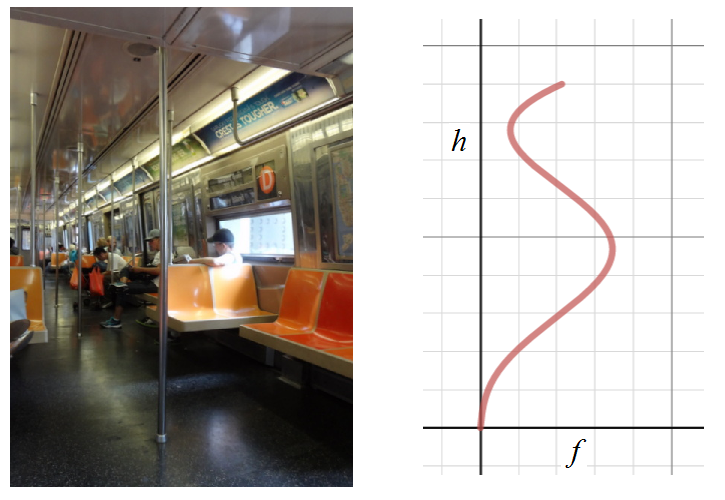
For example, when I look at a pole on the subway, I see the distribution of hands that have been on the pole.

hands on a subway combo

I think about things like this because they are interesting, but also because they are practical.  Where is the pole the dirtiest, and cleanest?  Where are germs most likely to reside?  New Yorkers know instinctively to touch as little as possible, but sometimes you have no choice.  Best to know your probabilities ahead of time.

Regents Recap — August 2015: Modeling Data

Here is another installment in my series reviewing the NY State Regents exams in mathematics.

Data and statistics play a much bigger role in algebra courses now, due in part to their increased emphasis in the Common Core standards.  I am generally supportive of this, but I do worry about how statistical concepts are presented and assessed in these courses and on their exams.

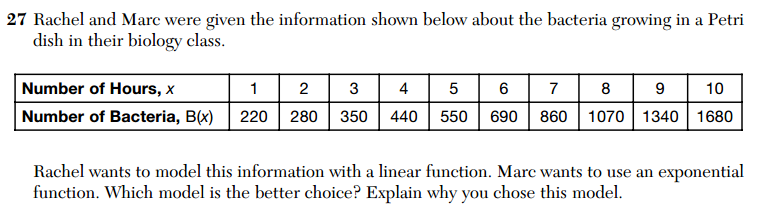
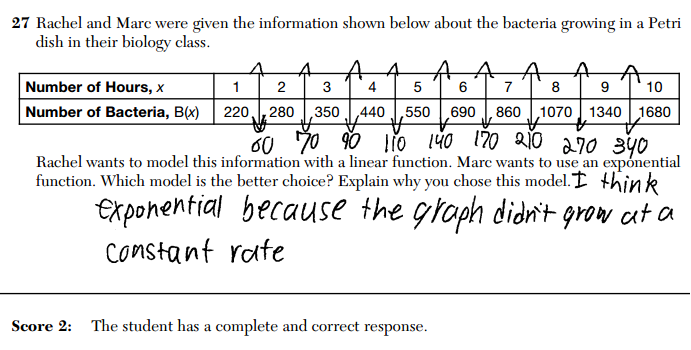
For example, here is question 27 from the August, 2015 Common Core Algebra exam.

2015 August CC Alg 27

Evaluating mathematical models is an extremely important skill in many aspects of life.  But properly evaluating mathematical models is subtle and complex.

The following sample response, provided by New York state as an example of an answer deserving of full credit, does not respect that complexity.  And it makes me worry about what we are teaching our students about this important topic.

2015 August CC Alg 27 MR 1

It’s true that the given data does not grow at a constant rate.  But that isn’t a good reason to reject a linear model for this set of data.  Models are used to approximate data, not represent them perfectly.  It would be unusual if a linear model fit a real set of data perfectly.

The weakness of this argument becomes even more apparent when we notice that the data isn’t perfectly fit by an exponential model, either.  Therefore, how could it be wrong for a student to say “We should use a linear model, because the data doesn’t grow at a linear rate and thus isn’t exponential”?

This is another example of the problems we are seeing with how statistics concepts are being handled on these high stakes exams, which is a consequence of both the rushed implementation of new standards and an ever-increasing emphasis on high-stakes testing in education.  It is also an example of how high-stakes tests often encourage terrible mathematical habits in students, something I address in my talk “g = 4, and Other Lies the Test Told Me“.

Related Posts

Regents Recap — August 2015: Trouble With Transformations

Here is another installment in my series reviewing the NY State Regents exams in mathematics.

The Common Core Geometry standards emphasize a transformation-based approach to congruence and similarity.  This is not a new mathematical idea, but it is novel in the context of traditional high school geometry.

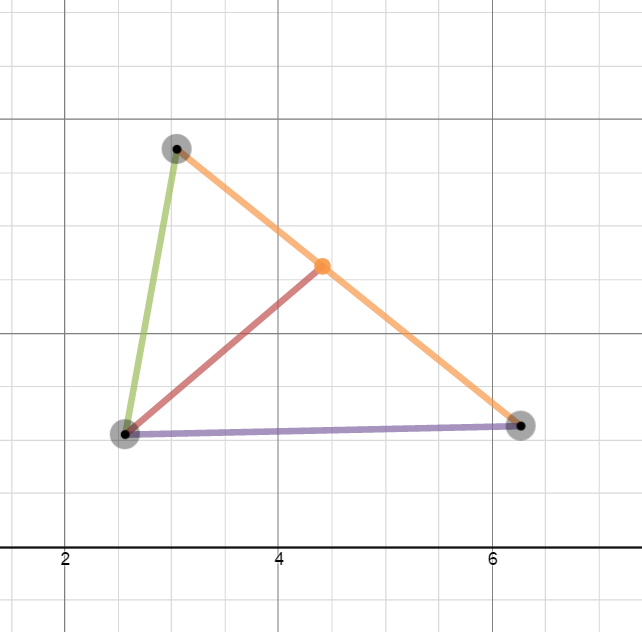
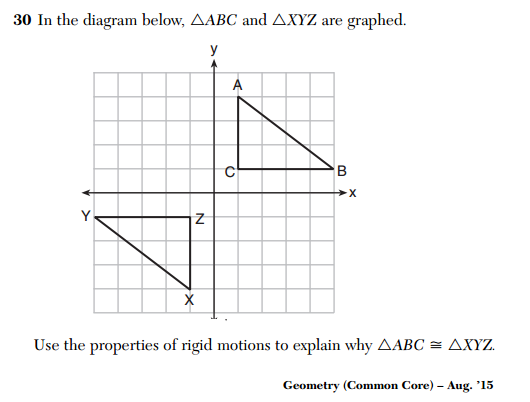
How transformation-based geometry is assessed has been an on-going concern, and this question from the August 2015 Common Core Geometry exam highlights some of the mathematical concerns.
2015 August CC GEO 30

The student is supposed to argue that one of these triangles is the image of the other triangle under some rigid motion, and since rigid motions preserve length and angle, the image is congruent to the original.

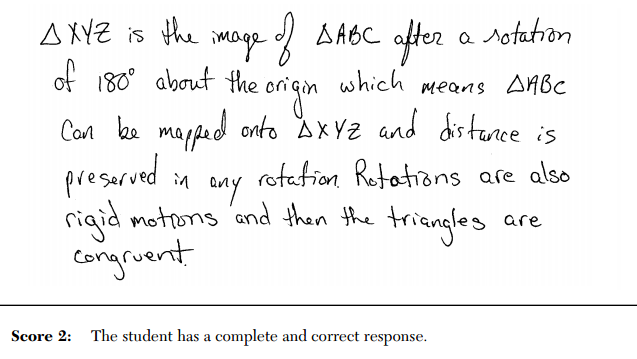
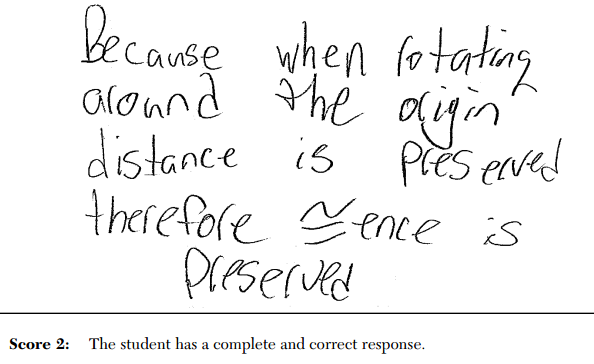
But the following work samples, provided by New York State as examples of full-credit responses to this problem, demonstrate a serious lack of appreciation for the mathematics involved in this argument.
2015 August CC GEO 30 response 3

Notice that no attempt has been made to justify that a mapping that takes triangle ABC onto triangle XYZ exists, which is the foundation of this argument.  The existence of such a mapping is merely stated as fact.
2015 August CC GEO 30 response 1

This full-credit response makes no reference to any specific triangle at all.  It merely states a general property of rotation.

Ironically, the sample zero-credit response offered by the state is the most complete and rigorous response of all.
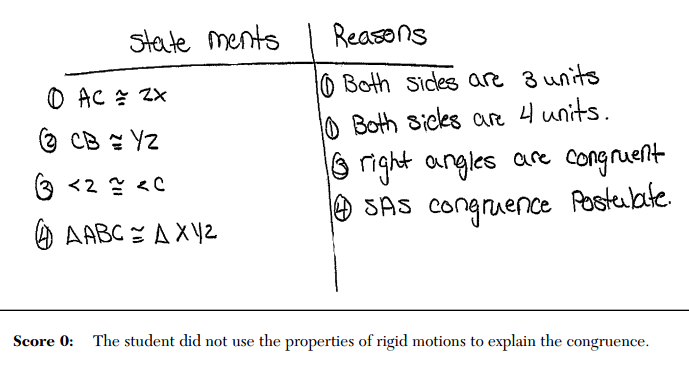
2015 August CC GEO 30 response 2

Here, the student has made a full, appropriate congruence argument, but receives no credit because they did not appeal to rigid motions.

I understand the desire to assess specific content and techniques, but in these sample response items, the state makes some curious decisions about who will be rewarded and who will be penalized.  A student trained to simply regurgitate facts about rigid motions (“Rigid motions preserve distance”) is rewarded, while a student who actually attempts to solve the specific problem at hand, demonstrating depth of knowledge (and, perhaps, flexibility) in the process is penalized.

It’s not hard to imagine the consequences this can have on teaching and learning.  These unintended, and typically unmentioned, consequences result from rushed policy implementation and over-emphasis on testing, and in many ways work to undermine the work of students and teachers.
3D Printing in Math Class

We were fortunate to receive a 3D printer for use in our math class midway through the last school year.  Figuring out how it best worked was fun, and often frustrating.

We enjoyed a variety of successes throughout the spring, printing simple surfaces and some complicated ones, too.  It was fascinating to uncover how the printer, and its software and hardware, tackled certain engineering obstacles, like how to print in mid-air!

Ultimately I got comfortable enough to start producing some lesson-specific mathematical objects.  This trio of solids I designed worked perfectly as an introduction to Cavalieri’s principle:  seeing and holding the objects immediately initiated the conversations I wanted students to have.

By the end of the school year, I felt comfortable enough with the process to run our first official student project.  It was fairly open-ended, with options for students, but essentially the idea was to design an object for printing using equations and inequalities.

The project was a success, and here are some of the student designs.
Student 3d Prints

I’m looking forward to exploring some new ideas and projects this year.  It’s clear to me that this technology, which is fundamentally mathematical in concept and design, can play a valuable and meaningful role in math class.

Follow

Get every new post delivered to your Inbox

Join other followers: