Regents Recap — August 2015: Common Core Algebra

Here is another installment in my series reviewing the NY State Regents exams in mathematics.

The August 2015 administration of the Common Core Algebra exam was similar in style, content, and difficulty to the prior Common Core Algebra exams.  There are a few interesting trends emerging.

Harder Multiple Choice

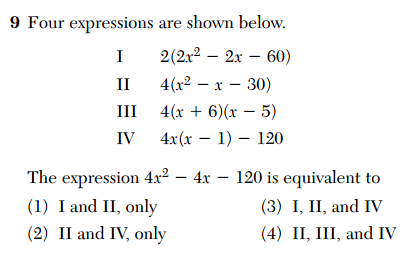
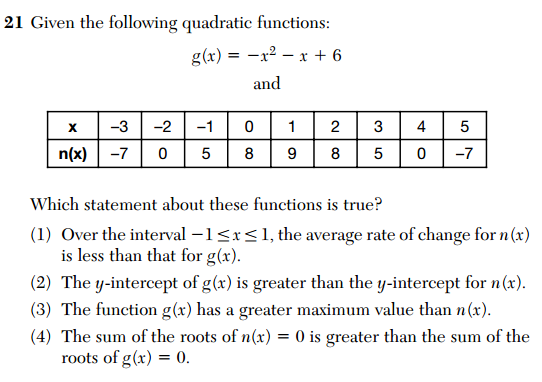
As part of the general increase in difficulty of these exams, we are seeing harder types of multiple choice questions.  Here are questions 9 and 21:

2015 August CC Alg 9

2015 August CC Alg 21

The simplest kind of multiple choice question in this style might just ask “Which of the following statements is true?”  It is generally more difficult to instead identify a false statement among a set, or to correctly identify the true or false subset of statements from a set.  I don’t object to these kinds of questions, but it’s worth acknowledging that this is one subtle way in which the difficultly of the exam can be tweaked.

Confusing Contexts

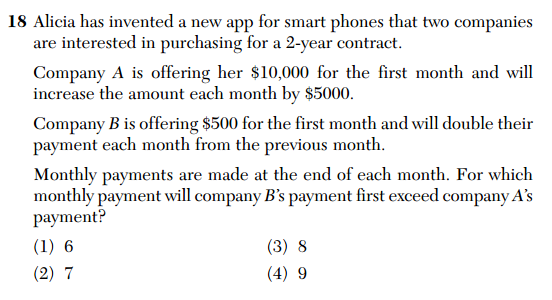
On each of the Common Core Algebra exams thus far, there have been real-world problems that I found very confusing.  In some cases, the more I read them, the less I understood what the question was asking.  Here is Question 18:

2015 August CC Alg 18

Apart from the decidedly unrealistic real-world context, I was quite confused about whether we were interested in monthly payments or total payments.  I wonder if these kinds of problems confuse students, or if they have just [properly] learned to ignore the model and just figure out what the test-maker wants to hear.

Physics

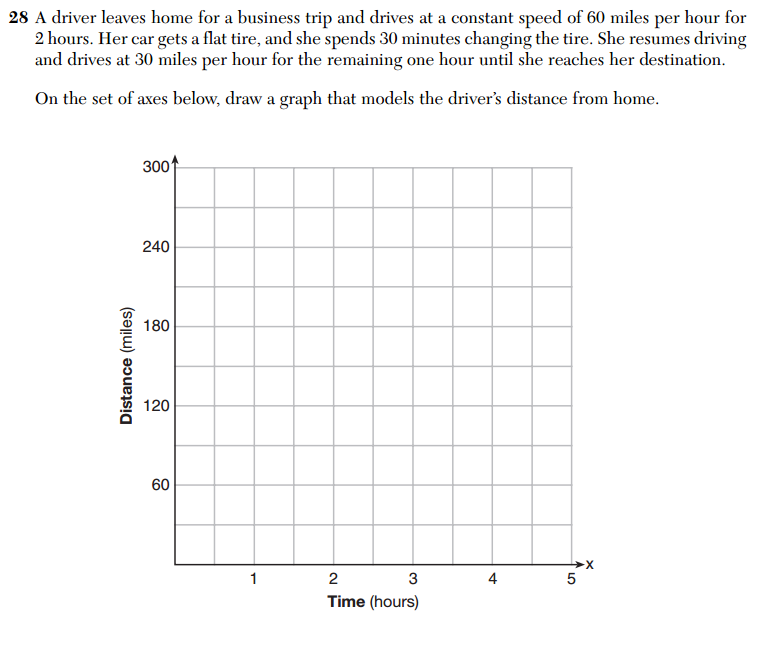
We have seen some Calculus-style content moved down into this Common Core Algebra exam.  Here, in Question 28, students are essentially asked to graph an antiderivative.

2015 August CC Alg 28I don’t have any philosophical objections to this particular content being part of an 8th- or 9th-grader’s mathematical experience, provided it’s part of a coherent curriculum.  But I do wonder about the inherent fairness of this as an 8th- or 9th-grade math exam question.


This question assesses an important concept in introductory physics.  Students in schools where Physics is taught in 9th grade will have a significant advantage on this kind of problem, while other students are in danger of being rated lower on mathematical proficiency simply because they haven’t taken physics.

This is another example of the virtually infinite set of confounding variables involved in assessing learning and teaching.

Teaching with “Why Do Americans Stink at Math?”

why do americans stink at mathMy latest piece for the New York Times Learning Network is a math lesson that uses Elizabeth Green’s article “Why Do Americans Stink at Math?” to get students thinking about the most effective ways to teach and learn mathematics.

Is there a crisis in math education? Lots of people seem to think so.

From worries about where the United States ranks on international tests to arguments over the Common Core, the way teachers teach and students learn math continues to be debated widely, leading to proposed changes in the ways mathematics is taught. But what really works for students in the math classroom? And when changes to the techniques are necessary, how can they be implemented effectively and appropriately across an entire system? This Text to Text lesson plan confronts those questions and more.

Students are invited to use the suggested texts, as well as their own experiences in math class, to explore questions like “Do you believe teaching with a stronger emphasis on conceptual understanding will improve students’ performance in math?”, “What are some of the potential obstacles one might face in trying to change the way mathematics, or any subject, is taught?”, and ultimately, “What are the best ways to teach and learn mathematics?”

The entire piece is freely available here.  There are already a number of interesting student comments on the piece.  It’s certainly eye-opening hearing what they have to say about how they perceive effective math teaching.

Cogito, Ergo, Summer

cogito ergo summerI was quite surprised to find myself prominently featured in the New Yorker essay, “Cogito Ergo Summer“, by Siobhan Roberts.

The piece begins ominously:

Patrick Honner, a math teacher at Brooklyn Technical High School, arrived at a recent class seemingly unprepared. This was surprising, given that, days before, he had received a Presidential Award for Excellence in Mathematics and Science Teaching. 

“Cogito, Ergo, Summer” is about the important role recreation plays in studying mathematics and science.  Summer is a time to relax and have fun, far from the responsibilities of the classroom and lab.  But for mathematicians and scientists, it is also a time for serious play.

Roberts experienced this firsthand this summer at both the Bridges Math and Art conference and the MOVES conference at the Museum of Mathematics, where she spoke about her new book “Genius at Play: The Curious Mind of John Horton Conway“.  Few know the value of mathematical play as well as Conway, which Roberts clearly captured in her work.

As summer comes to an end, it’s nice to reflect on a busy summer of serious play.  And here’s hoping those experiences can fuel us through another busy academic year!

Follow

Get every new post delivered to your Inbox

Join other followers: