
I was surprised to see this structure overhead. It brought to mind the theorem about parallel lines creating congruent arcs when intersecting circles, as well as one of my favorite math photos.
Related Posts
I was surprised to see this structure overhead. It brought to mind the theorem about parallel lines creating congruent arcs when intersecting circles, as well as one of my favorite math photos.
Related Posts
 I’m proud to announce that I am a 2018-19 National STEM Teacher Ambassador!
Through a National Science Foundation grant, the National Science Teachers Association (NSTA) and the National Council of Teachers of Mathematics (NCTM) jointly created a National STEM Teacher Ambassador program that brings together accomplished teachers from across the country for intensive training in policy, media, and advocacy. The goal is to create a network of teachers equipped to advocate for STEM education and related issues at the district, state, and national level.
The program is only open to teachers who have received the Presidential Award for Excellence in Mathematics and Science Teaching, and admission is very competitive. I’m honored to have been chosen, and I have already benefited greatly from meeting and working with the other nine teachers in my cohort.
You can find out more about the 2018 Teacher Ambassadors here, and learn more about the program at the NSTA website. You can also find NCTM’s press release here.
Related Posts
 Like so many in the mathematical community, I was deeply saddened by the sudden passing of Alexander Bogomolny.
Alex built and curated an incredible website, Cut-the-Knot.org, that showcased the playfulness, creativity, beauty, and rigor of mathematics. When I was studying to become a high school teacher, I remember listing Cut the Knot as one of my favorite mathematical resources. Twenty years later, there still isn’t anything quite like what he created.
I learned a tremendous amount of geometry and trigonometry thanks to Alex. His resources opened up new worlds to me, helped shape my thinking, and directly impacted my classroom practice. After I started a math research course at my school, his website inspired dozens of student projects. And his work often inspired me to do and to write about math.
I was excited to find him on Twitter many years ago, where he continued to share resources, pose puzzles, and engage our community in problem solving and reflection. It was a privilege to cross paths with him so often.
Alex did what so many of us aspire to do: He made a tremendous impact spreading the joy, wonder, and challenge of mathematics. The world of mathematics is poorer for his passing, but so much richer for his life and work. Thank you, Alex.
Photo Credit: Nassim Taleb
Thanks to Nassim Taleb for sharing the news of Alex’s passing, as well as his lovely tribute. Please read the other moving tributes to Alex by Jim Wilder and Gary Davis.

In the past I would have incorrectly identified this as a parabolic arch. But now I know better.
Related Posts
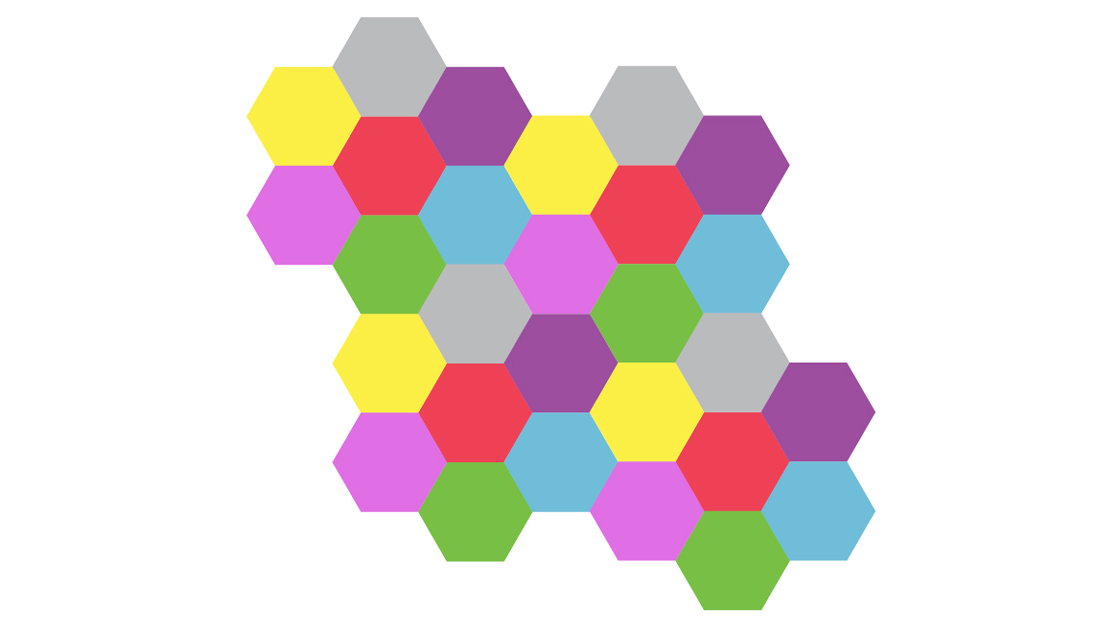 My latest column for Quanta Magazine explores the elementary geometry underlying an open problem in mathematics that has been given new life thanks to a recent, surprising discovery.
The Hadwiger-Nelson problem, also known as finding the chromatic number of the plane, involves determining the minimum number of colors necessary to color every point of the plane subject to a specific restriction.
Consider the standard geometric plane, an infinite expanse of points in two dimensions. Your task is to color each of the infinitely many points in the plane. You might wish to color the entire plane red, or maybe half red and half blue, or maybe you’d splatter the color like in a Jackson Pollack painting. But there’s one rule in our plane coloring problem: If two points are exactly 1 unit apart, they cannot be the same color. Can you color every point in the plane without violating this rule?
“Of course!” you might say, “I’ll just use infinitely many colors.” There is a certain elegance to this sneaky approach (setting aside the philosophical question of whether infinitely many colors exist), but can you do it with finitely many colors? And if so, how many different colors would you need?
Though studied for nearly 70 years, the Hadwiger-Nelson problem remains unsolved, but an unexpected discovery earlier this year has narrowed the possibilities. In my column, I explore elementary approaches to establishing both upper and lower bounds on the chromatic number of the plane, and discuss the exciting discovery that has re-energized the mathematical community around this problem. You can read my full article here.