Football Economics

This is a nice, short profile of David Romer, an economist and lifelong sports fan who briefly turned his attention to football some years ago.

http://www.nytimes.com/2010/09/05/sports/football/05romer.html

In 2002, Romer wrote the first serious academic paper asking the question “When should football teams go for it on 4th down?”, applying rigorous analytical from economics and mathematics.

belichickHere’s the simple summary:  a touchdown in football is (usually) worth 7 points, and a field goal is worth 3 points.  A team will often face the situation that, on 4th down, they can either kick a field goal with a relatively high probability of success (say 80-90%), or they can go for it on 4th down (which has something closer to a 40-50% success rate) and continue to try for the touchdown (not a guarantee).

Romer’s conclusion was basically that teams should go for it on 4th down far more often than they do.  This is essentially an expected value argument:  if, by going for it, you get 7 points about 40% of the time, that’s an average of 2.8 points per attempt; if, by kicking the field goal, you get 3 points about 80% of the time, that’s an average of 2.4 points per attempt.  So in the long run, going for it will produce more points.

However, the fact is that teams rarely go for it on 4th down, usually only trying this strategy in desperate times.  So what account for the difference between the theoretical conclusion and the practice of professionals?

More Math and Fruit (Vegetables?)

I was cutting up some squash the other day

squash 1

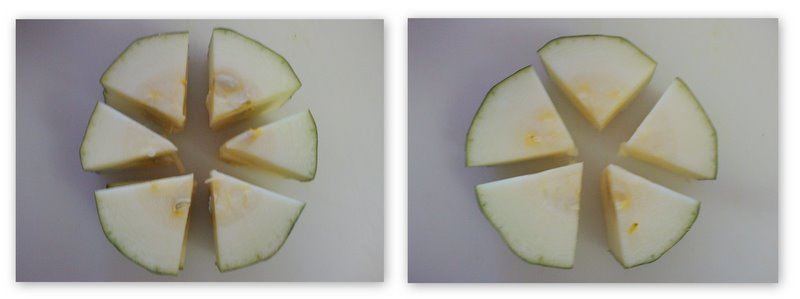
and I thought I’d experiment cutting the squash into fifths and sixths.

I thought I would do a much better job cutting the squash into equal sixths than into equal fifths.  I am generally more comfortable with even numbers, and there is something quite unnatural about cutting a circle into fifths.  But I’m not sure either division was especially equal.

cut squash
They both tasted great, though!

More on Buckyballs

buckyball doodleGoogle has a nice doodle celebrating the 25th anniversary of the buckyball.  (A video of the doodle can be seen here.)

“Buckyball” is the informal name of a particular kind of carbon molecule that, geometrically, resembles the geodesic dome made popular by futurist Buckminster Fuller.  They are more generally known as fullerenes (again, after Fuller), and among other things, have recently been detected in space.

Viewed mathematically/geometrically/graph-theoretically, a fullerene is a solid consisting of only pentagonal and hexagonal faces.  There are many different fullerenes–for example, having 20, 70, or 200 vertices–but what’s amazing is that apparently all of them have exactly 12 pentagonal faces.  Only the number of hexagonal faces changes.

Apparently this fact is a direct consequence of Euler’s formula, namely V – E + F = 2, where V, E, and F are the number of vertices, edges, and faces, respectively, in a given solid.  For example, a cube has 8 vertices, 12 edges, and 6 faces; note that 8 – 12 + 6 = 2, just as Euler requires.

Try verifying Euler’s formula for an octahedron!  Then, when you’re done with that, prove the above remark about fullerenes.

Related Posts

Volume, Surface Area, and Benches

My summer of modest carpentry continued with the staining of this unfinished bench:

stained bench

That one-pint can of Black Cherry stain claims that it will cover 75 square feet of surface.  If so applied, how thick would that layer of stain be?  Let’s go with inches first, and convert to microns later.  Or perhaps a more reasonable question is how does the thickness of the stain compare to the thickness of a sheet of paper?

Hopefully someone will figure that out and tell me.

Map Estimation and Arclength

map -- keyWhenever I spend a lot of time driving, navigating, and map-reading, I find myself making a lot of rough estimates of distances.  The process reminds me of how one estimates and ultimately evaluates, using Calculus, the arclength of a curve.

To find the length of a curve, we approximate the curve with a series of line segments.  It’s easy to find the length of a line segment, and so by sacrificing exactness, you turn a hard problem into an easy one.  This is a fundamental technique in Calculus.

I made my line segments equal in length to 40 miles on the map.  Now just add up the lengths of the line segments to approximate the length of the curve.

maps

Each of the seven line segments is (roughly) equal to 40 miles, so the approximate length of the path from Brooklyn to Burlington is 280 miles (not a terrible estimate).

There are plenty of ways to improve the approximation, and the straightforward, but complicated, calculus approach eventually produces the arclength integral.

On the actual drive my approximations weren’t as good, as I was using an inferior distance estimator.

finger estimation

Follow

Get every new post delivered to your Inbox

Join other followers: