Real-Life Transformers

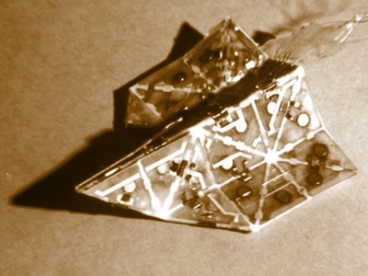
folding robotsThis is an absolutely mind-blowing idea:  robotic “paper” that can fold itself into an arbitrary three dimensional object.  Be sure to watch the short video accompanying the article.

http://web.mit.edu/newsoffice/2010/programmable-matter-0805.html

Tying (or folding?) all of the physics and engineering together here is the mathematics of origami.  How can you fold a square sheet into a boat?  A plane?  A tetrahedron?  A super-intelligent robotic giraffe?

What is the Hardest Word to Guess in Hangman?

hangmanIn 2007 Jon McLoone used Mathematica to create a Hangman game pitting the computer guesser against the human word-selector.  As his daughter became old enough to play against the demonstration, and old enough to get frustrated with the computer guesser always winning, she asked her dad the obvious question:  to beat the computer, what are the best words to choose?

Surprised that he had not considered such a good question himself, McLoone set about playing 15 million games of Hangman (automated, I imagine) using every word in the dictionary and arming the computer with a number of different letter-guessing-strategies.  The word that the computer failed to guess the most often was somewhat surprising.

So what kinds of strategies make the best guesser?  And to counter that, what kinds of strategies should the word-selector employ?

P v NP and Collaborative Mathematics

thinking computerThis is a nice article in the NYT about a recently proposed solution to the famously unsolved mathematical question “Does P = NP?”

http://www.nytimes.com/2010/08/17/science/17proof.html

Essentially this question is about how long it takes to solve certain kinds of problems:  if a proposed solution to a problem can be checked in some reasonable amount of time, does that mean we can always solve the problem in a reasonable amount of time?  [Warning:  the definition of reasonable here may seem unreasonable.]

For example, it doesn’t require many operations to determine whether or not 7411 divides 748511;  even by hand, you can work it out in a few steps.  It requires significantly more operations, however, to find the prime factors of, say, 837751.  Essentially, P v NP asks “are problems that can be checked by computers (maybe lots and lots of computers working in parallel) necessarily solvable by computers?”  It is still an open question.

Another fascinating aspect of this particular open question is the role that the internet has played in bringing great mathematical minds together.  Proposed solutions can be instantly accessed and vetted by those capable of evaluating the arguments.  Such a community can work quickly and efficiently, not just to ascertain a proof’s validity, but to improve and refine it together.

Follow

Get every new post delivered to your Inbox

Join other followers: