Pascal’s, and Rascal’s, Triangles

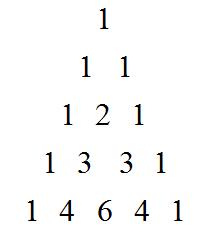
Pascal’s Triangle is one of the most well-known mathematical constructions in human history.  Named after Blaise Pascal, the triangle is rich in patterns and famous number sequences.  The first five rows are shown below.

Pascal triangle five rows

There are many ways to produce Pascal’s Triangle, but the typical way is to define every number as the sum of the two numbers above it:  the one above on the right and the one above on the left.  If there isn’t a number, then just use zero.  For example, 4  = 1 + 3, and 6 = 3 + 3.

The ubiquity of Pascal’s Triangle makes it even more remarkable that a group of three junior high school students have recently collaborated on a paper published in the College Mathematics Journal that uses the famous triangle to find a new number pattern!

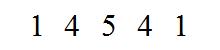
Apparently the story begins with one of the students confounding their teacher by insisting that the fifth row of the triangle should be

rascal numbers

Despite the teacher’s attempts to “correct” them, the students produced a valid recursive relationship for the new triangle, which they describe as ( East * West + 1 ) / North.  They then went on to link their definition to a known sequence in the Online Encyclopedia of Integer Sequences and Voila!, mathematical immortality!

As if the story of three eighth-graders publishing a paper in a college mathematics journal isn’t cool enough, the students collaborated entirely via the internet:  one lives in Washington State, one in Alberta, Canada, and one in Indonesia!

A truly inspiring and remarkable story, and an object lesson in encouraging students to pursue their “wrong” answers!

Math Photo: (Sine) Waves on the Beach

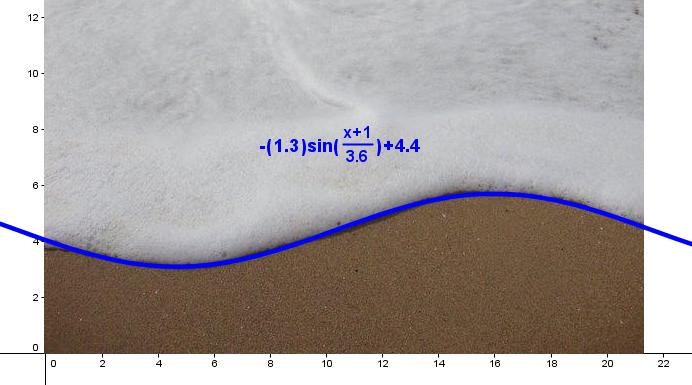
While on vacation, I passed some of my time looking for math on the beach, and I saw a sine wave creeping up the shore.

sine wave in nature

I thought I might be looking too hard for something mathematical, thereby seeing things that weren’t really there.  Thankfully, Geogebra is well-equipped to justify my observations.

wave sine wave equation

Or perhaps it’s more accurate to say that Geogebra helps enable my obsessions.

America By the Numbers

NYT us by the numbersThis is a nice infographic from the NYT highlighting some of the data from the 2010 U.S. Census:

http://www.nytimes.com/interactive/2011/01/07/us/CENSUS.html

Some of the highlights

  • We’re eating less meat and fewer vegetables per person per year, down 5.4 lbs and 30 lbs, respectively, since 2000.  One wonders where we are making up the difference?
  • The marriage rate is the lowest since 1970, and the divorce rate is comparable to that year’s, as well.

The accompanying article from the Times can be found here, and the U.S. Census Bureau’s Statistical Abstract of the United States, where this summary information is drawn from, can be found here.

New NFL Overtime Rules and Strategy

At the beginning of the 2011 playoffs, the NFL implemented a new set of overtime rules that drastically altered how tie games would be decided.  The rules entail many significant strategic consequences, and I’m not sure how well-understood those consequences are.

The old overtime rule is straightforward:  initial possession of the ball in overtime is determined by a coin-toss, and the first team to score is the winner.  Critics of this model argued that since initial possession of the ball was such an advantage, awarding it based on a coin-toss essentially made the outcome of the game equivalent to a coin-toss.  The argument seems reasonable, although whether the data backs it up is a story for another time.

The NFL’s new system tries to counterbalance the advantage of initial possession.  From here on out, let’s call the team that wins the coin-toss, and therefore begins overtime with the ball, Team A.  In the new system, Team A can win the game on its initial possession only if they score a touchdown.  If Team A scores a field goal on their initial possession, Team B will receive the ball and have a possession to then try to win or tie the game.

Here is a diagram illustrating the old system.NFL OT Old RuleThe basic idea here is if Team A scores, they win.  If they don’t, then Team B gets the football and starts at the front of the graph.
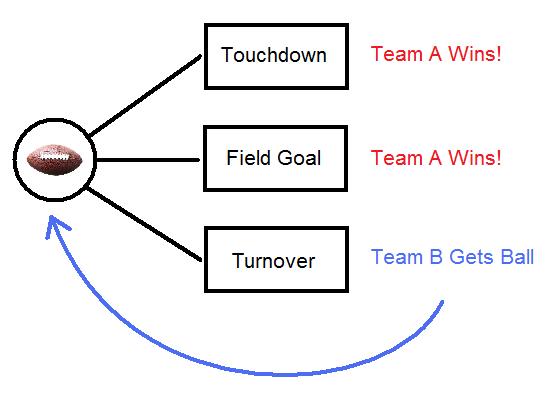
Here’s a graph representing the new system.

This system is far more complex.  First of all, Team A now has a great incentive to try for a touchdown on its first possession, whereas under the old system, they had virtually no incentive to do so.  Furthermore, the value of a field goal for Team A on its initial possession has been greatly decreased.  Under the old system, a first-possession field goal won the game.  Under the new system, its value is considerably less.NFL OT New RuleWhat are the consequences of these new realities?
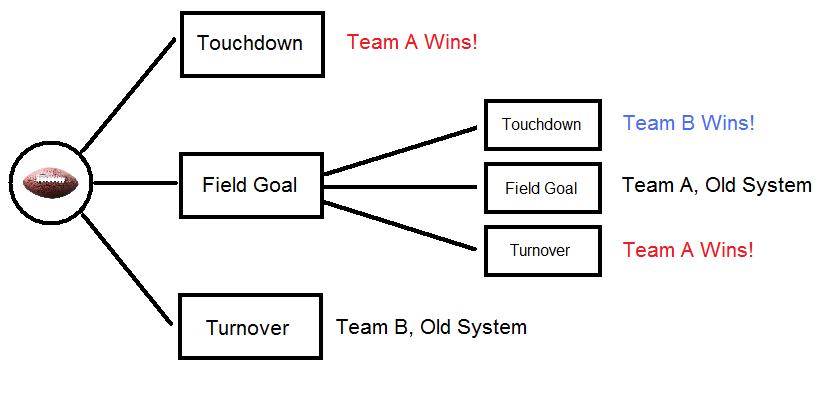
Consider a long field goal on the initial possession.  Make it, and your opponent gets the ball and can beat you with a touchdown or tie you with a field goal.  Miss it, and your opponent will have good field position and now can beat you with a field goal.  Perhaps punting is the better option:  you gain field position and if you defend successfully, you get the ball back and now all you need is a field goal to win.

Even more interesting is a short field goal attempt on the initial possession.  Make it, and your opponent still gets field position and a chance to beat or tie you.  Why not go for a touchdown?   You win outright if you succeed, and if you don’t, not only does your opponent get poor field position, but if you defend successfully you’ll only need a field goal to win.

Because of the altered values of touchdowns and field goals mentioned above, I think 4th down strategies on the initial possession should be modified as well.  As complex as it is, at least the new system reverts to the old ruleset after (at most) two possessions.

As interesting as the many consequences of these rule changes are, I still think the “first to six” idea makes more sense.  We’ll see what happens this weekend! 

Related Posts

 

More on College Rankings

college rankingsThis article in the New York Times discusses a controversy surrounding a recent ranking of colleges that put Egypt’s University of Alexandria among the top 200 universities in the world.  An informed observer describes the school as “not even the best university in Alexandria“.

http://www.nytimes.com/2010/11/15/education/15iht-educLede15.html

How did this school achieve such a high ranking?  In a subcategory measuring the impact of research, which counted for approximately 33% of the school’s overall score, the University of Alexandria placed fourth in the world, ahead of Harvard and Stanford.  Sound fishy?  Seems as though most of the research citations came from one professor who published 320 articles in a journal he, himself, was in charge of.

Trying to come up with quantitative measures for colleges (or high schools, or teachers) is tricky business.  Not only is it hard to agree on what to measure, but it’s tough to figure out how to measure it.

And once the rating culture sets in, gaming of the system, as seen in this particular case, will inevitably follow.  “Tell me how I will be measured, and I will tell you how I will behave“.  I’m not sure who said this originally, but an engineer friend shared it with me many years ago, and it always comes to mind in these situations.

Hopefully in the future, more schools will follow the example of Reed College and refuse to participate in these rankings.

Follow

Get every new post delivered to your Inbox

Join other followers: