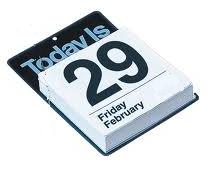
Math Lesson: 10 Ways to Celebrate Leap Year

My latest contribution to the New York Times Learning Network is a collection of teaching and learning ideas that use the New York Times to explore leap year and other calendar oddities.

https://learning.blogs.nytimes.com/2012/02/27/10-activities-for-learning-about-leap-year-and-other-calendar-oddities/

The activities include day-of-the-week calculations, alternate calendar conventions, days and years on other planets, and reflections on the value of one extra day.

In short, there are plenty of ways to make the most of this quadrennial event!

Math Quiz: NYT Learning Network

Through Math for America, I am part of an on-going collaboration with the New York Times Learning Network.  My latest contribution, a Test Yourself quiz-question, can be found here:

https://learning.blogs.nytimes.com/2012/02/27/test-yourself-math-feb-27-2012/

This problem is based on the unlikely emergence of basketball star Jeremy Lin.  How unlikely was his inaugural 7-game winning streak?


On Coin Distributions

Inspired by a recent foray into Piggy Bank Estimations, I started thinking about the following question:  how are coins distributed?  That is, what percentage of coins in a collection of random change are pennies?  Nickels?  Dimes?  Quarters?

I began with two assumptions.  They are debatable, like most assumptions are, but they seem like a good place to start an investigation:

1)  Every amount of change is equally likely to be received.

2)  Every amount of change is provided using the minimum number of coins.

What (1) means is that you are just as likely to get 13 cents back in change as you are to get 91 cents when you purchase something.   And (2) means that, when you get that 91 cents back, you’ll get it as 3 quarters, 1 dime, 1 nickel, and 1 penny; not 4 dimes, 9 nickels, and 6 pennies.

I made a chart in Excel of all the possible change amounts from 1 to 99.  I then figured out how many of each coin would be used to provide that amount of change, assuming that change was given efficiently.

Now, assuming each change amount is equally likely, we can simply count the total number of coins and then figure out each percentage as a share of that total.  The total number of coins in the list is 466.  The number of each coin, and it’s approximate percentage, is given below.

By this analysis,  a large, random collection of coins should be roughly 42.5% pennies, 8.5% nickels, 17% dimes, and 32% quarters.   Do me a favor:  the next time you find yourself sitting on a big pile of change, see how it stacks up against these numbers and let me know.

And if you like, you can check this theoretical ratios against the actual numbers in my Piggy Bank.

21022012

Happy European Palindrome Day!

Expressing today’s date in the typical European style [ Day / Month / Year ] gives us a palindromic date!  Definitely a cause for mathematical celebration.  Or at least mathematical appreciation.

I admit that, as an American, this doesn’t resonate with me as much as another recent Palindrome Day, but it’s always nice to take a moment and appreciate a good number.

Follow

Get every new post delivered to your Inbox

Join other followers: