The way these triangular acoustical tiles alternate bases creates a cool visual pattern. I wonder if this is part of some sonic strategy, or just an aesthetic choice?
Challenge Resources
Project Euler
This is a wonderful website offering a long list of interesting and challenging math and computer science problems.
There are many different kinds of problems to solve: some are purely mathematical in nature, and some would be considered more like pure computer science.
Some are easy (“What is the 1001st prime number?“), some seem moderately challenging (“What is the sum of the digits of ?”), and some are, well, difficult (“How many strong Achilles numbers are there?”).
The problems are freely available, but it looks like you have to register to submit answers.
Appreciation
Richard Lippold
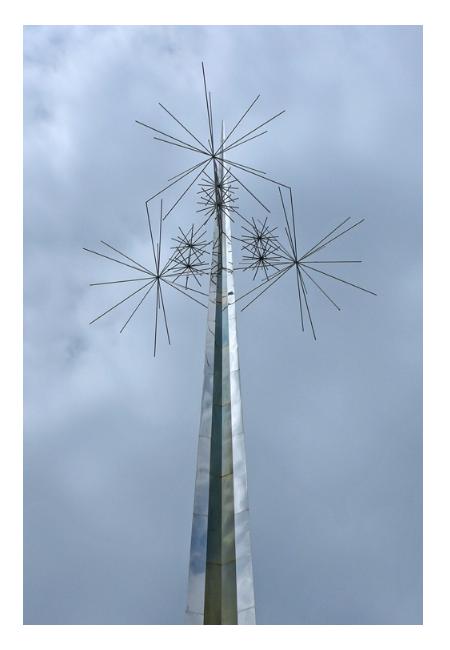
On a recent trip to the MoMA, I saw several pieces by Richard Lippold, an 20th century American sculptor with a background in industrial design. Lippold was known for his skill with geometry and engineering, creating beautiful pieces from wire, among other materials.
Lippold’s Ad Astra, which resides at the National Air and Space Museum in Washington, D.C., is seen here at the right. And there is a Lippold at the Metropolitan Museum of Art, called Sun, which apparenlty contains more than 2 miles of gold wire.
A lot of people live in the intersection of Math and Art, and they do some very cool things!
Appreciation Art
Mathematical Snow Art
This is unbelievable: artist Simon Beck creates large-scale works of art by walking intricate paths in the snow. Check out the photos at his Facebook page:
http://www.facebook.com/snowart8848
Creating these works obviously requires great detail in planning and often days to execute. I don’t know how mathematical Simon Beck is, but his art is clearly mathematical in nature.
This really puts my snow art to shame. I’ll definitely aim higher next time!
Application Probability
Leap Day Birthdays
In my Leap Day contribution to the New York Times Learning Network, “10 Activities for Learning About Leap Year and Other Calendar Oddities,” I calculated the odds of a person having a Leap Day birthday.
Assuming each day of the year is an equally likely birthday, and noting that there is one Leap Day every four calendar years, I calculated the probability to be
P (Leap Day Birthday) =
or around 0.7%.
So how many people with Leap Year birthdays do you know?
