We always end up arguing about stuff like this in my class.

For more images from math class, check out my Facebook page.
We always end up arguing about stuff like this in my class.
For more images from math class, check out my Facebook page.
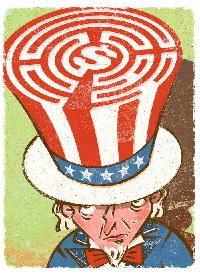 Here is a math lesson I put together for the New York Times Learning Network that is built around parsing income information and properly filling out tax forms.
This lesson supplies students with cost-of-living scenarios and mocked-up W2 and 1099-INT forms and challenges them to work their way through Federal Form 1040EZ.
A few older students might like to try this, too!
A palindrome is a number (or word) that reads the same forward as backward.

What’s especially nice about this palindrome is that it’s still a palindrome when you rotate it 180 degrees!

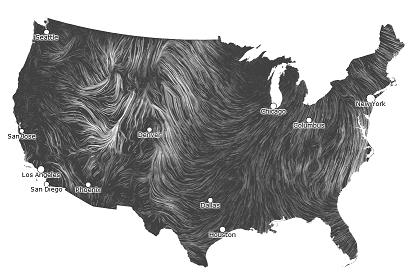 This is a stunningly beautiful visualization of wind patterns in the US:
Not only is this a functional and immediately accessible representation of data, but it also brings to life the mathematical concepts of vector fields and flow lines.
Apart from atmospheric science questions like “Why is this area windier than others?” are purely mathematical questions like “Which location is the calmest?” and “Which location is most volatile?”
And if you enjoy this, be sure to check out this visualization of the world’s ocean currents!
 This is an interesting article about a young mathematician who is using techniques from seismology to build crime-prediction models.
http://www.wmbfnews.com/story/13492456/man-uses-math-to-thrwart-crime
The basic idea is that crimes are more likely to be committed in geographical clusters, much like how afterschocks of earthquakes occur around the epicenter of the original quake. Such patterns have already been identified in burglaries and gang violence.
By looking at the data from crime reports and 911-calls, better predictions can be made about where and when crimes might occur. That way resources–police officers, in particular–can be deployed more efficiently.