CD Packing Problems

I consider myself an expert arranger of things.  I enjoy rearranging storage space, packing things away, and helping people fill up moving trucks.  It’s a way to apply geometry and optimization techniques, two of my favorite things.

In general, the packing problem entails trying to find the most efficient way to pack a certain kind (or kinds) of object into a certain fixed space.  Packing problems are, generally speaking, very challenging because every packing problem is unique.  There isn’t a good, efficient procedure that solves them all.

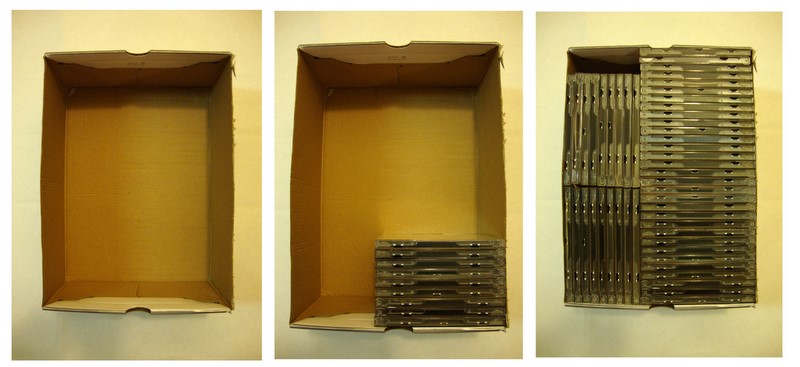
Here is yet another example of problems with packing problems.  After shedding a bunch of CD cases, I thought I’d try to pack them up in a box.  Here was my first attempt.
cd-packing-1

I got 49 CDs in the box, but there was a bit of unused space left over.  I couldn’t fit a CD into that unused space, but I thought maybe I could rearrange everything to make some of that space usable.

So I tried again.cd-packing-2
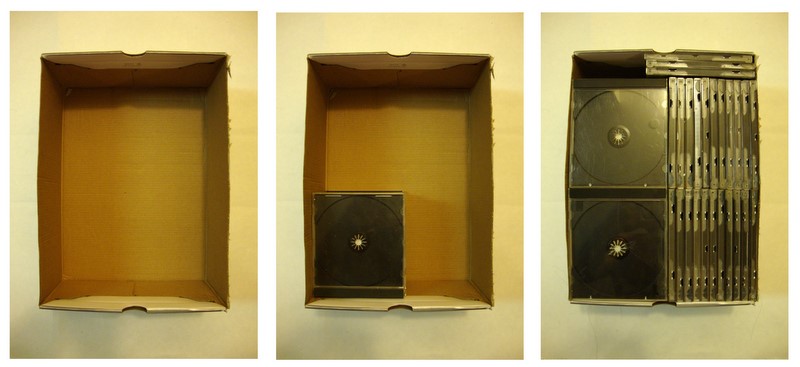
The number of CDs in this new arrangement differed by one.  While I can compare which of these packings is more efficient, the problem is comparing all possible packings!  There are a lot of options to consider.

As useless as they are, I ended up having a lot of fun with these CD cases.  I made some parallelepipeds with them and used them to demonstrate Cavalieri’s Principle!

Related Posts


Folding Website

This is great website from Joseph O’Rourke, author of  “How to Fold It:  The Mathematics of Linkages, Origami,and Polyhedra” .

www.howtofoldit.org

The website has several videosand cool animations that demonstrate some of the basic ideas in mathematical folding, like the one-cut problem, the map puzzle, and folding polygons into convex polyhedra.

There are also a few folding patterns available for download, just in case you’d like to produce a turtle with one cut!

And for more resources on math and origami, check out my fun with folding page!


Uneven Haircuts

Barbers strike me as a practical lot.  Which makes this pricing structure seem especially strange to me.

barber shop

I mean, isn’t a kid going to have less overall hair than an adult?  I understand that an adult head may have less coverage percentage-wise, but the larger head-radius more than makes up for the lower proportion of hair.  I’ve got to believe that the price-per-hair is considerably higher for a child than an adult under this pricing system.

Of course, I would not be so naive as to expect understandable pricing structures from hair stylists.

Related Posts


BBC Podcasts: A Brief History of Mathematics

This is a set of ten podcasts from the BBC titled “A Brief History of Mathematics“:

http://www.bbc.co.uk/podcasts/series/maths

Narrated by mathematician Marcus du Sautoy, these podcasts begin with Newton, Leibniz, and Calculus, and cover other great personalities in mathematics like Euler, Fourier, Ramanujan, Poincare, and, of course, Gauss.

Each podcast is about 15 minutes in length, and all 10 are freely available for download.

Math Photo: Windowsill Contours

I have an adjustable screen for my window, the kind you expand horizontally to fill up the windowsill.  It’s somewhat effective at keeping bugs out of the house.

When it’s not opened all the way up, the two layers of screen overlap in the middle.  Depending on the angle you are looking from, you can see some cool images.

At this angle, for example, I see a contour map of a function of several variables.

I wish I understood where the curves come from!

Follow

Get every new post delivered to your Inbox

Join other followers: