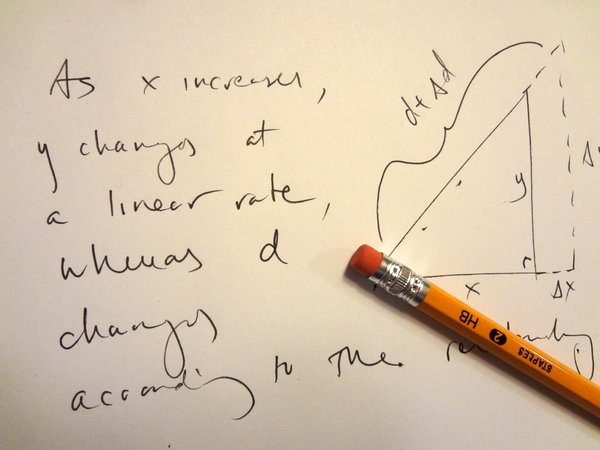
 Finding ways to get students to write about mathematics has played a pivotal role in my development and growth as a math teacher. Mathematical writing challenges students to express their ideas clearly and efficiently; it forces students to stop thinking of mathematics as merely equations and answers; and it opens up a new and unexpected dialogue between math teacher and student.
I have always found great value and pleasure in writing. It is a valuable skill, a necessary tool of scholarship, and a powerful creative outlet. And now I see its value as a math teacher. The more my students write, the more useful and interesting we all find it.
In this post, I’ll discuss some strategies for making writing part of the culture of the math classroom.
Here are a few simple things that make writing in math class work for me and my students.
Keys to Success
1) Short and Sweet
Keep the assignments short and well-defined, especially at the beginning. Don’t ask students to write pages and pages; sometimes a short paragraph or even a thoughtful sentence says it all! Students may be hesitant to write at first, so making it easy on them can help get the process moving.
2) Feedback
As with all student work, meaningful feedback goes a long way. Make sure the students know that you are reading their work, even if you aren’t grading everything. Correct as much grammar as you are comfortable with, but don’t necessarily feel obligated to grade it like a literature teacher might. This is likely to be an “extra” assignment anyway, for both the students and you! Keep it fun.
3) Shareout and Peer Review
With every assignment, honor those pieces that really moved you by picking a few and sharing them with the class. Have small groups exchange papers and then share their favorites aloud. It only takes a few minutes, but sharing rewards students for taking a risk in their writing, and regular peer review helps everyone get better over time.
Get Writing!
There are a lot of ways to get students writing in math class. It isn’t easy, and it takes time for everyone to get comfortable with it, but it’s an investment worth making. Establishing a culture of writing has dramatically impacted my classroom: it gives my students a different way to interact with mathematics, and it gives me a different look into how my students think about math.
For more resources, see my Writing in Math Class page.