This is Not a Trig Function

I spend a lot of time looking at New York State Math Regents Exams.  In addition to the critical analysis of the exams I undertake here, we typically grade several thousand exams at the end of each year at my school.

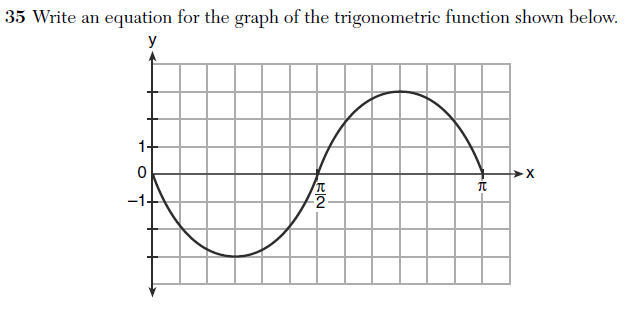
When grading so many exams, it’s not uncommon to feel disoriented and unsettled looking at the same problems over and over again.  However, there was something particularly unsettling about this question.

This trigonometric function just appeared to be too round to me.  Perhaps my senses were just dulled after hours of grading.

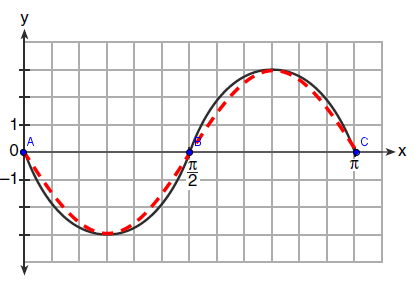
Thankfully, we have Geogebra to settle such mathematical disputes.

I was right!  It is too round.  Thanks again, Geogebra, for enabling my mathematical compulsions.

Related Posts


Mathblogging.org Profile

Mathblogging.org is running a series of profiles of math bloggers called Mathematical Instruments, and I am happy to be their latest subject.  You can learn a little bit more about me and my blogging history here:

http://mathblogging.wordpress.com/2012/10/20/mr-honner/

Mathblogging.org has played a significant role in my development as a math blogger, so I am quite proud to be a part of this series.

Around the time I started putting together my website, Mathblogging.org came into existence.  Mathblogging instantly connected me to dozens (and ultimately, hundreds) of other math bloggers from the worlds of academia, industry, and education.  It was a place for me to see what different people were writing about and where the conversations were happening.  I felt an immediate sense of community, which made my own blogging seem more relevant.

And I was always excited and proud to make Mathblogging’s Weekly Picks.  It gave me a sense that people were actually reading, and enjoying, what I was publishing.  That positive feedback encouraged me to continue writing about math, taking mathematical photographs, and reflecting about what I could share with the greater math and education community.

So happy birthday to Mathblogging.org!  Thank you for connecting me to so many fascinating and inspiring people, and for helping me find my place in the math blogging community.

Birthday Frequency Visualization

This is a beautiful visualization of birthday frequency:

http://gizmodo.com/5910773/how-common-is-your-birthday

This “heat map” shows which days are the most common birthdays in the U.S.

Lost of interesting questions arise from this representation of data.  We can immediately see that July, August, and September seem to form a disproportionate band of birthdays.  And take a look at July 4th:  what’s the explanation for that?

In addition, you could also use this chart to create some new twists on the classic birthday paradox!

Follow

Get every new post delivered to your Inbox

Join other followers: