Math Photo: A 26-gon

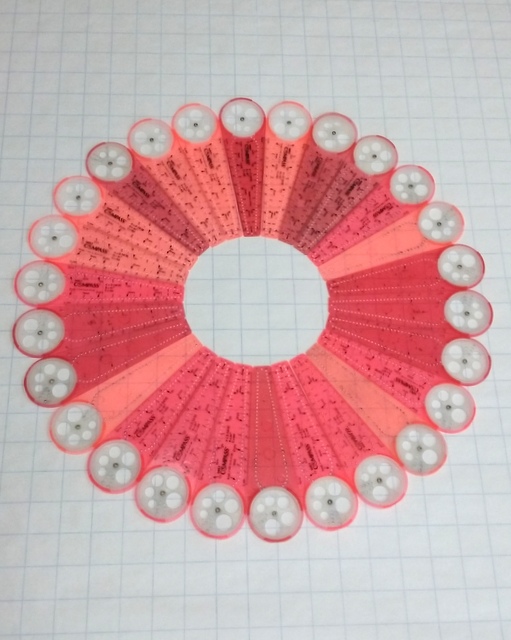
Thanks to the strong presence of mathematicians and math teachers on social media, I know I’m not the only person who, when sitting around with a box full of compasses, unexpectedly ends up doing things like this.

Compass-gon

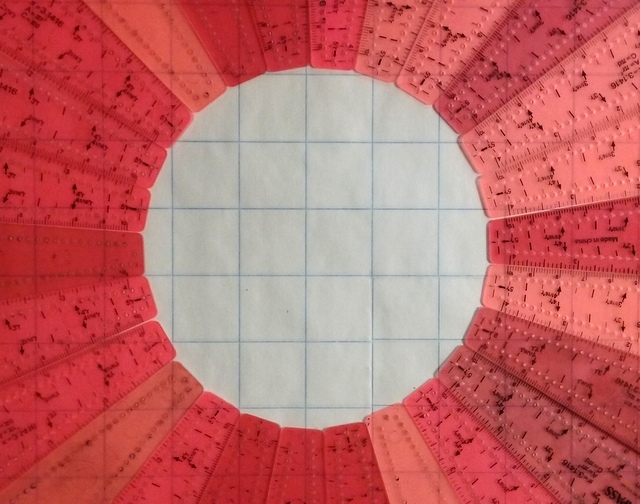
A circle made of circle-makers!  Or, from another perspective, a regular 26-sided polygon.

26-gon 2

The fact that I created an object that doesn’t even appear to have a name made me feel a little better about this use of time.

TCM at NCSSM

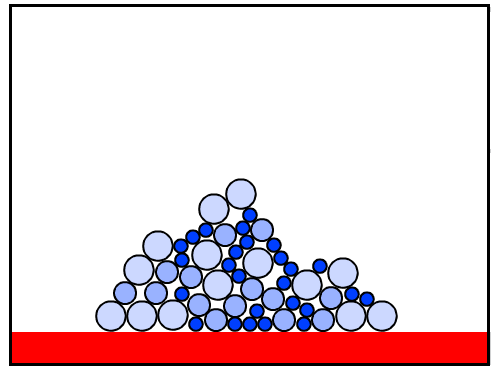
falling pebbles 3I’m excited to be presenting at the upcoming Teaching Contemporary Mathematics (TCM) conference at the North Carolina School of Science and Mathematics (NCSSM).

NCSSM is an internationally known leader in providing advanced math, science, and engineering education to public school students.  They have a residential program that serves 11th and 12th graders and distance programs that serve students all across the state of North Carolina.

NCSSM hosts the annual TCM conference to bring together teachers to talk about innovations in teaching modeling, technology, and problem-solving in advanced high school courses.  My talk, Mathematical Simulation in Scratch, details some of the work I and my students have done in our mathematical computing course.

TCM runs January 29-30 on the campus of NCSSM in Durham, North Carolina.  You can find out more information about the TCM conference and see the schedule of talks here.

How Much Would You Pay for a 20% Discount?

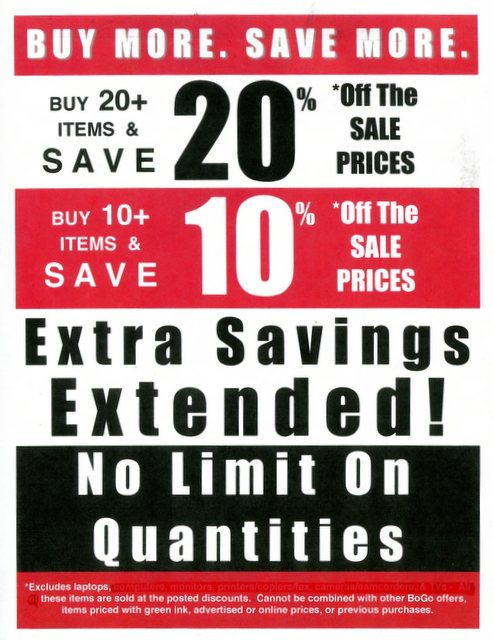
A local Office Max is going out of business and is having a very interesting sale.
20 percent discount 2

I’m not sure I’ve ever seen a sale where you earn a discount by purchasing a certain number of items.  Of course, I immediately began exploring the mathematical consequences of the policy.

The first thing that occurred to me was that you can essentially purchase a 20% discount.  Say you need to buy n items.  Simply buying another 20 – n items earns you a 20% discount.  The natural question is thus, “Under what circumstances would buying an additional 20 – n items be worth a 20% discount?”

There are a variety of factors to consider.  For example, if you can just find an additional 20 – n items that you are happy to buy, it’s definitely worth it:  you get the 20% discount, and you get items of value to you.  Also, the answer likely depends on n:  if you are only 1 item short of the discount, it’s easier to justify an unnecessary purchase than if you are, say, 19 items short.

As an extreme case thinker, I considered the following scenario.  Suppose I wanted to buy one item; under what circumstances would I buy 19 items I didn’t want in order to get a 20% discount?

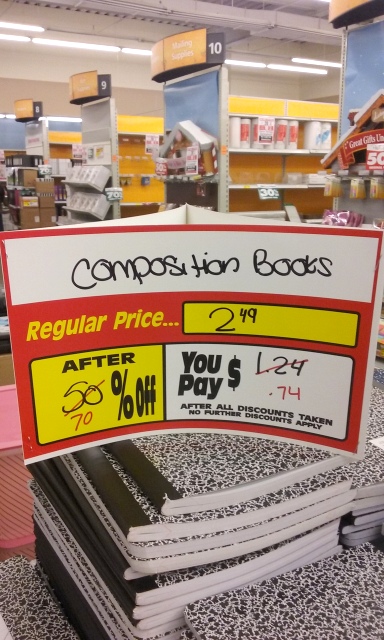
Obviously, the key to this strategy is finding a cheap item to purchase 19 times.  I thought I had found the cheapest possible item here:
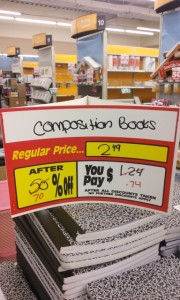
composition books 74 cents

Nineteen composition books would cost me $14.06.  If the 20% discount saved me more than $14.06, this strategy would be worth it.  This sets the bar for my one item at $70.30.

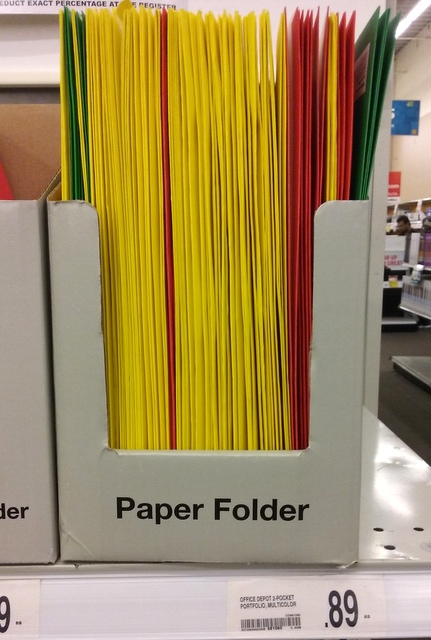
However, I later realized I could do better here:
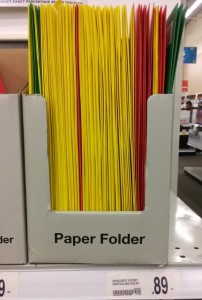
paper folers 89 cents

These paper folders cost more per item, but unlike the composition books above, the folders are themselves eligible for the 20% discount!  Nineteen folders would cost $16.91, but they’ll be discounted 20% to $13.53.  This means if my single item cost more than $67.65, this strategy would save me money.

I could have done a lot better if these Slim Jims were sold here, or these 10-cent envelopes!  But this is the best I could find in the store.

Another interesting question to consider is “For what range of prices would buying nine additional items, to receive a 10% discount, be a better strategy than buying 19 additional items, to get the 20% discount?”

In any event, I appreciate Office Max giving me something interesting to think about as I waited in line.  And as usual, I waited a very long time.  Let’s just say it’s no surprise they are going out of business.
Happy 2016!

In honor of the new year, here’s the complete graph on 64 vertices, with its 2016 edges!

k_64

complete graph is a graph in which every pair of vertices is connected with an edge.  In a complete graph with n vertices, there are

\binom{n}{2} = \frac{n(n-1)}{2}

edges.  The above graph has 64 vertices equally spaced around the perimeter.  Thus, n = 64, and we have

\binom{64}{2} = \frac{64*63}{2} = 2016

edges.

The number 2016 is special for a variety of reasons.  For example,

1 + 2 + 3 + ... + 63 = \sum\limits_{n=1}^{63} n = 2016

So 2016 is equal to the sum of the first 63 positive integers!  This makes 2016 a triangular number, a fact beautifully demonstrated by David Swart in this image.

And John D. Cook illustrates the combinatorial nature of 2016 by pointing out that this is the number of ways to place two pawns on a chessboard!

However you think of it, 2016 is a pretty great number!  And here’s hoping 2016 is a great year.

2015 — Year in Review

I always enjoy taking time at the end of the year to review my blog. It’s a great way to reflect on what I did and what I was thinking about, and it always reminds me how busy the year was! And 2015 was definitely a busy year.

The Presidential Award

awards_PAEMSTWithout a doubt, the highlight of my professional year was being named a recipient of the Presidential Award for Excellence in Mathematics and Science Teaching (PAEMST).

I traveled to Washington, DC with other awardees to meet with representatives of the National Science Foundation, the National Academies of Science, and the Office of Science and Technology Policy. And the highlight of trip was meeting President Obama at the White House!

The trip to DC was part of an active professional summer.  I presented my paper “Monte Carlo Art” at this year’s Bridges Math and Art conference, and the following week I ran a fun workshop called “Games on Graphs” at the MOVES conference at the Museum of Mathematics. At the end of a very busy few weeks, I was surprised to find myself in this terrific New Yorker piece, “Cogito, Ergo, Summer” by Siobhan Roberts!

Speaking

In addition to presenting at Bridges and MOVES this summer, I traveled to Washington, DC earlier this year to speak at a policy briefing hosted by the Mathematical Sciences Research Institute (MSRI) during the first ever National Math Festival. I spoke about building the profession of math teachers, and was a bit intimidated to follow Nancy Pelosi, Harry Reid, and Al Franken! I also ran a variety of workshops on math and technology for teachers, and hosted Math for America’s 4th annual Master Teachers on Teaching, a great evening of talks from MfA Master Teachers.

Teaching

I always try to do new things in my classroom and my school, and 2015 was no exception. I’ve been having fun playing around with 3D-printing in a variety of classes, building demonstrations for geometric ideas, printing hard-to-imagine surfaces, and getting students creating with mathematics. I continue to develop and teach an integrated mathematics and computer science course, and I have taken on a part-time role as our department’s instructional coach.

Writing

For a variety of reasons I write less frequently than I used to, but I did surpass 1,000 total blog posts this past year! My work critiquing the New York State Regents exams continues to get attention,  and I was informally consulted for an excellent report by the Center for New York City Affairs about the serious issues facing New York state’s algebra exams that eventually caught the attention of the New York Times. And I continued my work with the New York Times Learning Network, contributing math lessons on evaluating compulsory retirement savings plans and asking students “Why Do Americans Stink at Math?”

So a great year comes to an end, but here’s hoping 2016 is just as challenging, productive, and rewarding!

Related Posts

Follow

Get every new post delivered to your Inbox

Join other followers: