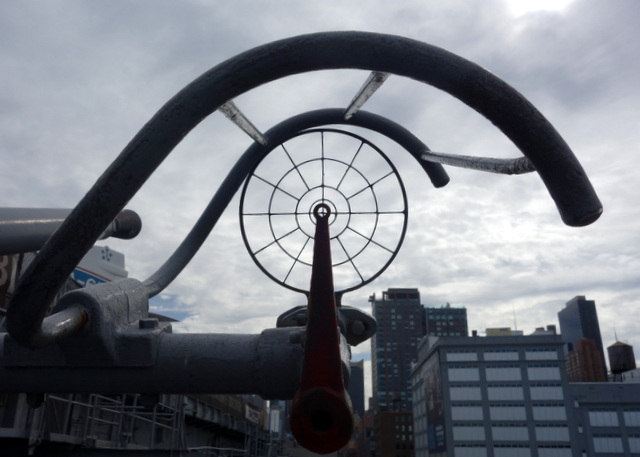
I suppose it makes sense to use polar coordinates to map the sky if you’re an anti-aircraft gunner.
This interesting application of mathematics is brought to you by the USS Intrepid.
I suppose it makes sense to use polar coordinates to map the sky if you’re an anti-aircraft gunner.
This interesting application of mathematics is brought to you by the USS Intrepid.
For a political science professor, Andrew Hacker is surprisingly familiar to math teachers. His 2012 New York Times Op-Ed “Is Algebra Necessary?” generated lots of conversation in the math education community, including several pieces from me: “N Ways to Use Algebra With the New York Times” in NYT Learning, and “Replace Algebra with Algebra?”.
Professor Hacker is back in 2016 promoting a new book, and in a recent NYT interview he revives his anti-math arguments from four years ago: math is not really necessary for jobs; it’s too hard; it prevents students from graduating.
I saw the piece and didn’t feel the need to respond. There was nothing new, and I’d said what I wanted to say here.
But I was pleasantly surprised when I saw this letter-to-the-editor, written by a high school student, published in the February 19th edition of the New York Times.
In “Who Needs Math? Not Everybody” (Education Life, Feb. 7), Andrew Hacker, who teaches quantitative reasoning at Queens College, says that since only 5 percent of people use algebra and/or geometry in their jobs, students don’t need to learn these subjects.
As a high school student, I strongly disagree.
The point of learning is to understand the world. If the only point of learning is job preparation, why should students learn history, or read Shakespeare?
And while your job may never require you to know the difference between a postulate and a theorem, it will almost certainly require other math-based skills, like how to prove something or how to understand a graph.
And my surprise turned to delight when I realized that the author is a 9th grader in my Geometry class!
While her love of mathematics and her wonderful attitude toward learning certainly predate my Geometry course, I am very proud to see reflections of our classroom in her letter.
You can read the full text of her letter here.
Related Posts
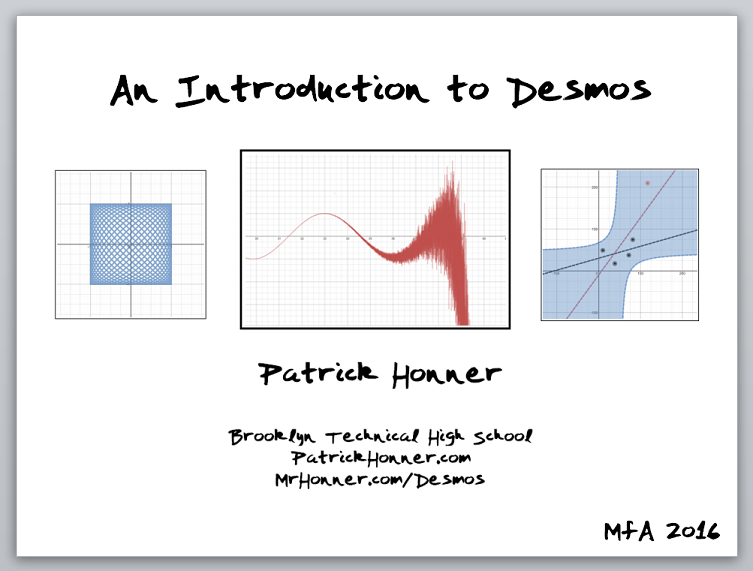
I’ve presented on Desmos many times to teachers, administrators, and students. So I was excited to bring that experience to the Math for America community through my workshop, An Introduction to Desmos, at the MfA offices in New York City.
Nearly 50 MfA teachers attended, and it was a very active and engaged bunch. Most attendees were familiar with Desmos, and many were using it in their classrooms. But I got the sense that everyone’s eyes were opened a bit wider to the power and possibility of this mathematical technology.
Participants began by working through a document I’ve put together that functions as a guided tour of Desmos. I’ve used this document many times with both teachers and students: it provides a quick overview of the power and breadth of the functionality of Desmos, and it allows me to circulate and answer, and ask, questions. [You can find the document here: Introduction to Desmos]
The second part of the workshop had participants working on a series of content-specific challenges. The goal was to use get teachers using Desmos to build mathematical objects. For example, some teachers worked through these parabola challenges:
Construct an arbitrary parabola
(a) with vertex (2,3)
(b) with vertex
(c) with roots 2 and 3
(d) with roots 

(f) with focus 
There were similarly structured challenges for Lines, Transformations, Regions, and several other areas. Participants could choose what to work on based on what they taught or what they were interested in.
As I circulated the room, I answered lots of good questions. And I listened in as teachers talked about how they were already using Desmos in their classrooms. I was especially gratified to hear several teachers tell me that they learned something in the workshop that would have made yesterday’s lesson better. It felt good to deliver immediate impact to my colleagues, and I’m excited to know that many teachers have already integrated Desmos into their instruction.
Throughout the workshop I emphasized that the real power of Desmos is not as a presentation tool, but as a creative tool. I often describe Desmos as a mathematical makerspace: a place where we can design and build using the tools and techniques of mathematics. As teachers, it’s tempting to see Desmos primarily as a tool for demonstrating mathematics to our students, but it’s true power lies in how it can help us all, teachers and students alike, make mathematics.
You can find more of my work with Desmos here. And you can see pictures of the workshop here.

Here’s an interesting structure from a neighborhood park. It seems to be half an icosahedron, whose triangles are lined with empty bottles. Art, or eco-friendly greenhouse?
Today we celebrate the second Permutation Day of the year! I call days like today permutation days because the digits of the day and the month can be rearranged to form the year.
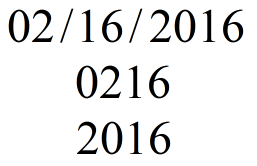
We can also consider today a Transposition Day, as we need only a single transposition (an exchange of two numbers) to turn the year into the day and date.
Celebrate Permutation Day by mixing things up! Try doing things in a different order today. Just remember, for some operations, order definitely matters!

