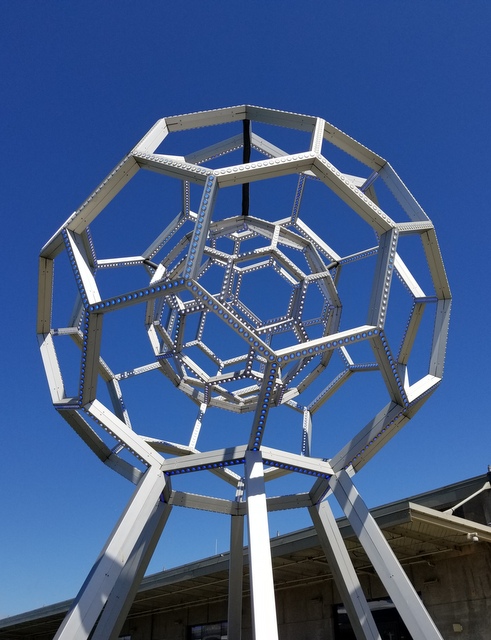
A beautiful sculpture and a beautiful blue sky in front of San Francisco’s Exploratorium. I wonder if the same artist was responsible for the temporary exhibit in Madison Square Park a few years ago?
Related Posts
A beautiful sculpture and a beautiful blue sky in front of San Francisco’s Exploratorium. I wonder if the same artist was responsible for the temporary exhibit in Madison Square Park a few years ago?
Related Posts
Next week I’ll be in San Francisco for the 2019 STEM Forum and Expo, hosted by the National Science Teachers Association. This annual conference brings together thousands of educators from around the world to talk about STEM education, share resources, and discuss outreach strategies.
As part of my work as an NCTM / NSTA National STEM Teacher Ambassador, I’ll be participating in an opening panel on STEM teaching on Thursday, and a Share-a-Thon of classroom resources on Friday. I’ll also be presenting “STEM Up Math Class with Computing”, which relates to my work integrating computer science into math class.
You can learn more about the STEM Forum here, and see the full program of events here.
Related Posts

My latest column for Quanta Magazine makes a connection between high school geometry and recommendation engines used by companies like Netflix.
Adrienne is a Marvel movie fanatic: Her favorite films all involve the Hulk, Thor or Black Panther. Brandon prefers animated features like Inside Out, The Incredibles and anything with Buzz Lightyear. I like both kinds, although I’m probably closer to Adrienne than Brandon. And I might skew a little toward Cora, who loves thrillers like Get Out and The Shining.
Whose movie preferences are closest to yours: Adrienne’s, Brandon’s or Cora’s? And how far are your cinematic tastes from those of the other two? It might seem strange to ask “how far” here. That’s a question about distance, after all. What does distance mean when it comes to which movies you like? How would we measure it?
Using the perpendicular bisector–an elementary and underappreciated idea from high school geometry–we can carve up abstract data spaces into regions that can be fruitfully compared and contrasted. And knowing which region you lie in, and whom you are closest to, can help make predictions about your preferences.
To learn more, read the full article, which is freely available here.
My students needed more computing experience. Our graduates were coming back to thank us for their rigorous mathematical training, but they told us their lack of programming experience put them at a disadvantage. I had the skills to teach them, I just didn’t have the resources: Classroom sets of laptops were scarce and expensive. But my students deserved this opportunity. What was I going to do?
I went to my principal, explained the situation, and next year he had a laptop cart for me.
This story of classroom need will never go viral. You won’t see it written up in the papers or profiled on the nightly news. After all, I didn’t run a Kickstarter that tugged at the nation’s heartstrings or convince some celebrity on Twitter to bankroll my classroom dream. My students needed something and luckily my well-managed school was in a position to provide it. It’s a pretty boring story.
But school funding should be boring. Schools should have money to buy the things that teachers and students need. Things like computers, books, paper (why are we always running out of paper?) and paint. Isn’t it totally obvious that elementary school kids should be painting? Shouldn’t it be a simple matter for schools to make sure those kids and teachers have paint?
But for some reason it isn’t that simple. In fact, it’s gotten so complicated that we now regularly see stories about teachers like Arizona’s Elisabeth Minsch, whose Facebook plea about her impoverished classroom caught the attention of Ben Adams, a sympathetic and generous New Yorker. Thanks to Mr. Adams, Ms. Minsch’s students now have the supplies they need. One of her students said she was thankful that now she gets to paint a lot.
These everyday heroes rightly deserve our admiration. Ms. Minsch went above and beyond for her students, as so many teachers do. And Mr. Adams not only continues to support Ms. Minch’s classroom, he has also created a program to help other teachers find the financial support they desperately need. This is a heartwarming story about two well-intentioned people going out of their way to do good.
But it’s also a story that should sadden us. Pity is not a healthy funding mechanism for education. It demeans both the profession of teaching and the experience of schooling. Teachers should not have to beg to make sure their kids have enough crayons. Students’ vulnerabilities should not be the set up for feel-good human interest stories. Taking pity on teachers and students is not heartwarming: These stories are really about how we are failing to provide for the education of our children. And we should be ashamed.
I’ve been a teacher for a long time, and a taxpayer even longer. I know the answer isn’t as simple as throwing more money at the situation. But throwing an appropriate amount of money at the situation would be a good start: For example, paying teachers professional wages and funding schools at the proper levels. And maybe if someone paid closer attention to those billion dollar iPad deals, hundred million dollar data systems, and charter school rent checks, we might save enough so that all the Ms. Minsches out there could get the paint their kindergartners need. And maybe my colleagues and I could stop stashing reams of paper around school like squirrels hiding nuts.
Let’s fund schools properly, pay teachers appropriately, and stop making pity a policy. Then let’s talk about that heartwarming story of the guy whose neighbors started a GoFundMe campaign to pay for his kidney transplant.

While in Berkeley, CA for MSRI’s Critical Issues in Mathematics Education conference, I happened upon this lovely piece of public art. Walking around the sphere I wondered about the maximum percentage of sky able to sneak through the numerous nested layers.