I’m surprised that there aren’t more hexagons around town. It really is a lovely shape.

I’m surprised that there aren’t more hexagons around town. It really is a lovely shape.
Recently I posted two photos of a runner taken 1.1 seconds apart and asked readers to speculate as to how fast he was running. Here is a second proposed solution.
As I did in my first solution, I pasted the two photos together and took measurements of various lengths in pixels.
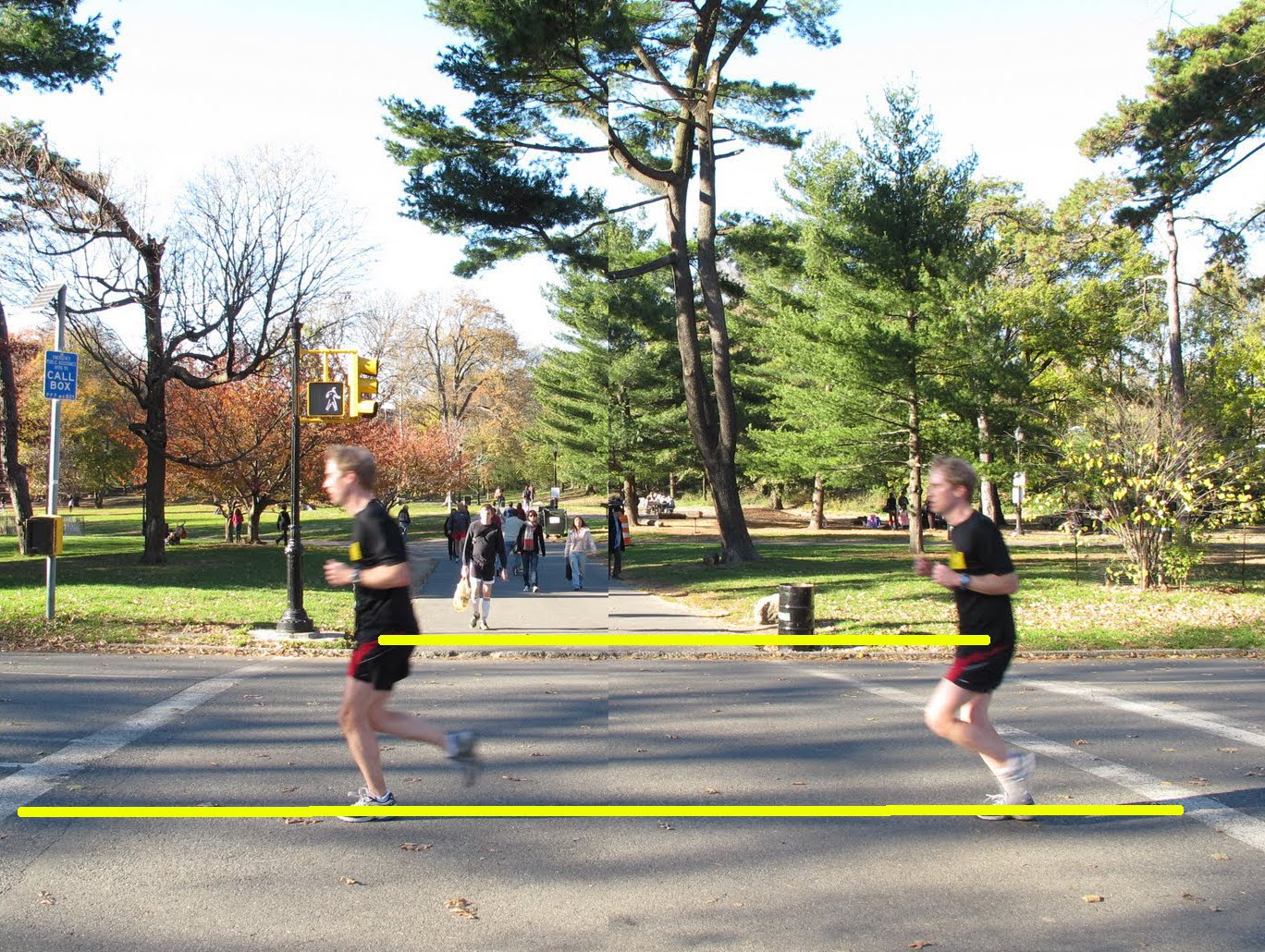
But this time, instead of estimating the runner’s height, I returned to the park and took a measurement of the distance between the white lines. This distance is about 18 feet 9 inches in the park, and about 1250 pixels in the photo.
Thus, the 650 pixel distance between the runner’s two positions translates into about 9.75 feet. If the runner is running 9.75 feet in 1.1 seconds, this scales to a speed of about 6.04 miles per hour.
The approximation of this runner’s mile is therefore around 9.93 minutes. Pretty close to my first estimate.
Related Posts
Through Math for America, I am part of an on-going collaboration with the New York Times Learning Network. My latest contribution, a Test Yourself quiz-question, can be found here:
http://learning.blogs.nytimes.com/2010/12/15/test-yourself-math-dec-15-2010/
This question is based on a Wikileak-ed cable regarding trade negotiations between China and Saudi Arabia. Hopefully posting this won’t get me on somebody’s watch-list, but to be safe I’m going to double-check my tax returns this year.
Recently I posted two photos of a runner taken 1.1 seconds apart and asked readers to speculate as to how fast he was running. Here is one proposed solution.
Using a photo utility, I merged to two photos into one. 
You can definitely see the seam between the two photos, but what’s important here is that the geometry of the two photos seems consistent. In other words, I claim that I haven’t altered any distances by pasting the two pictures together.
I then used the photo utility to measure in pixels the distance between two similar points on the runner and the runner’s height. The orange lines are here to illustrate the measurements.
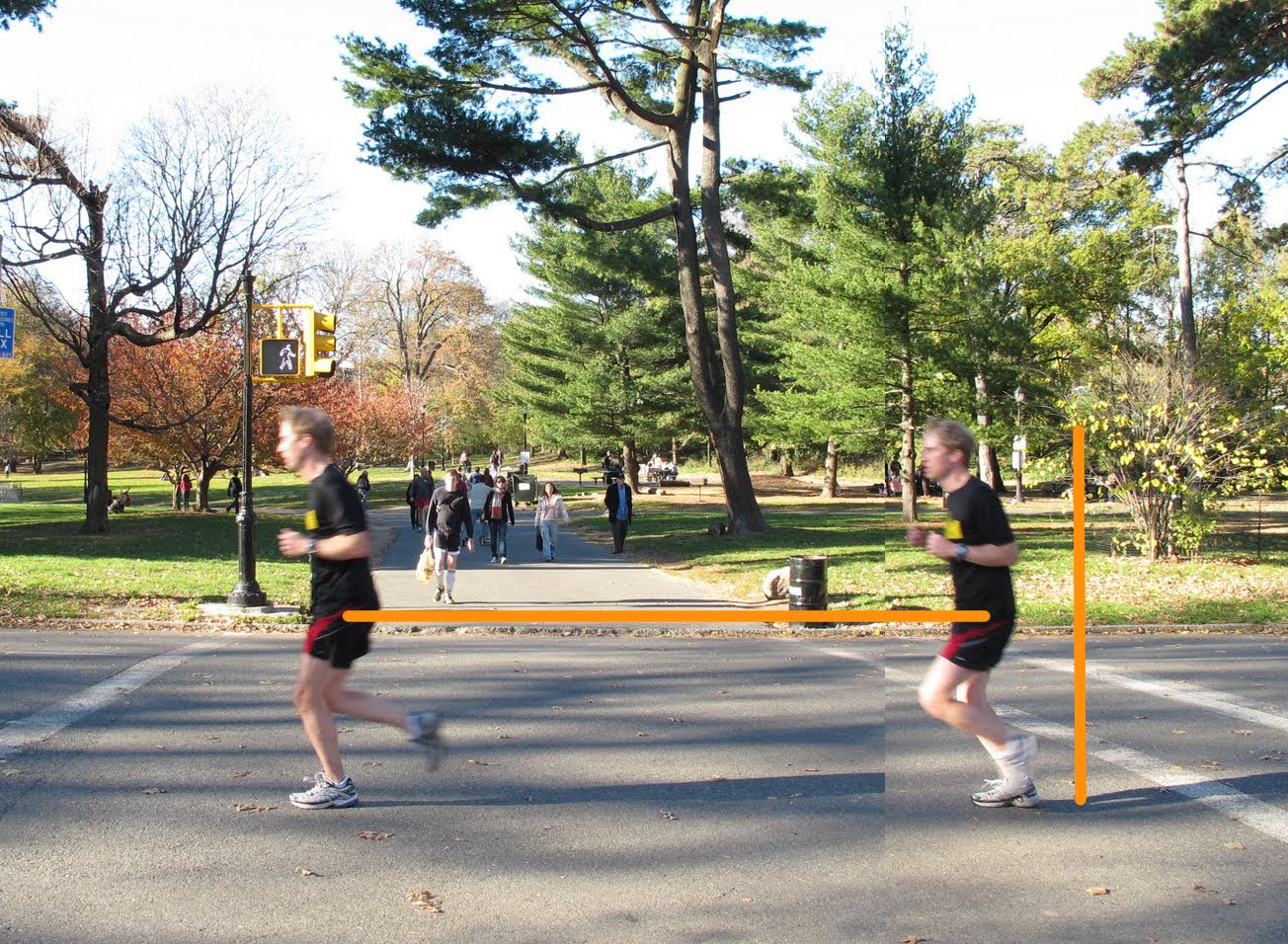
The distance from hip-to-hip is about 650 pixels. Since the photos were taken 1.1 seconds apart, this means that the runner’s pace is around 650 / 1.1 , or 590 pixels per second.
The runner’s height is 380 pixels. How tall do we think the runner is in real life? Well, he doesn’t look that tall, and he’s hunched over a bit in his runner’s stance. I’m estimating his height, the vertical orange bar, to be around 5.75 feet. This gives us the following scale factor: 380 pixels is about 5.75 feet.
We can now easily convert the rate from pixels per second into feet per second. Using the above scale factor, 590 pixels should be around 8.93 feet, so the runner’s speed is approximately 8.93 feet per second. Now that we have a meaningful rate to work with, we can easily complete the problem with some straightforward calculations.
So how long will it take to run a mile at this rate? By my calculation, about 9.86 minutes.
Related Posts
 This is a brilliant video introduction to the fine mathematical art of doodling.
http://www.youtube.com/watch?v=heKK95DAKms
This video–one of several from vi hart–is an engaging, witty, and serious look at the mathematics one can explore just by doodling and playing around with a few basic ideas. Sophisticated concepts in graph theory and knot theory spring up from some very simple, and very beautiful, sketches.
The creator of the videos is a bit hard on math teachers in her narration; apparently she’s had some bad ones. The snarkiness definintely adds character to the videos, but it’s a bit excessive at times.
I’m sure it isn’t easy making innovative, mind-opening videos like this, but it isn’t easy teaching a class full of doodling students, either!