Coins in the Piggy Bank

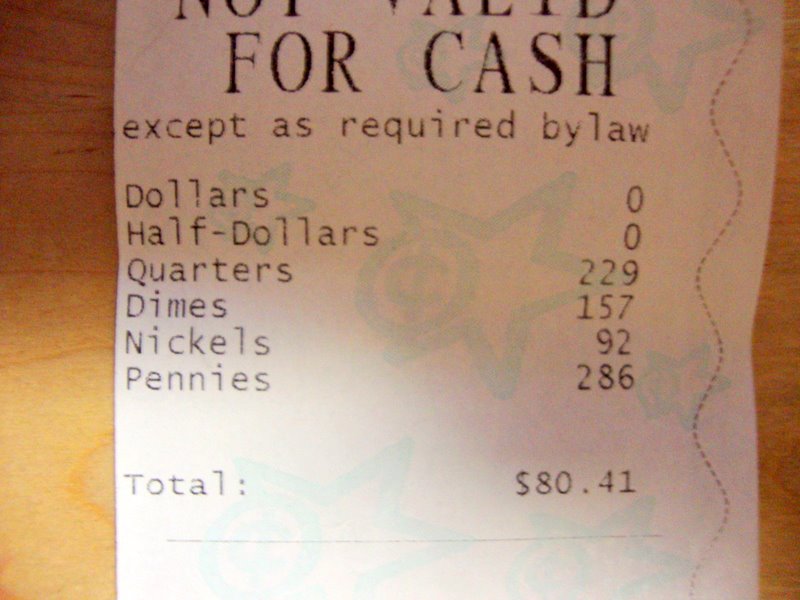
coins--receiptHere’s the answer to the Piggy Bank Challenge!

Coinstar was nice enough to provide all the data I needed after it consumed my coins.  As you can see, there was $80.41 in the Piggy Bank.  The coinage consisted of 286 pennies, 92 nickels, 157 dimes, and 229 quarters.

Let’s take a quick look at some interesting strategies involving using the weight of the Piggy Bank to make an educated guess as to the total value.  I’ve made some general remarks about reader guesses in a separate post.

As previously mentioned, the weight of the full Piggy Bank was about 2996 grams.   Using the weights of individual coins, we can set up this linear equation:

coin equation

where P, N, D, and Q are variables representing the number of pennies, nickels, dimes, and quarters, and each coefficient is the weight of that coin in grams.

This equation has several uses.  First, you can try to establish some bounds for the value of the Piggy Bank by considering extreme cases.  What if all the coins were quarters?  What if they were all pennies?  These cases would likely produce the maximum and minimum possible value of the Piggy Bank (is that obvious?).

Or, if you had some idea about how the coins were distributed, you could use this equation to estimate the total value of the Piggy Bank.  One place to start might be assuming that there are equal numbers of each kind of coin.  What other distributions might be used?

Related Posts


Math Quiz: NYT Learning Network

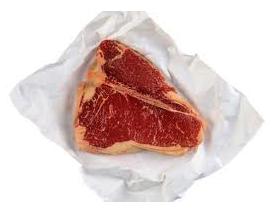
red meatThrough Math for America, I am part of an on-going collaboration with the New York Times Learning Network.  My latest contribution, a Test Yourself quiz-question, can be found here:

http://learning.blogs.nytimes.com/2011/01/24/test-yourself-math-jan-24-2011/

This problem is based on the recent Times Infographic America By The Numbers, which displaye a selection of U.S. Census-related data.  My question deals with how much red meat Americans consume per year.

Mathematical Knitting

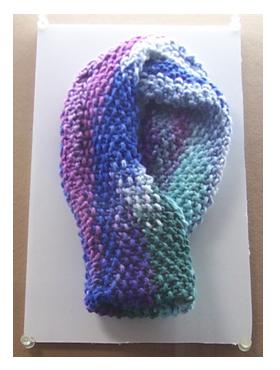
klein bottle hatOn the face of it, it’s hard to imagine two things as unrelated as mathematics and knitting.    And yet, here we have a website devoted to mathematical knitting:

http://www.toroidalsnark.net/mathknit.html

A Klein-bottle hat (seen at right)?  A Mobius scarf?  Ingenious stuff, and a testament to our unlimited creativity and resourcefulness, if not our practicality.

The Klein bottle hat actually reminds me of the Klein bottle one of my students made out of plaster.

Logicomix: A Mathematical Graphical Novel

logicomixThis is an innovative and intriguing idea:  a graphic novel based on the infamous struggles to articulate the foundations of mathematics.

http://www.logicomix.com/

The story is apparently narrated by the great mathematician and philosopher Bertrand Russell, and the cast of characters includes Georg Cantor, Kurt Godel, Ludwig Wittgenstein, and many other prominent figures from mathematics and logic.  A review in the New York Times can be found here.

The philosophy of mathematics is extremely interesting (start by asking yourself “What is a number?”), and this particular tale is truly a fascinating one.   I am eager to see how these graphic artists tell the story.

Guesstimation: Part II

I recently invited readers to try to guess the total value of the coins in this piggy bank.  I’ll share that data shortly, but I wondered how accurately someone could estimate the total value of the piggy bank if they knew the weight?

So, I weighed my pig.pig on scale

The full piggy bank weighed out to around 2996 grams.  I took some other weighings to find that a penny weighs approximately 2.7 g; a nickel is approximately 4.9 g; a dime is approximately 2.3 g; and a quarter is approximately 5.6 g.

Armed with this information, how much more accurate might the estimates be?

Related Posts

Follow

Get every new post delivered to your Inbox

Join other followers: