The $1,000,000 Question

Riemann Zeta GraphThis article offers a nice introduction to the Riemann Hypothesis, one of the mathematics problems eligible for the Millennium Prize.

Solve it, and you’ll earn yourself one million dollars!  If you do solve it, I’d be happy to look it over before you submit your proposal to the committee.  Just send it my way and I’ll get back to you shortly.

If finding zeroes of the Riemann Zeta function is asking too much, the author offers up a classic problem in elementary number theory at the end of the article–something anyone with a few minutes to spare and a calculator can dive into.  It’s a surprisingly serious result, with a surprisingly easy solution!

Proofiness

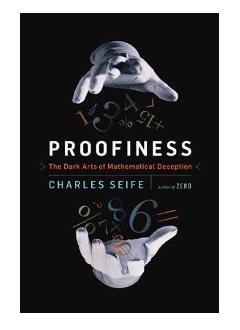
ProofinessThis is a short interview in the NYT with Charles Seife, the author of “Proofiness:  The Dark Art of Mathematical Deception”.

http://well.blogs.nytimes.com/2010/10/29/the-dark-art-of-statistical-deception/

Trading on Colbert’s clever coinage–Truthiness–Seife’s book apparently address the myriad ways that the misrepresentation and misinterpretation of statistics negatively affects medicine, economics, politics, justice, and other aspects of society.

It’s not clear that this book is covering any ground that hasn’t already been covered in, say, How to Lie With Statistics (an amusing classic!) or the engaging and readable work of John Allen Paulos, but hopefully the more the issue is raised, the more seriously it will be taken.  The consequences of innumeracy, and general scientific illiteracy, are profound and far-reaching, and they affect us all.

Math Lesson: Predicting the Vote

newspaperI am very excited to have my first Lesson Plan published by the New York Times Learning Network.  I wrote a mathematics lesson built around profiling the upcoming presidenital election, using data and analysis from Nate Silver’s 538 Blog at the Times.

The lesson is titled “Predicting the Vote: Analyzing Election Data”, and can be found here:

http://learning.blogs.nytimes.com/2010/10/18/predicting-the-vote-analyzing-election-data/

Trying to write a lesson plan for general use was much more challenging than I imagined, but it was an interesting and educational experience for me.  Hopefully it will produce some interesting educational experiences for others.

The First Word Calculator

word calculatorThis is a pretty awesome widget from the folks at Wolfram Alpha:  a word calculator!

http://blog.wolframalpha.com/2010/10/15/celebrating-dictionary-day-with-new-word-data/

It does the basic things you’d expect, like give you definitions, pronunciations, synonyms, and the like.  But it also gives you cool things like word frequency (“frequency” is the 3209th most common word) and hyphenations (me-di-e-val has 8 letters and 4 syllables)

And, when I typed my name in, I learned that 599,125 people are named Patrick, and our most common age is 46.

WolframAlpha’s mission is to make the world’s information computable–not just searchable.   I guess the lesson here is that everything is computable in some way.

What’s So Special About 733?

number spiralThis is a nice resource from Erich Friedman, a math professor at Stetson University:  it’s a list of distinctive characteristics of [most of] the numbers between 1 and 9999:

http://www2.stetson.edu/~efriedma/numbers.html

Now, maybe knowing that 215 is equivalent to 555 in base 6 isn’t that useful, but there are a lot of great ideas woven throughout this list of integers.  If you can fill in any of the gaps (do you know anything distinctive about 6821?), I’m sure Dr. Friedman would love to hear from you.

Follow

Get every new post delivered to your Inbox

Join other followers: