
I like the parallel paths traveling across the surface of this lampshade. I can’t recall ever seeing this irregular polyhedron before, with its equatorial belt of alternating isosceles triangles and trapezoids at the top and bottom.
I like the parallel paths traveling across the surface of this lampshade. I can’t recall ever seeing this irregular polyhedron before, with its equatorial belt of alternating isosceles triangles and trapezoids at the top and bottom.
My latest column for Quanta Magazine starts with a simple question: If you had a cover a hole that was at most 1 inch wide, what kind of patch would you need?

This problem is related to Lebesgue’s universal covering problem: The goal is to find the smallest such patch that could cover any hole of diameter one. After 100 years mathematicians still don’t have a full answer, but some techniques from high school geometry are getting us closer.
By starting with known covers, we can chop off pieces we can prove we don’t need, and make our covers smaller and smaller.

Read the full article for more, which is freely available in Quanta Magazine.
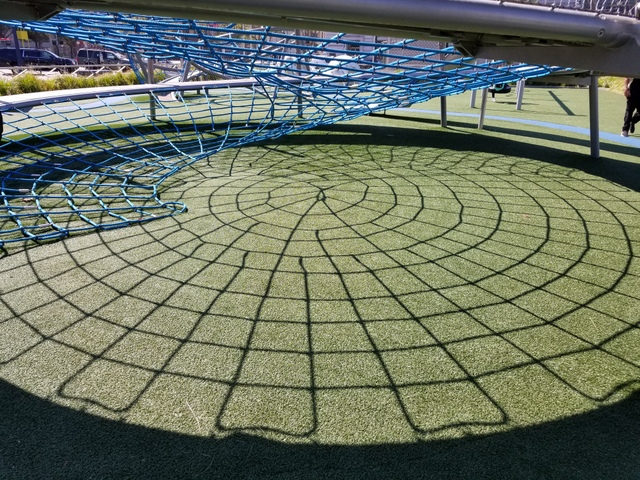
A playground structure in downtown San Francisco cast some really lovely shadows that I struggled to capture.
The structure itself is a helical ramp that reminds me of a parametric surface area problem from multivariable calculus class.

Related Posts
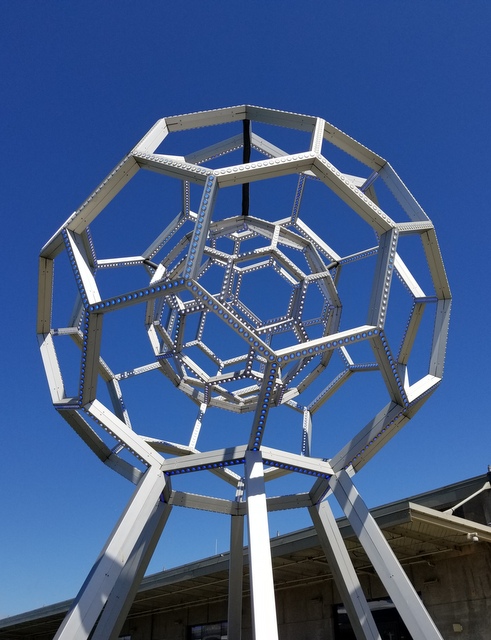
A beautiful sculpture and a beautiful blue sky in front of San Francisco’s Exploratorium. I wonder if the same artist was responsible for the temporary exhibit in Madison Square Park a few years ago?
Related Posts

My latest column for Quanta Magazine makes a connection between high school geometry and recommendation engines used by companies like Netflix.
Adrienne is a Marvel movie fanatic: Her favorite films all involve the Hulk, Thor or Black Panther. Brandon prefers animated features like Inside Out, The Incredibles and anything with Buzz Lightyear. I like both kinds, although I’m probably closer to Adrienne than Brandon. And I might skew a little toward Cora, who loves thrillers like Get Out and The Shining.
Whose movie preferences are closest to yours: Adrienne’s, Brandon’s or Cora’s? And how far are your cinematic tastes from those of the other two? It might seem strange to ask “how far” here. That’s a question about distance, after all. What does distance mean when it comes to which movies you like? How would we measure it?
Using the perpendicular bisector–an elementary and underappreciated idea from high school geometry–we can carve up abstract data spaces into regions that can be fruitfully compared and contrasted. And knowing which region you lie in, and whom you are closest to, can help make predictions about your preferences.
To learn more, read the full article, which is freely available here.