TIME 2000 Conference

TIME 2000I am excited to once again be participating in the TIME 2000 conference at Queens College.

This conference showcases the TIME 2000 program at Queen’s College, which supports undergraduate students in studying mathematics and math education.  I will be running a workshop on the geometry of folding and cutting.  James Tanton–mathematician, teacher, and creator of fantastic mathematical challenges–will be giving the keynote address.

The conference is Friday, November 22nd, and is open to high school students who are considering mathematics education as a possible career.

Math Quiz — NYT Learning Network

college applicationThrough Math for America, I am part of an ongoing collaboration with the New York Times Learning Network. My latest contribution, a Test Yourself quiz-question, can be found here

Test Yourself Math — November 13, 2013

This question deals with the Common App, an online system that processes millions of college applications every year.  What is the average number of applications processed per college?

Nathan Selikoff on Art, Chaos, and Computation

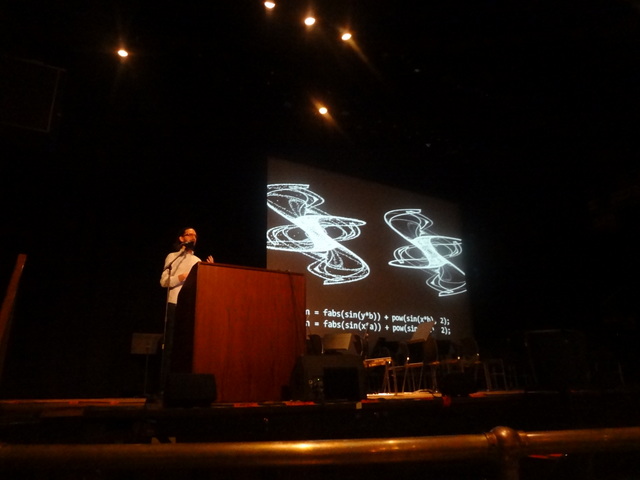
DSC06837-001We recently hosted artist and computer programmer Nathan Selikoff at our school, and he spoke to our students about art, mathematics, and technology.

Nathan Selikoff is an award-wining artist and an organizer of the Bridges Math and Art conference.  In his talk, “Art, Chaos, and Computation”, Nathan provided an engaging overview of the history of computation in art while talking about his personal experiences conceiving and creating mathematical art.

The talk left quite an impression on our students, many of whom were not aware that mathematicians and computer scientists could also be artists.   Students left the talk interested in experimenting with their own mathematical creations, and they were excited to play with the programs the artist generously provided.

A few student quotes nicely summarize the impact of the talk:

It made me want to learn more about the codes and the mathematical equations that make up the paradoxes of the chaotic art pieces.

This really makes me wonder about the extent of art that can be created. I’m curious to find out what I’ll be able to program.

The talk inspired me to create my own art with math equations. 

Thanks to the artist for such a great visit!  You can find out more about Nathan Selikoff here.  And be sure to check out the Bridges Math and Art conference.

Order These Things From Least to Greatest

A colleague and I had an interesting conversation about a quiz question of his.  He asked students to put the four following quantities in order from least to greatest:

log_{3}10     log_{2}3     log_{2}10     log_{4}5

I don’t think I’ve ever written a problem like this for a test or quiz myself, which may explain why thinking about how to assess potential answers perplexed me so.  How, exactly, would you grade this problem?

Suppose the correct order is A > B > C > D.   A first attempt to grade this problem might be “One point for every item in the correct absolute position”.  So

A > B > D > C

would earn two out of four points, as only A and B are in the correct absolute position, while

B > D > C > A

would earn one point, as only the C is in correct absolute position.

But there are some issues with this approach.  This response:

B > C > D > A

earns zero points, since no item is in the correct absolute position.  But in some sense this response is mostly correct:  three of the items (B, C, and D) are correctly ordered relative to each other.  Notice also that, in this scoring system, it is impossible to get 3 our of 4 points:  the only possible scores are 0, 1, 2, or 4.

My suggestion was to consider all \binom{4}{2} = 6 possible pairs of items and award one point for each of the relationships that the response implies is true.   For example the arrangement

B > C > D > A

implies the following correct relationships:  B > C,  B > D, and C > D.  The other three implied relationships are incorrect, thus this response would earn 3 out of 6 points.

The problem with this scoring system is that it is nearly impossible to get a zero!  The only response that earns zero points under this scheme is

D > C > B > A

but this answer is compelling in its own way.  The correct order is perfectly reversed, which strongly suggests the student knew something about the order of the items.

I like this problem, but I don’t think I”d put it on a test.  It’s too hard to assess!  But it was fun and mathematically interesting to think about, so maybe I’ll put the question “How would you grade this question?” on a test.

Follow

Get every new post delivered to your Inbox

Join other followers: