Exploring Compound Interest

Go to a <a href="http://bucks.blogs.nytimes.com/2013/01/07/investing-money-plus-lots-of-time-equals-excitement/">related post</a> about a topic one blogger calls “incredibly important to share with your kids.” »My latest piece for the New York Times Learning Network is a math lesson exploring personal savings and the power of compound interest.  The piece was inspired by a new program in Illinois that creates an automatic payroll-deduction savings program for all state residents.

In addition to exploring the basic ideas of savings and compounding, students are invited to analyze the merits of this state-run program.

The automatic retirement savings program mentioned in the article is described as a zero-fiscal-cost program because it does not require any government funding to run. This is because the savers themselves pay the costs, in the form of fees to financial institutions, amounting to 0.75 percent of their total savings each year.

Have students compute the costs associated with maintaining the account for each of the typical savers they profiled in the previous activity. One way to do this is to compute 0.75 percent of the total value of the savings account each year, before interest is computed. This is an estimate of the amount that would be paid in fees that year, and thus should be subtracted from the amount in savings.

The entire piece is freely available here.  Hopefully students will get a sense of the power and value of long-term savings, and maybe ask a few good questions about the the true price of zero-fiscal-cost programs.

Math Photo: Surprising Heptagon

Surprising Septagon

It took several hundred encounters with this park bench before I realized it was a heptagon!  I don’t see many regular, seven-sided figures in my experience, which made this a surprising discovery.  I wonder what prompted this design choice.

Septagon Angle

Like most real-world instances of perfect geometric objects, it doesn’t exactly measure up.  But what’s a few degrees between n-gons?


New York State Master Teacher Program

NYSMTPI’m happy to announce that I am now officially a member of the New York State Master Teacher Program.

The NYSMTP is designed to connect great math and science teachers from around New York State through networking, professional development, and professional service.  The program is inspired, in part, by the Math for America Master Teacher program in New York City, which I have been actively involved in for the past 9 years.

This past summer I was fortunate to attend a NYSMTP retreat in upstate New York, and I had a fantastic time.  I talked with teachers from all over the state, and learned a great deal about the many different, and similar, things going on across New York.  I also ran a workshop on using Twitter for professional development, which I think is a natural medium for connecting teachers in a program like this.

I’m looking forward to working more with great colleagues from across New York State!


When Technology Fails

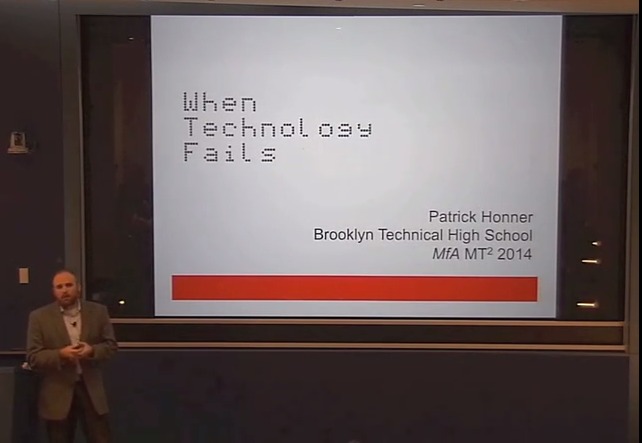
when technology failsAt Math for America’s most recent Master Teachers on Teaching event, I presented “When Technology Fails”, a short talk about how my personal and professional experiences have shaped the way I view and teach technology.

The failure of technology has been a consistent part of my personal and professional computing experience.  These failures have served as excellent learning opportunities, and perhaps more importantly, they have instilled in me a healthy distrust of technology.

As a teacher, I find students far too trusting of technology.  Often, they accept what their calculators or computers tell them unthinkingly.  In my talk, I discuss how we can make students conscious of the shortcomings of technology in ways that create meaningful learning opportunities.  And hopefully, by confronting the failures of technology head on, students will develop a healthier attitude about what technology can, and can’t, do.

A video of “When Technology Fails” can be viewed here.  And a talk I gave at a previous MT^2 event, “g = 4, and Other Lies the Test Told Me”, can be seen here.
Math Photo: Curvilinear Coordinates

Curvilinear Coordinates

Looking through this system of parallel curves makes me think about the many different ways we can impose coordinate systems on spaces.  An ordered pair of coordinates specifies a unique location on this curved surface just as a pair (x,y) locates a point in the flat Cartesian plane.

This image also reminds me of the role of context in geometry.  From our perspective, this coordinate system looks curved, but if we lived on this surface, it would all seem perfectly flat!  Maybe our world looks really curved to someone standing outside it.


Follow

Get every new post delivered to your Inbox

Join other followers: