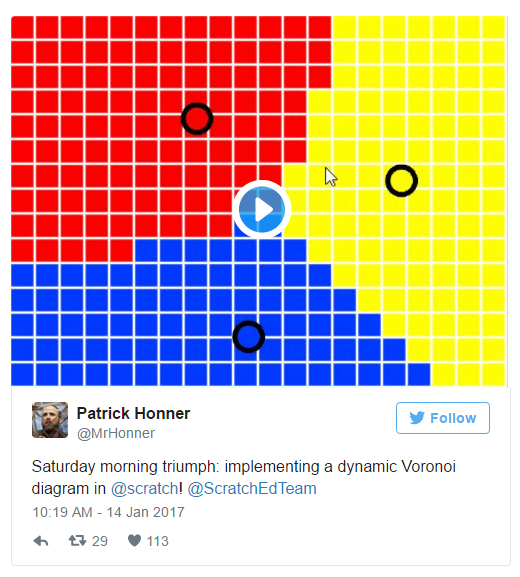
 Scratch Ed, an organization at the Harvard Graduate School of Education that supports teaching and learning with Scratch, recently profiled some of my work teaching mathematics using Scratch.
The article, Making Math with Scratch, highlights a Math for America workshop I ran for teachers that centered on approaching mathematical concepts through the lens of coding and computer science. Several projects I use in my classroom are featured, and I also discuss why I like teaching with Scratch and how it’s become a valuable part of my approach to teaching math.
The purpose of the workshop and Patrick’s classroom activities are to demonstrate the power of bringing mathematics and computer science together. “Ultimately the goal is to show how math and computer science are great partners in problem solving. And Scratch provides a terrific platform for that.”
I’m excited to share the work I’ve been doing with math and Scratch over the past few years–including talks and workshops at conferences like Scratch@MIT, SIAM ED, and the upcoming NCTM Annual meeting–and I really appreciate this nice profile from Scratch Ed.
You can read the full article, Making Math with Scratch, at the Scratch Ed website.