Regents Recap — January, 2018: Problems with Pre-Calculus

Since the advent of the “Common Core” Regents exams in New York state, there has been a noticeable increase in decidedly Pre-Calculus content on the tests. Questions involving rates of change, piecewise functions, and relative extrema now routinely appear on the Algebra I and Algebra II exams. Unfortunately, these questions also routinely demonstrate a disturbing lack of content knowledge on the part of the exam creators.

Here’s number 36 from the January, 2018 Common Core Algebra I Regents exam.

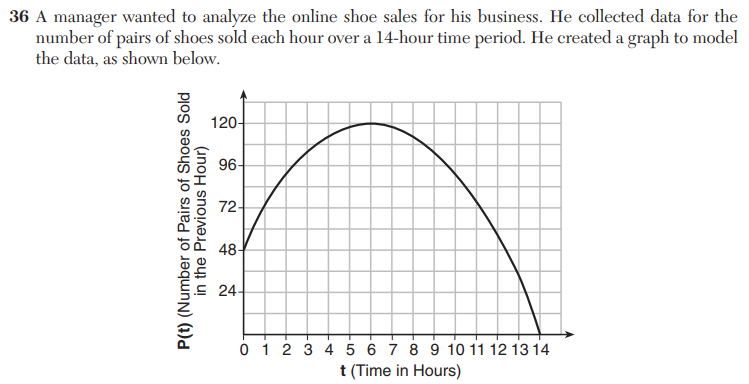
This graph represents “the number of pairs of shoes sold each hour over a 14-hour time period” by an online shoe vendor. A simple enough start. But things start to get tricky halfway down the page, when the following directive is issued.

State the entire interval for which the number of shoes sold is increasing.

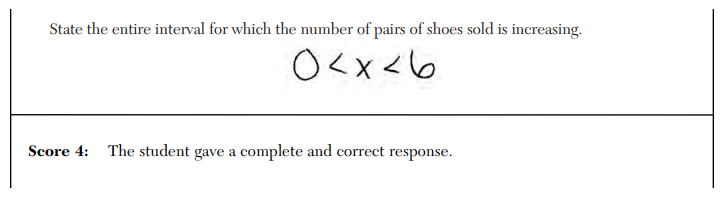
The answer must be 0 < t < 6, because that’s when the graph is increasing, right? The official rubric says so, and the Model Response Set backs it up (this Model Response has been edited to show only the portion currently under discussion).

But 0 < t < 6 is not the correct answer. Can you spot the wrinkle here? Basically, the number of shoes sold is always increasing.

The graph shown is a model of the number of shoes sold per hour. The model shows that, at any time between t = 0 and t = 14, a positive number of shoes are being sold per hour. In short, more shoes are always being sold. That means the number of shoes sold is always increasing. The correct answer is 0 < t < 14.

The exam creators have made a conceptual error familiar to any Calculus teacher: they are conflating a function and its rate of change.

In this problem, the directive pertains to the number of shoes sold. But the given graph shows the rate of change of the number of shoes sold. The given graph is indeed increasing for 0 < t < 6, but the question isn’t “When is the rate of change of shoes sold increasing?” The question is “When is the number of shoes sold increasing?” Since a function is increasing when its rate of change is positive, this means the number of shoes sold is increasing whenever the graph is positive. Thus, the answer is 0 < t < 14.

After the exam was given and graded, those in charge of the Regents exams became aware of the error. They quickly issued a correction, updated the rubric, and instructed schools to re-score the question (giving full credit for either 0 < < 6 or 0 < t < 14). Thankfully, it didn’t take a change.org campaign and national media attention for them to admit their error.

But as usual, they did their best to dodge responsibility.

In their official correction, the exam creators blamed the issue on imprecision in wording, pretending that this was just a misunderstanding, rather than an embarrassing mathematical error. This is something they’ve done over and over and over again. These aren’t typos, miscommunications, or inconsistencies in notation. These are serious, avoidable mathematical errors that call into question the validity of the very process by which these exams are constructed, graded, and, ultimately, used. We all deserve better.

Related Posts


My PAEMST Story

My heart sank a little as I watched the video.

It had been three months since I submitted my application for the Presidential Award for Excellence in Mathematics and Science Teaching (PAEMST). As I often do in the summer, I was reviewing materials from the school year, cleaning up and getting organized. I found my PAEMST application folder, noticed the video — the centerpiece of the application portfolio — and clicked play.

I remembered feeling pretty good about the lesson I chose to record. Re-watching it months later confirmed that it was a good lesson. But it wasn’t flashy. I didn’t perform a rap about even and odd functions. Students weren’t chasing each other around the classroom in a relay race. I didn’t dramatically slice a melon in half with a meat cleaver. My chance of earning the country’s highest honor for K-12 STEM teachers hinged on this video, but it was just me teaching a normal lesson. I resigned myself to the fact that my odds probably weren’t very good.

But as I continued to watch the video, my attitude slowly changed. No, it wasn’t flashy — my lessons never are — but it was a really good lesson. It was well-designed, well-executed, and well-received. Students were deeply engaged in complex mathematics. There was a clear arc that everyone could connect with. By the end of the video, my resignation had turned to pride: This is what happens every day in our classroom. This is who I am as a teacher. This was a normal day: exactly the right way to represent myself and my work.

I know what kind of teaching captures the public’s interest, and this wasn’t it. But I was proud of what was showcased in the video, even if it might not look like “great teaching” to an outside observer. Would PAEMST reviewers appreciate the well-chosen problems that bridged prior knowledge and new concepts? Would they notice the classroom culture in which students immediately began collaborating, seeking each other’s validation before mine? Would they see the subtle changes I made after assessing small group discussions? Would they appreciate how I strategically answered some questions and respectfully put others right back to the students? Would they notice how students listened to each other during whole-class discussion? How they comfortably responded to each other’s questions? How they made conjectures that would be resolved later in the lesson?

I guess they did.

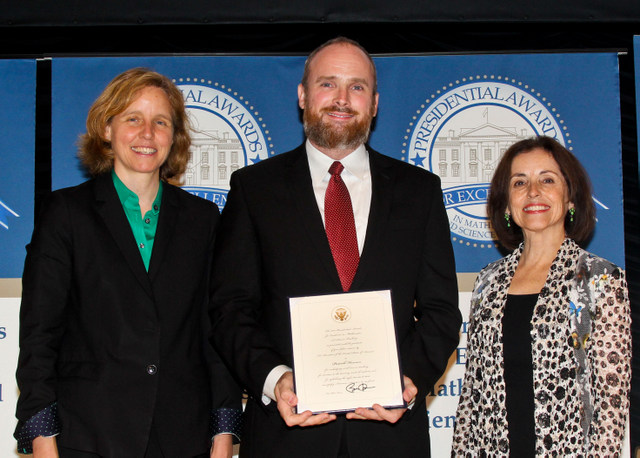
I received the Presidential Award in 2013. Here I am, between then-US CTO Megan Smith and Dr. France Cordova, Director of the National Science Foundation. It was a tremendous honor to win the PAEMST and to travel to Washington D.C. to meet leaders from the National Science Foundation, the National Academy of Sciences, and the White House. And meeting and connecting with other awardees — teachers doing great work in all manners of classrooms, schools, and communities across the country — continues to impact the work I do.

And it was encouraging to know that those responsible for awarding the PAEMST understood what they were looking at when they watched my video: nothing flashy, just good teaching. The kind that happens in my classroom, and countless others around the country, every day. Years later, I still occasionally look at my PAEMST application materials: the essays, the artifacts, even the video. It’s a nice snapshot of where I was at in 2013, and it’s fun and productive to think about the ways I’ve changed, and stayed the same, as a teacher.

Creating that snapshot is one of the many reasons I encourage teachers to apply for the PAEMST. The application process is a worthwhile professional experience in and of itself. It’s the kind of work good teachers want to do anyway: planning instruction; thinking about curriculum; analyzing outcomes; reflecting on process. Applying for the Presidential Award is a great motivator to do that work.

Teachers out there who feel ready should consider applying. And if you know a great teacher, you can nominate them for the Presidential Award. The process alone is worth it, and the potential reward is career-changing.

Related Posts

AMS Feature

My latest column for Quanta Magazine, on vaccinations and the mathematics of herd immunity, was the subject of a recent feature on the American Mathematical Society’s website. I also answer a few questions, including one about the challenges of communicating mathematics to those who may be reluctant to listen.

“I’d say the more we can get people to tap into their inner mathematicians and inner scientists, the better. As a teacher, I’m always trying to get students to engage actively with mathematical ideas, and not just simply consume mathematical results. In some ways, I think this applies to communication and outreach, too”

You can read the full piece here.

Related Posts


Regents Recap — January 2018: Promoting Bad Habits

As an AP Calculus teacher, I looked upon number 30 on the January, 2018 Algebra 2 exam with great trepidation.

Functions are frequently given as tables in AP Calculus. This alternate representation of function helps create a numerical bridge between their formal and graphical representations, and it can also establish connections with data and statistics. If nothing else, the ability to represent and understand mathematical objects in different ways is incredibly powerful.

But it’s crucially important to understand that tables, by design, represent only a small sample of a function. Unless we have other information, there’s very little we can say about what the function does outside the table values. In particular, we have no reason to believe that the largest value in the table is the largest value the functions takes, either globally or locally: the function could do practically anything in between the given values. This is a common misconception among calculus students, and it takes consistent effort to correct it.

Thus, I was worried to see a Regents question asking about extreme values for a function given as a table. As it turns out, there’s nothing mathematically wrong with this particular question: the given trigonometric function is bounded between -1 and 3, so the fact that q(x) takes a value of -8 means it must take the smaller minimum value. However, it would be a mistake to claim that the minimum value of q(x) is -8, as the function could potentially drop below -8 between any pair of given values on that interval.

So it’s disheartening to see student work that makes this exact claim labelled as “complete and correct”.

I think this is a fairly reasonable answer for an Algebra 2 student. And I don’t entirely blame them for not fully understanding the subtleties of the correct argument: that the minimum value of q(x) must be less than or equal to -8, which is less than the minimum value of h(x), and therefore q(x) must have the smaller minimum value.

But I do blame the test makers for not fully understanding the subtleties of the correct argument. And I blame them for writing yet another test question that promotes bad mathematical habits, by expecting and rewarding an incomplete answer, and setting students up for deeper misconceptions later on down the line.

Related Posts


My Favorite Theorem

It was an honor to appear on the latest episode of My Favorite Theorem, the podcast hosted by mathematicians Evelyn Lamb and Kevin Knudson.

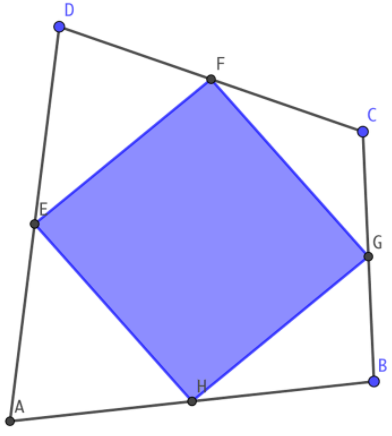
Evelyn and Kevin invite mathematicians to talk about their favorite theorem, and I chose Varignon’s theorem: I love sharing and exploring this theorem with students because it’s so each to start playing around with and it constantly defies expectations and intuitions!

To find out more, you can listen to the podcast at Evelyn’s Scientific American blog or download it from iTunes. You can also find a full transcript of our conversation at Kevin’s website.

I had such a blast talking about mathematics and teaching! Many thanks to Evelyn and Kevin for having me, and for putting on such an excellent podcast. I’ve been introduced to a lot of great people and math through My Favorite Theorem. I highly recommend it, and you can catch up on all the episodes here.

Related Posts

Follow

Get every new post delivered to your Inbox

Join other followers: