Remote Learning — Week 9

My emergency Remote Learning strategy has evolved primarily around teacher-student interaction. Given my limited experience and tool set, this has been my best leverage point. I’ve tried to establish a simple work-flow that lets me interact with students around mathematics, and that has formed an effective foundation for the course.

As the semester has unfolded I’ve tried to recapture some of what has been missing in this approach. One small thing we did recently was a peer review assignment that successfully recreated a little of the student-to-student interaction that’s been missing.

The activity centered on a typical assessment item, but rather than write my own I pulled an old Regents question. Longtime readers know I’m not a huge fan of Regents questions, but I wanted students to work on a specific kind of “applied” area / volume question that typically appears on the Geometry Regents exam. Also, by using an old test question, I could use the pre-existing rubric (as it were) and the published sample student responses as the basis for the peer review.

I assigned students to groups and distributed the scoring resources. After students submitted their own work they had to connect with their group and, using the scoring materials, perform their peer reviews. I captured everything in a Google form, where I could sort responses by reviewer or reviewee and look for consistency among the evaluations.

Usually the goal of peer review is to get students to engage with rubrics, but here it also served to get students interacting with each other. In my regular survey of students, one of the highest variance items had been:

I interacted with my classmates around mathematics this week.

Many students were naturally interacting with their peers, but many weren’t. This modest peer review activity succeeded in getting the entire class communicating with each other and interacting around their shared work.

And it was nice to find a standard classroom assignment that could be effectively repurposed to serve the goals of remote learning as well. As we look toward an uncertain future, we’ll need as many of those activities as we can find.

Related Posts

Remote Learning — Week 8

Last week the New York Times published the opinion piece “Why I’m Learning More With Distance Learning Than I Do in School“, by Veronique Mintz, an 8th grade student from New York City. As the title suggests, Ms. Mintz not only enjoys the current distance learning model, but actually prefers it to being in school.

It’s a terrific essay that offers teachers plenty to think about, even if it isn’t a flattering portrayal of their work. Important questions about classroom management, collaborative learning, and instructional design are raised. At it’s heart the piece touches on a very complicated question: Where does a teacher focus their effort?

It’s a thoughtful and well-written piece, and Ms. Mintz deserves praise for it. But I don’t believe that her experience is anywhere near typical. Which led me to submit the following letter to the editor.

It’s wonderful that Ms. Mintz is finding success during emergency remote learning. Many of my students are also doing well. I’d even say some are thriving. What they and Ms. Mintz are doing isn’t easy, and it’s inspiring. And not just to us teachers.

But many students are missing the structure of school and the collaboration of the classroom. They miss the school leaders who greet them at the door with a smile. They miss the teachers who can read slumped shoulders and slight hesitations and say just the right thing to get them back on track. I hope Ms. Mintz understands that despite great efforts, many students are not finding the same kind of success she is. More importantly, I hope the readers of the New York Times understand that, too.

I appreciate a good opinion piece, but certain kinds of opinions on education are far more likely to make the pages of the NYT than others. As I mentioned on Twitter, these Op Eds always leave me with questions, and not just about education.

Related Posts

To Win This Numbers Game, Learn to Avoid Making Math Patterns — Quanta Magazine

My latest column for Quanta Magazine starts with a simple game of numbers and ends with some unsolved problems in mathematics.

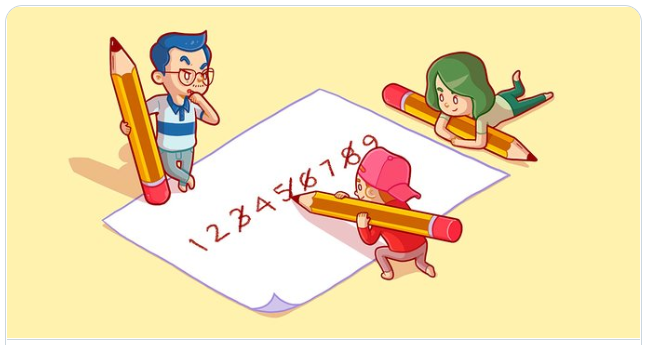
For example, let’s change the rules to make the loser the first person to complete three in a row of any step size. This means you lose if you make 2-3-4, as in the original game, but also if you make 1-3-5 (three in a row of step size 2) or 1-4-7 (step size 3). These patterns are “arithmetic progressions”: sequences of numbers with a common step size, called the common difference.
Let’s return to our first game board and use the new rules. It’s still your turn. And you’ve lost.

This simple game, where each player tries to avoid completing an arithmetic progression, leads to some complicated math, involving open questions about Salem-Spencer sets and a new result about polynomial sequences.

The full article is available here and includes several exercises to test your game play!

Remote Learning — Week 7

One thing I’ll miss from Remote Learning is rolling submissions of student work. As I discussed last week, students have 4-5 days to submit their assessments, and work that comes in before the deadline is evaluated and returned with feedback. Students can then choose to revise and resubmit their work before the deadline for full credit.

The approach has successfully created a consistent space to interact with students around their mathematical work. But it has also brought a welcome change in my grading workload. From the moment it’s assigned, student work trickles in slowly and steadily. This lets me evaluate a few at a time and quickly return them. Of course there are still plenty of students who wait until the deadline to turn in their work, but the incentive to submit early means there’s nothing like 100+ tests waiting for me all at once.

The ability to spread out my work has been invaluable during Remote Learning. The chaos of everyone working and schooling at home means uninterrupted blocks of time to focus are even rarer now. Knowing I can always turn an unexpected free 15 minutes into productive work helps keep all the balls rolling.

This process also has me approaching feedback differently, in a way that’s more like an ongoing conversation between teacher and student. I think we’ve both benefited, and it’s something I’ll continue to think about after Remote Learning has ended.

Related Posts

2020 AP Calculus BC Practice Exams

The 2020 AP Calculus BC exam will be very different in scope and structure than previous years, as a consequence of logistical issues brought on by the COVID-19 pandemic. The College Board has indicated the test items will be similar to those on past exams, but there aren’t many existing practice materials designed with the 2020 format in mind.

I’ve created two sample practice exams for my BC Calculus students and will share them here for teachers and students looking for additional resources. All are welcome to use them, but keep in mind that these are merely guesses about what the exam might be like in terms of scope and difficulty. I will say that I intentionally tried to make these more challenging than the College Board’s sample exam, which is just a re-combination of existing 2019 items. (I referred to this as Practice Exam #1, which is why you see #2 and #3 below.)

Please use as you see fit. And let me know if they are helpful!

Follow

Get every new post delivered to your Inbox

Join other followers: