Sharks, Geometry, and Optimization

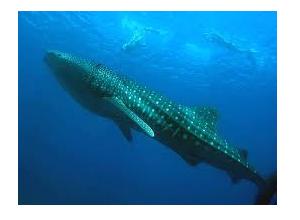
Whale SharkSome recent research sheds light on the interesting mathematics of how whale sharks move through the ocean.

Covering vast empty spaces between resources forces the shark to be natural optimizers when it comes to energy usage.  For example, due to its natural negative buoyancy, the shark tends to sink in the ocean, meaning that ascending through the water requires greater energy expenditure.

In order most efficiently move through the water, the shark naturally gravitates to two general kinds of ascents.  According to the article, the two techniques are a low-angle ascent that tends to minimize energy expenditure per unit of ascent, and a steep ascent that tends to maximizes the vertical change per unit energy.

It’s no surprise that nature is full of optimizers.  Making the most of your resources goes a long way to survival!

You can read the full article here.

Efficient Ticket Hypothesis

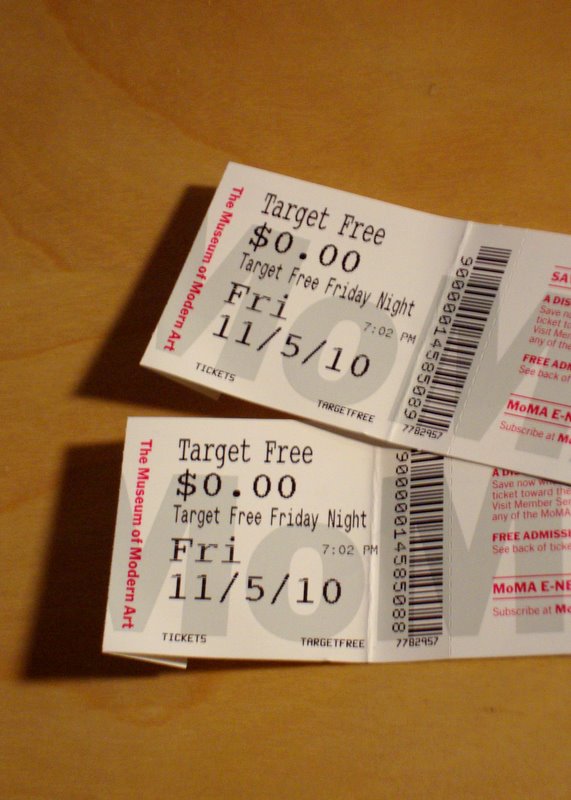
ticketsIn a past post, I wondered how a local museum theater could make money showing movies to limited audiences.  Well, here is a step in wrong direction, business-wise, anyway:  the $0.00 ticket.

All kidding aside, Free Fridays are a great way to get people into the museums, and it’s probably pretty good for business overall.  The MoMA was packed with people, and the gift shop–and it’s $40 photobooks and $23 T-shirts–was equally occupied.  An interesting question is then “How much does the museum make on each $0.00 ticket?”

An uninteresting question is “why didn’t the security guard just let me in without a ticket, instead of demanding that I go grab two from a big pile on the front desk and then not collect the tickets from me anyway?”

It was enough to make me consider asking for my money back.

Coffee, Cream, and Making a Wish

We have looked at several solutions to the classic Coffee and Cream mixture problem:

Suppose you have a cup of coffee and a cup of cream.  If you take a spoonful of cream, mix it up with the coffee, then take a spoonful of that mixture and add it back to the cream, is there more cream in the coffee, or more coffee in the cream? 

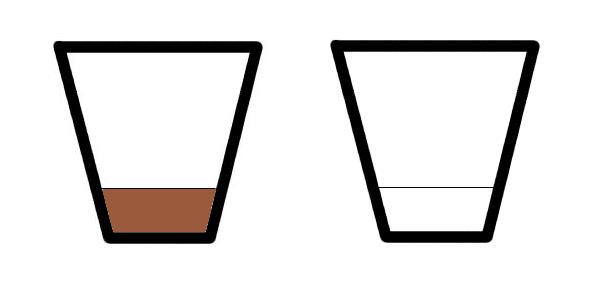
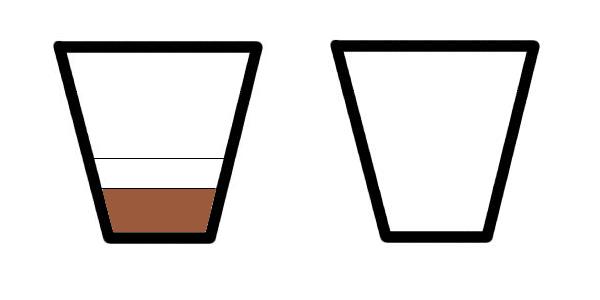
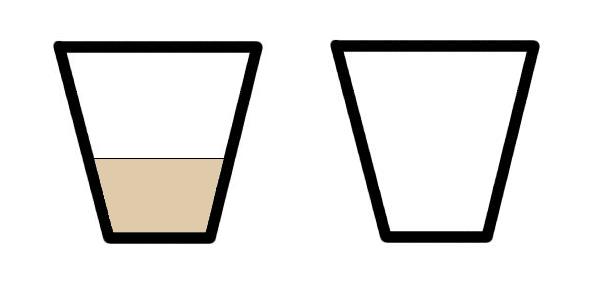
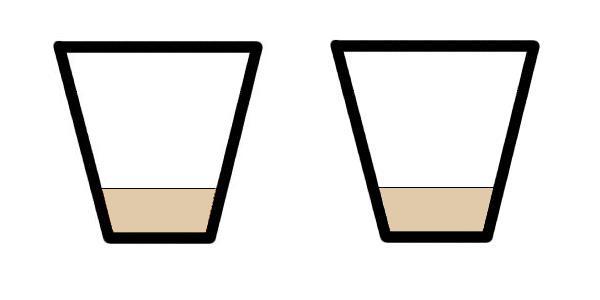
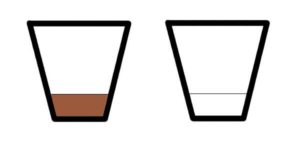
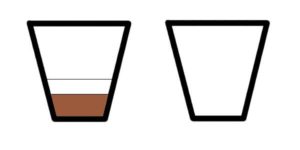
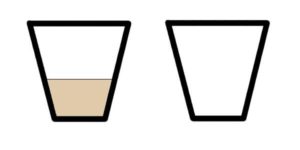
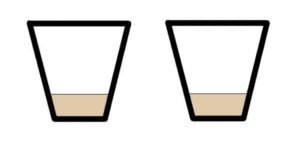
I offered a solution that begins by making a wish.  That is, I wished that each cup initially contained 10 spoonfuls of liquid; then I proceed to solve the problem algebraically, by following spoonfuls of liquid back and forth between cups.  To illustrate the real power of the make-a-wish strategy, though, let’s wish that each cup started with one spoonful of liquidcoffee and cream extreme case 1In this case, the act of transferring one spoonful of cream into the coffee amounts to pouring all the cream in the coffee. coffee and cream extreme case 2Now, mix it up.  The mixture on the left is obviously half coffee and half cream. coffee and cream extreme case 3Now, pour a spoonful of the mixture, or half, back into the empty cup.   coffee and cream extreme case 4The two cups now contain exactly the same solution:  half coffee, and half cream!  So the answer to the question is obviously that there are equal amounts of cream in the coffee and coffee in the cream!
Be sure to check out the elegant solution to the problem, as well!

Related Posts
 

Inforgraphic Competition

visualization magazineVisualisation Magazine, which seems to specialize in Data Representation and Information Graphics, is holding a homemade, handmade Infographic Contest.

The contest is apparently open to anyone, and the publishers are emphasizing handmade techniques.  The winner will make the cover of the next volume of their magazine.  I leafed through their volume on Circles (screenshot above) and there were some good looking infographics in there.

There is a flickr group set up for submissions, which you can check out here:  http://www.flickr.com/groups/vismaghandmadecontest.

Follow

Get every new post delivered to your Inbox

Join other followers: