Well, he looks angry to me.
Appreciation Technology
Digi-Comp II: A Mechanical Computer
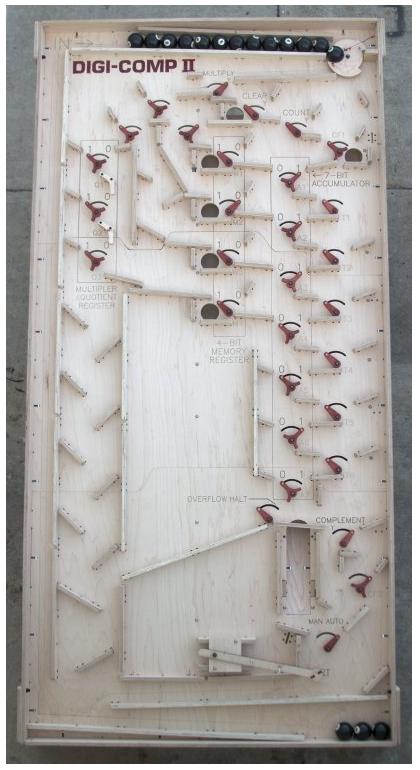
The folks at EvilMadScientist.com bring you a giant working replica of the Digi-Comp II, a 60s-era build-it-yourself computer kit:
http://www.evilmadscientist.com/article.php/dciivid
After the switches are initialized to choose the operation, the machine channels a stream of pool balls through various binary gates to effect addition, multiplication, and other basic mathematical and computational procedures. For more information, check out www.digi-compii.com.
As a pure math person, I never fully appreciated these mechanical computers. But after seeing things like the Digi-Comp, cam-based mathematics, and various mechanical calculators, I’m developing a genuine respect for them

Uncategorized
More Clever Accounting
I’ve become something of a coffee snob. A few years ago I never drank the stuff, but now I buy good coffee and enjoy it. To me, it’s worth paying a little extra per pound to get high quality coffee. I just didn’t realize how much I was paying per pound.
Operating under the assumption that the standard unit of coffee beans was one pound, I assumed that I had been paying around $11 per pound for my coffee. But recently I found myself buying coffee a little more frequently than usual. So the next time I bought a bag, I threw it on my scale.
And then I took a closer look.
The fine print says this is 12 ounces of coffee, a full 25% less than the 16 ounces I naively assumed I was buying!
Come to think of it, my coffee shop doesn’t advertise prices by the pound. If they did that, they’d have to admit that my bag of coffee was actually around $15 per pound, not the $11 that common experience might suggest.
I might not have noticed this, had I not recently had a similar realization about my orange juice.
Related Posts
Challenge NYT
Math Quiz: NYT Learning Network
Through Math for America, I am part of an on-going collaboration with the New York Times Learning Network. My latest contribution, a Test Yourself quiz-question, can be found here:
https://learning.blogs.nytimes.com/2011/06/27/test-yourself-math-june-27-2011/
This problem is based on a recent jobs report and the number of unemployed people in the United States.
Teaching
Teaching and Social Media: A Small Success
On one of those summer vacation days, full of promise and possibility, I innocently added an item to my To Do list: start a blog and post something mathematical every day. I saw it mostly as an intellectual exercise, one that might potentially be of use to some of my students, and I figured I’d just try it out and see where it led. A productive waste of time, I thought.
Somewhere along the way, I started seeing, and capturing, more and more Math Photos. Compelled to find math to think and write about, I started seeing more math around me. People liked the photos, and my camera became a regular companion. I began thinking more visually, more creatively. While visiting home, I caught some light slipping through the blinds and snapped a few photos like this:
A few days later, I received a message on Twitter from a digital colleague. Jim Wilder (@wilderlab), a math and science teacher in Alabama, had shown my photos to some of his fourth-grade students. Inspired, they went around looking for their own quadrilaterals in the shadows. He shared this photo with me.
I was truly moved by this small surprise. With barely an afterthought, I shot and posted that photo. A fellow teacher saw it, shared it, and it’s now become a mathematical experience for a student I’ve never met.
This is just one small example of how much my professional world has changed through this process. The impact of social media technologies on teachers and students seems virtually limitless, and it’s exciting to be a part of it in my own small way.
At the very least, it’s a productive waste of time.