Returning to work in person in 2021 meant returning to the subway, and I tried to make the most of the extra reading time.
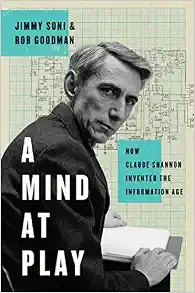
The most notable math book I read this year was A Mind at Play, Jimmy Soni and Rob Goodman’s biography of Claude Shannon. Shannon pioneered the development of Information Theory, which ultimately revolutionized multiple disciplines by allowing information of all kinds to be uniformly treated as a simple mathematical object. In many ways Shannon’s story is that of the eccentric genius, from boyhood tinkering in the Midwest to juggling on unicycles at MIT, but the book avoids caricatures and tells an engaging story about both a fascinating person and a groundbreaking scientific discovery. I’ve also been enjoying Information Theory: A Tutorial Approach in an attempt to better understand the mathematics of Shannon’s work.
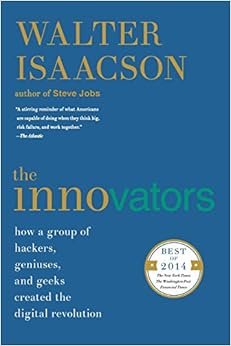
Walter Isaacson’s The Innovators, the history of the digital revolution, was a serendipitous companion read to the story of Claude Shannon. The Innovators starts with Ada Lovelace and mechanical looms and ends with hypertext and Wikipedia, telling the story of the many breakthroughs along the way — both technical and commercial — that made personal computing and the internet possible. Isaacson continually makes the point that innovation requires more than just a lone genius with a world-changing idea: Each individual innovation is usually just one step in a long chain of ever-evolving ideas. In addition, having good ideas is rarely, if ever, enough: Getting people to accept those innovations is itself a challenge. As the computing pioneer Howard Aiken famously said, “Don’t worry about people stealing your ideas. If your ideas are any good, you’ll have to ram them down people’s throats.”
Fortune’s Formula was another enjoyable read from this past year, with some similar characters and backdrops as Mind at Play and even The Innovators. And I finally got around to reading Nate Silver’s The Signal and the Noise. Silver has lost a lot of credibility since first being deemed a statistical wizard following his accurate predictions of the 2008 Presidential Election, but his book is a thorough and well-researched introduction to the challenges and successes of elementary statistical forecasting.
As always I read a lot of science fiction this year. I devoured The Murderbot Diaries by Martha Wells, a fun and fast-paced series of short novels about a corporate security cyborg who hacks its own governor module and struggles to adapt to its newfound freedom. I also read several novels in Iain Banks’s Culture series, though the books are so good I’m trying to pace myself. I know I’ll be re-reading The Player of Games again someday soon.
I read both of Ted Chiang’s books of stories this past year — Exhalation and Stories of Your Life and Others — which are full of not only fresh and rich ideas that seem so obvious in retrospect, but also the kind of writing that makes amateur writers think to themselves “Why do I even bother?”
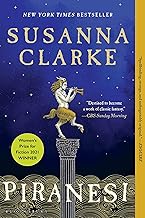
NPR posted a list of the top 50 sci-fi and fantasy books of the past decade, and I picked up many new books from that list this year. One was Sarah Gailey’s The Echo Wife, whose story of a scientist at the forefront of human cloning was much more personal, and more disturbing, than I anticipated. And thanks to a recommendation from Jordan Ellenberg, I read Susanna Clarke’s Piranesi, a beautiful, thought-provoking, surprising book that ended up in a few stockings this Christmas.
As always, many thanks to the Brooklyn Public Library for providing access to books all year! And thanks to all who recommended books throughout 2021. Please keep them coming in the new year.
Related Posts