Workshop — Learning to Love Row Reduction

I’m running a workshop for teachers tonight titled Learning to Love Row Reduction.

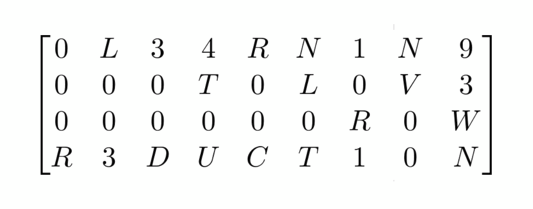
If a math teacher has done anything with matrices, they’ve probably row-reduced one. Row reduction is often experienced as mindless symbol manipulation, but in fact it is an incredible and surprising process that is deeply connected to the fundamental ideas of linear algebra. A little row reduction takes you a very long way! My goal in this workshop is to show teachers just how far it can take us.

This is part of an ongoing series of workshops I’m running on Linear Algebra, that have their origins in the tremendous amount I’m learning by teaching this course at the high school level. I’ll be offering the workshop through Math for America, where I’ve given talks and offered workshops on linear algebra, computing, and many other topics.

Related Posts

The Basic Algebra Behind Secret Codes and Space Communication — Quanta Magazine

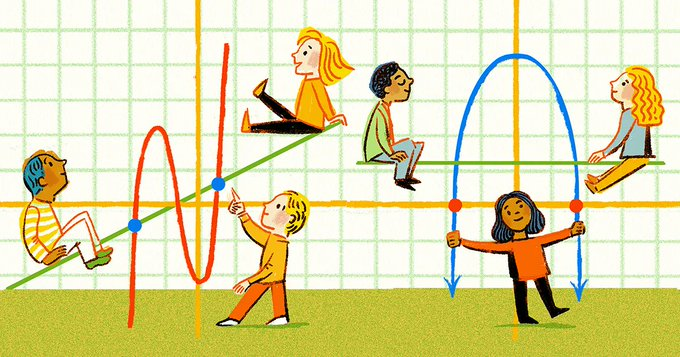
How can you use systems of linear equations to send secret messages? Just do what NASA does! In my latest column for Quanta Magazine I explore the school math behind Reed-Solomon codes, which are used to safely and securely send data across the solar system.

Space exploration requires tremendous precision. When you’re landing a rover on Mars 70 million miles away from the nearest service station, you need to maximize efficiency and prepare for the unexpected. This applies to everything from spacecraft design to data transmission: Those messages returning to Earth as a steady stream of 0s and 1s are bound to contain some errors, so you need to be able to identify and correct them without wasting precious time and energy.

That’s where math comes in. Mathematicians have invented ingenious ways to transmit and store information. One surprisingly effective method uses Reed-Solomon codes, which are built on the same basic algebra that students learn in school. Let’s drop in on a math class to see how Reed-Solomon codes help transmit and secure information while correcting any costly errors that pop up.

The full article is freely available is here.

2022 — Year in Review

In keeping up with (what is now a 10-year!) tradition, here’s a brief review of my professional year.

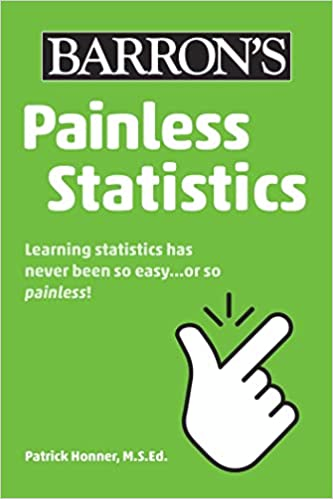
Without question my biggest professional accomplishment of 2022 was the publication of my book, Painless Statistics. People are buying it and even saying nice things about it! From start to finish it was an incredible learning process, and I now know what is meant by the saying “It is better to have written a book than to write one.”

I was happy to resume giving talks and workshop again in person in 2022. In the spring I returned to Queen’s College to speak to soon-to-be math teachers about making math by design. And after two years of remote-only teacher workshops, I was thrilled to return to the Math for America offices for The Geometry of Linear Algebra. It’s been exciting to learn so much linear algebra as I teach it, and I already have new workshops and talks scheduled for 2023.

On top of publishing Painless Statistics, it was another busy year of writing. As usual my column for Quanta Magazine provided a year full of the best kind of mathematical challenges, and I had a blast writing about brownie bake-offs and geometric dissections, different kinds of infinities, and Wordle, among other things. And I reviewed Ben Orlin’s book Math Games with Bad Drawings for the American Mathematical Monthly.

Above all, it was just nice to have a professional year that seemed to be trending toward normal.

Here’s to an even more normal 2023!

Related Posts

2022 in Tweets

Here’s a tweet-per-month review of my 2022. Enjoy!

January

February

March

April

May

June

July

August

September

October

November

December

Related Posts

Review — Math Games with Bad Drawings

It was a pleasure to review Ben Orlin’s wonderful book Math Games with Bad Drawings in the American Mathematical Monthly. The review is available online, with subscriber access, here, and will appear in the next print edition of the Monthly.

And in case you’re still shopping, Math Games would make a fabulous holiday gift for the math enthusiastic, math teacher, math student, or math parent in your life!

Follow

Get every new post delivered to your Inbox

Join other followers: