How to Optimize Traffic

Yesterday while stuck in traffic I noticed that the dynamically priced express lanes were nearly empty *and* the price to use them was quite high. This seemed odd, as I thought that if the lanes weren’t being used, the price would come down to encourage drivers to use them. It seems like a straightforward optimization problem.

The twist is that the express lanes are privatized, so the operators price the lanes to maximize profit, not, as I had assumed, to optimize traffic flow. This different objective lead to different behavior in the system.

This is a nice, simple example of how every applied math problem depends on many different assumptions, some of which might be hidden from view. It’s also a good example of how math can be used to better understand the different approaches to managing public resources.

Note: I originally posted this on Mastodon. Jeremy Kun posted some nice resources in response, including this paper surveying the research on the topic and a link to the Transportation Research Board’s Managed Lanes Committee.

Math That Lets You Think Locally but Act Globally — Quanta Magazine

My latest column for Quanta Magazine explores some recent results in graph theory that use local information to draw global conclusions, a powerful tool in math! It begins with a puzzle.

In math, as in life, small choices can have big consequences. This is especially true in graph theory, a field that studies networks of objects and the connections between them. Here’s a little puzzle to help you see why.

Given six dots, your goal is to connect them to each other with line segments so that there’s always a path between any pair of dots, with no path exceeding two line segments in length.

You can see the solution to the puzzle and learn how it connects to new results in graph theory by reading the full article here for free.

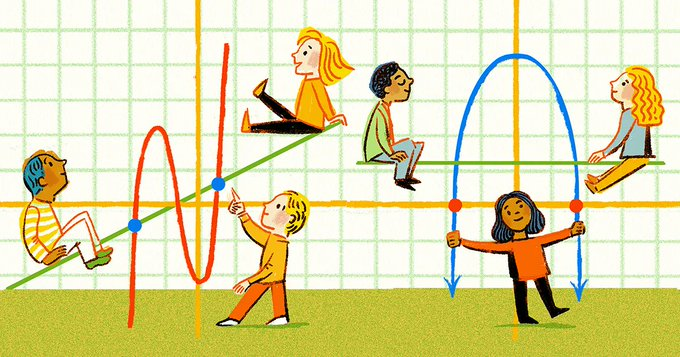
The Symmetry That Makes Solving Math Equations Easy — Quanta Magazine

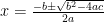
My latest column for Quanta Magazine is about one of the most dreaded mathematical objects in high school math: the quadratic formula!

x=\frac{-b \pm \sqrt{b^2-4ac}} {2a}

As complicated as the quadratic formula is, the cubic formula is much worse, but a simple geometric idea connects the two.

As intimidating as this looks, hiding inside is a simple secret that makes solving every quadratic equation easy: symmetry. Let’s look at how symmetry makes the quadratic formula work and how a lack of symmetry makes solving cubic equations much, much harder. So much harder, in fact, that a few mathematicians in the 1500s spent their lives embroiled in bitter public feuds competing to do for cubics what was so easily done for quadratics.

You can read the full article here.

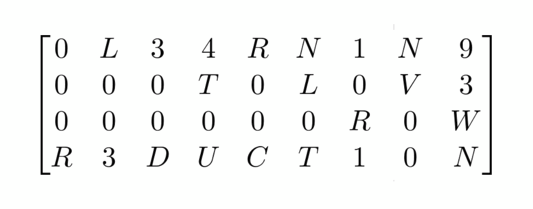
Workshop — Learning to Love Row Reduction

I’m running a workshop for teachers tonight titled Learning to Love Row Reduction.

If a math teacher has done anything with matrices, they’ve probably row-reduced one. Row reduction is often experienced as mindless symbol manipulation, but in fact it is an incredible and surprising process that is deeply connected to the fundamental ideas of linear algebra. A little row reduction takes you a very long way! My goal in this workshop is to show teachers just how far it can take us.

This is part of an ongoing series of workshops I’m running on Linear Algebra, that have their origins in the tremendous amount I’m learning by teaching this course at the high school level. I’ll be offering the workshop through Math for America, where I’ve given talks and offered workshops on linear algebra, computing, and many other topics.

Related Posts

The Basic Algebra Behind Secret Codes and Space Communication — Quanta Magazine

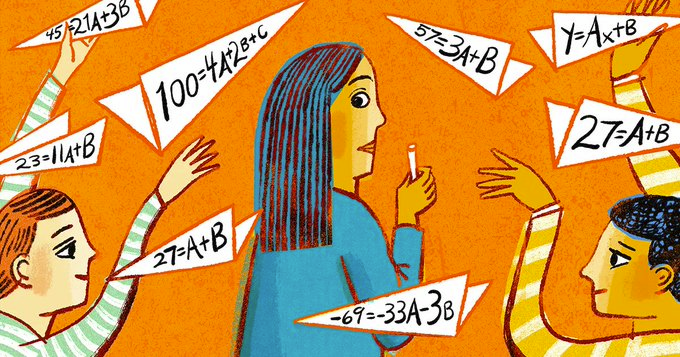
How can you use systems of linear equations to send secret messages? Just do what NASA does! In my latest column for Quanta Magazine I explore the school math behind Reed-Solomon codes, which are used to safely and securely send data across the solar system.

Space exploration requires tremendous precision. When you’re landing a rover on Mars 70 million miles away from the nearest service station, you need to maximize efficiency and prepare for the unexpected. This applies to everything from spacecraft design to data transmission: Those messages returning to Earth as a steady stream of 0s and 1s are bound to contain some errors, so you need to be able to identify and correct them without wasting precious time and energy.

That’s where math comes in. Mathematicians have invented ingenious ways to transmit and store information. One surprisingly effective method uses Reed-Solomon codes, which are built on the same basic algebra that students learn in school. Let’s drop in on a math class to see how Reed-Solomon codes help transmit and secure information while correcting any costly errors that pop up.

The full article is freely available is here.

Follow

Get every new post delivered to your Inbox

Join other followers: