As he often does, Grant Wiggins recently published a thought-provoking piece on mathematics and teaching. In it, he articulated his view of conceptual understanding in mathematics, and he offered his readers a set of questions designed to challenge their notions of conceptual understanding.
Here, I present my answers to Grant’s questions, which are in bold. I have edited and re-ordered his questions to suit my response. A link to his original post follows my answers.
13) “In geometry we assume many axioms.” What’s the difference between valid and goofy axioms – in other words, what gives us the right to assume the axioms we do in Euclidean geometry?
There is no such thing as a “valid” axiom. Axioms are pre-logical assumptions: they can never be proved, and so they cannot rightly be described as “valid” or “invalid”.
While some axioms may seem more self-evident than others, we need no “right” to assume an axiom. We can assume anything we want, we just have to be prepared to live with the consequences.
For example, we could assume “Anything divided by 0 is 12” if we wanted, but why would we want to?
1) “You can’t divide by zero.” Explain why not, (even though, of course, you can multiply by zero.)
You can! The answer is 12. See above.
12) “In geometry, we begin with undefined terms.” … So: define “undefined term”
An undefined term is an axiomatic object.
9) What is the difference between a convention and a law? Give another example of each.
“Law” is not a well-defined mathematical term. For example, the distributive law is really the distributive property. Some people think properties are things in and of themselves, while others think of them as axioms, or maybe conventions.
The laws of exponents, on the other hand, are theorems. They are logical consequences of definitions and axioms.
An example of a convention is decreeing the positive orientation of the plane to be counterclockwise. We don’t have any real reason not to choose clockwise as the positive orientation, but it helps if we all agree on which way is positive. Actually, this sounds a lot like an axiom.
4) Place these numbers in order of largest to smallest: .00156, 1/60, .0015, .001, .002
Done!
10) Why were imaginary numbers invented? [EXTRA CREDIT for 12th graders: Why was the calculus invented?]
Trick question! Imaginary numbers weren’t invented, they were discovered! My calculus class discovered them last week while trying to solve some differential equations. I’ll let you know about the EXTRA CREDIT question if my calculus students ever discover calculus.
5) “Multiplication is just repeated addition.” Explain why this statement is false, giving examples.
Consider 2 * 3. This is equivalent to adding 3 and 3. We are only adding once, so there is no repeated addition. QED.
8) Construct a mathematical equation that describes the mathematical relationship between feet and yards. HINT: all you need as parts of the equation are F, Y, =, and 3.

6) A catering company rents out tables for big parties. 8 people can sit around a table. A school is giving a party for parents, siblings, students and teachers. The guest list totals 243. How many tables should the school rent?
OMIT
7) Most teachers assign final grades by using the mathematical mean (the “average”) to determine them. Give at least 2 reasons why the mean may not be the best measure of achievement by explaining what the mean hides.
The mean doesn’t hide anything. It’s a multivariable, many-to-one function that, by design, maps an n-tuple of numbers to a single value. Accusing of it hiding its domain is unfair: it can’t help being non-invertible!
One reason the mean is not the best measure of achievement is that you can’t really take the average of achievements like, say “climbing to the top of Mount Ranier” and “successfully performing Maple Leaf Rag“. Another reason the mean is not the best measure of achievement is that it’s just a number.
11) What’s the difference between an “accurate” answer and “an appropriately precise” answer?
An accurate answer is one that’s close to the true answer, assuming a true answer exists. If there is no true answer, then pretty much every answer is sort of accurate (see: Statistics).
An answer is precise if the answer to the question “What is the estimated difference between my answer to the question and a reasonable answer to the question?” is accurate.
3) You are told to “invert and multiply” to solve division problems with fractions. But why does it work? Prove it.
Actually, you invert and multiply any time you divide anything! If works because division is the inverse operation of multiplication: this means that, to divide by something, you really just multiply by its [operation-and-identity-dependent] inverse. I can’t prove it, because it’s the definition of division. Or is it an axiom?
2) “Solving problems typically requires finding equivalent statements that simplify the problem” Explain – and in so doing, define the meaning of the = sign.
It’s hard to define the meaning of the = sign, because it means so many things to so many mathematical objects. It may be the most overloaded binary relation in existence.
Sometimes A = B means “these two numbers are the same”. Sometimes A = B means “these two sets are the same”. Sometimes A = B means “these two geometric objects are, in fact, the same object”, although in some ways that’s the same as saying “these two sets are the same”.
And not only can the = sign have different meanings for different objects, it can have different meanings for the same objects!
For example, saying f(x) = g(x) sometimes means “the functions f and g take the same value”. But sometimes it means “the functions f and g are identical”. These are two very different statements!
In short, the = sign generally denotes sameness, but you have to be very careful how you use it. One situation where the = sign should never be used is in a statement like
The Grant Wiggins Conceptual Understanding Challenge = Fun !
no matter how true it may be.
You can, and should, read Grant’s full post here.
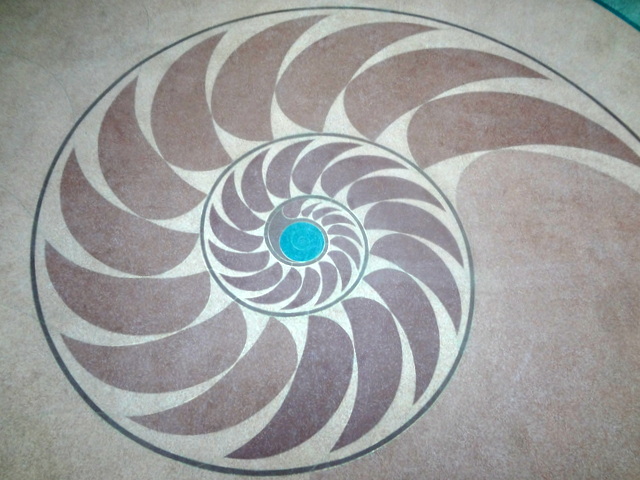
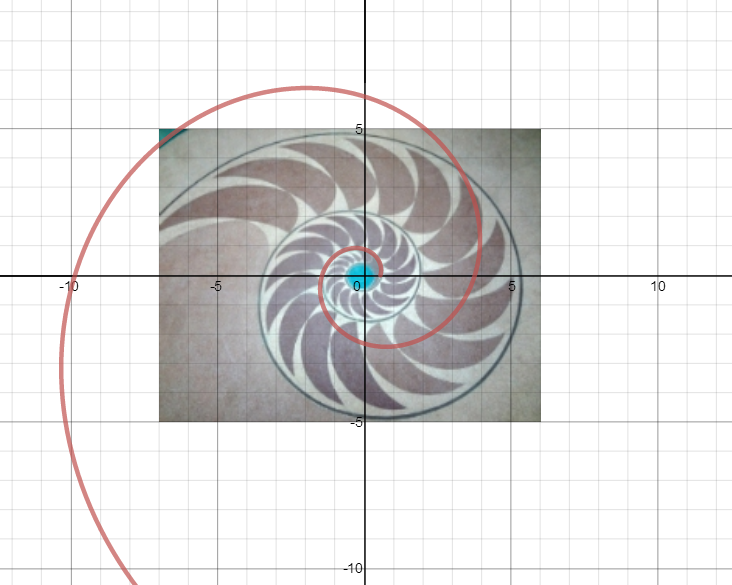

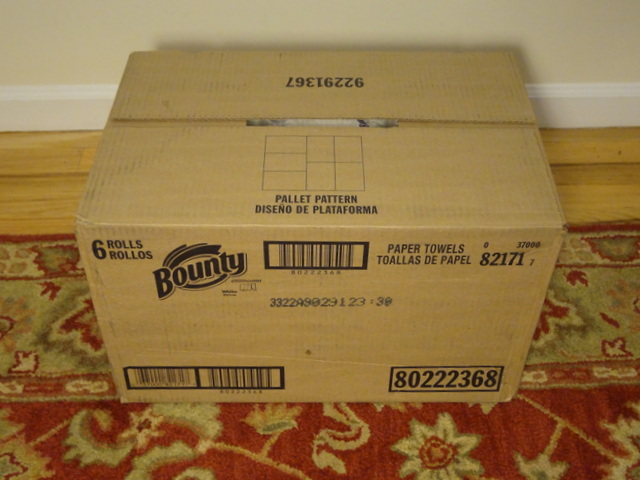
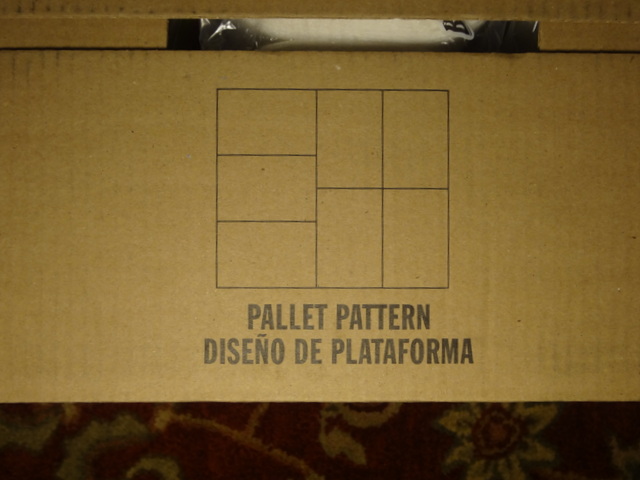
 immediately came to mind. I also noticed that the pallet could not be a square: if
  , then
  , which would make the box itself a square-based box, which it clearly is not.
 and
and  . This box has already been discarded, so I guess I’ll have to order another box to find out!