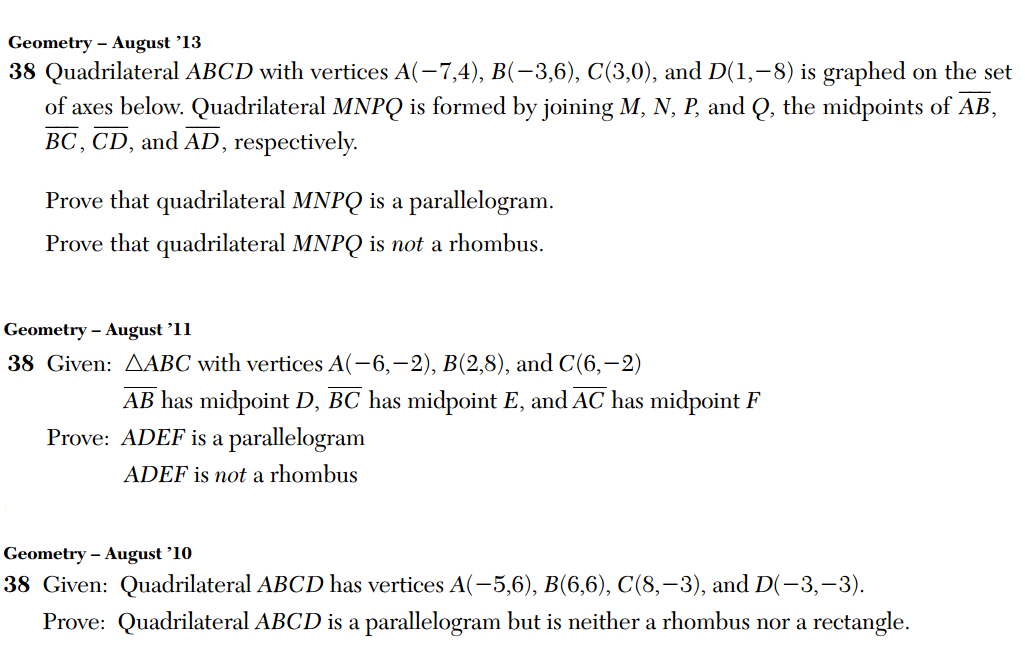
Here is another installment in my series reviewing the NY State Regents exams in mathematics.
June, 2014 saw the administration of the first official Common Core Regents exam in New York state, Algebra I (Common Core). Roughly speaking, this exam replaces the Integrated Algebra Regents exam, which is the first of the three high school level math Regents exams in New York.
The Algebra I (Common Core) exam was structured differently than the Integrated Algebra exam. Algebra I (Common Core) contained 24 multiple choice questions, while Integrated Algebra contained 30 multiple choice questions. This change, in and of itself, likely translates to lower average scores on the Algebra I (Common Core) exam: merely guessing on those 6 extra multiple choice questions would yield an extra 3 points on average, and multiple choice questions are generally easier to score points on than free response.
The free response sections are structured slightly differently, as well, but not substantially so. In fact, apart from some significant content differences, not much distinguishes the new Common Core exam from the old Integrated Algebra exam.
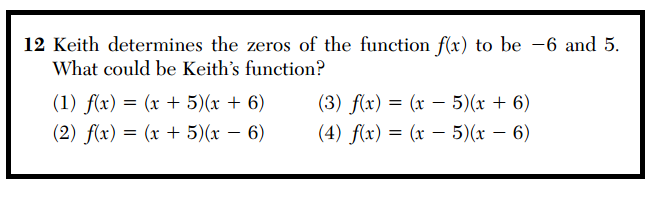
Many of the questions on the Algebra I (Common Core) exam are similar in style and content to questions on other math Regents exams. For example, here is number 1 from the Common Core exam compared with number 5 from the Integrated Algebra exam.
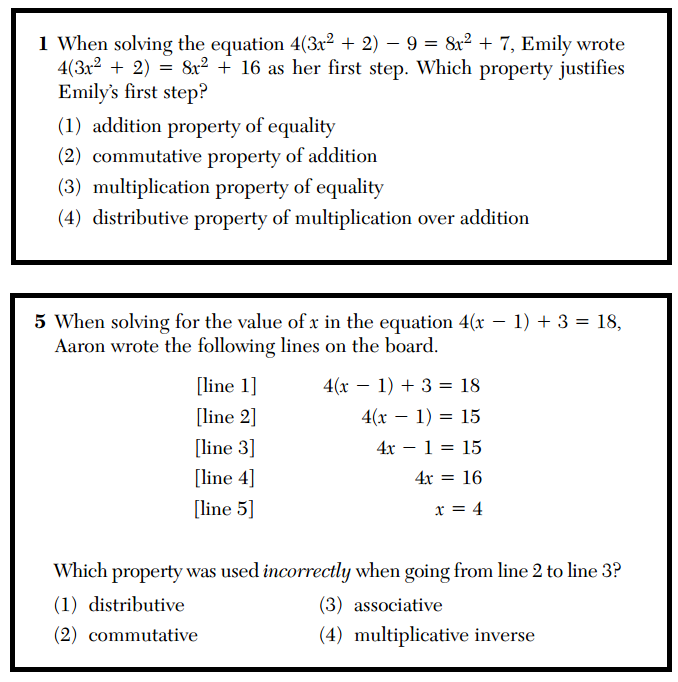
And here is number 3 from the Common Core exam compared with number 14 from the Integrated Algebra exam.
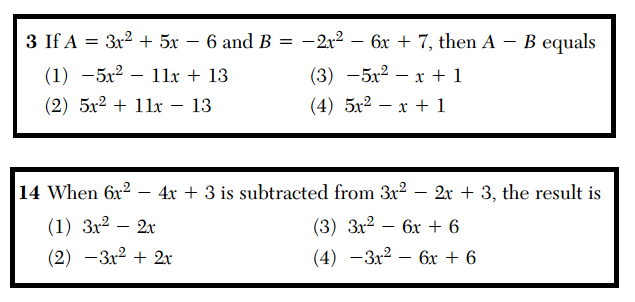
A few of the questions on the Algebra I (Common Core) exam do show improvement over similar items on other exams. Consider number 8 from the Common Core exam, compared with number 8 from the Integrated Algebra exam.

The two questions address the same issue, but the top is more mathematically precise. (I really dislike the “Which step could be used?”-type problems).
Overall, in terms of the way questions and posed and structured, there is not much of a difference between the new and old exams. The Algebra I (Common Core) exam is pretty much standard test fare. When the current testing culture is criticized, a common response is that we just need to make better tests. This is easy enough to say, but surprisingly hard to do. And it doesn’t look like this first Common Core Regents exam is substantially different, or better, than its predecessor.