8/17/15: Happy Right Triangle Day!

It’s 8/17/15, or as I like to think of it, Right Triangle Day!

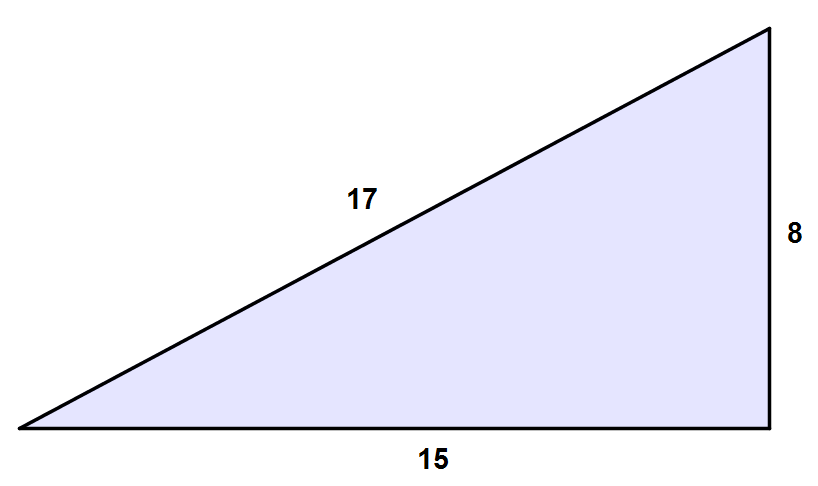
8-15-17 Triangle

Since

8^2 + 15^2 = 17^2

we know that 8, 15, and 17 are the lengths of the sides of a right triangle.  Informally, we say this is true because of the Pythagorean Theorem, but technically it’s true because of the converse of the Pythagorean Theorem.

It’s been a while since we’ve celebrated a Right Triangle day, and it won’t be long before we get to celebrate another.  To commemorate this numerical novelty, the Museum of Mathematics is teaming up with the Pacific Science Center to pythagorize Seattle’s Triangle Pub.  They certainly had fun pythagorizing the Flatiron building in NYC on 5/12/13!

Enjoy being right today!

Regents Recap — June 2015: Pointless Questions

Here is another installment in my series reviewing the NY State Regents exams in mathematics.

I really do not understand the point of questions like this, from the June 2015 Geometry Regents exam.

2015 GEO 12Why do we manufacture artificial multiple choice questions to assess whether or not students understands geometric constructions?  Why not just ask them to construct something?

Moreover, the construction aspect of this question is essentially irrelevant:  the question might as well be, “Which diagram shows an altitude?”.

The Regents exam writers have been using this approach in testing geometric constructions for some time.  It just seems pointless to me.  And it is often the case that the exam also includes a free-response question that asks the student to actually construct something with a compass, which makes this multiple choice question both pointless and redundant.

Much is made about the importance of testing when it comes to student learning and teacher accountability.  But such arguments seem less reasonable the more closely we look at what we test and how we test it.

Regents Recap — June 2015: Common Core Geometry Structure

Here is another installment in my series reviewing the NY State Regents exams in mathematics.

June, 2015 saw the administration of the first Common Core Geometry Regents exam in New York.  This exam will replace the Geometry Regents exam, which was also offered this testing cycle.

The CC Geometry exam has fewer multiple choice questions (24) than the Geometry exam (28).  It is worth noting that this change, in and of itself, likely will reduce average scores, as random guessing on those four extra questions would, on average, earn 2 points.  The free response sections are structured slightly differently, but not substantially so.  These differences mirror those between the new Common Core Algebra exam, introduced last year, and the old Integrated Algebra exam (see here).

The two Geometry exams are not drastically different, though there is greater emphasis on transformations on the CC Geometry exam, which I covered here.   However, there are some minor differences that have impact.

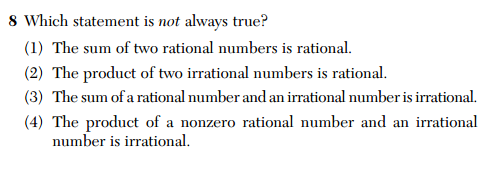
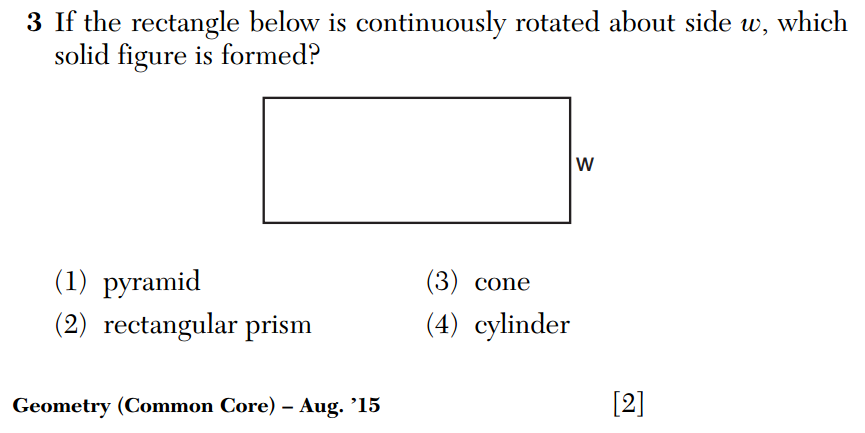
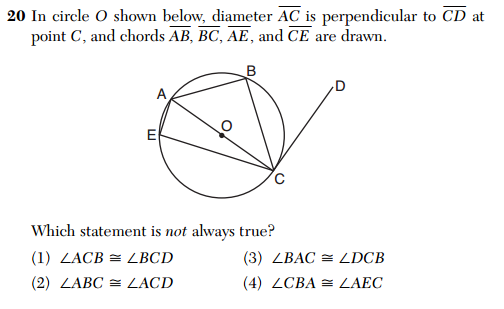
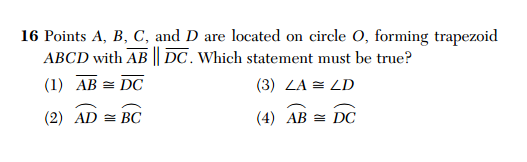
First, the multiple choice questions on the CC Geometry exam definitely seem a bit harder, on average, than those on the old Geometry exam.  One place this is apparent is the higher frequency of questions that ask the student to identify the false statement, rather than the true statement.  Here are two questions similar in content, one from each exam:  Question 20 from the CC exam (top) and Question 16 (bottom) from the non-CC exam.

2015 CC GEO 20

2015 GEO 16Generally speaking, I’d say it’s more challenging to identify a statement that is not always true than one which must be true.  There are three such problems on the CC exam, compared with one on the old exam.

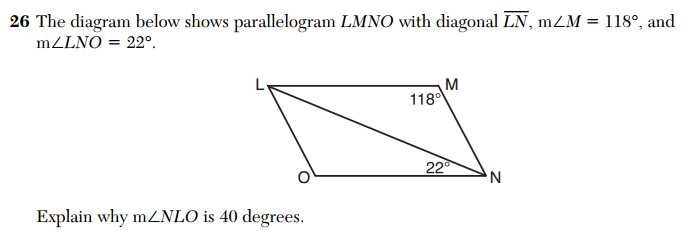
Question 26 on the CC exam exemplifies the increased emphasis on explaining one’s work.

2015 CC GEO 26

A more traditional question might simply ask for the measure of angle NLO.  Here, the measure of the angle is given, and the student is asked to provide the mathematical justification for that value.

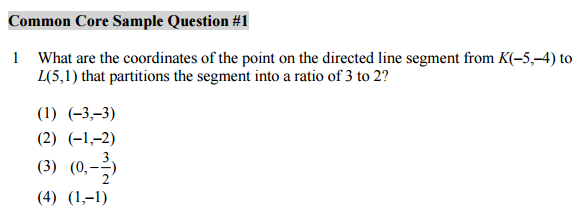
Lastly, our teacher team was somewhat surprised at how closely the exam tracked the sample items that were released by the state.  For example, the segment partitioning problem on the CC Geometry exam

2015 CC GEO 27

was very similar to a sample item

CC Sample Segment partitionAdditionally, the construction problem on the CC Geometry exam

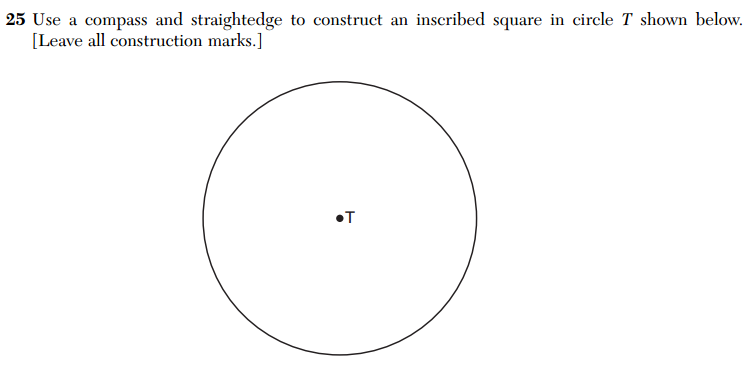
2015 CC GEO 25was identical to problem 12 in the Fall sample items.

Our Geometry teacher team generally found this inaugural CC Geometry exam to be in line with our expectations in terms of content and difficulty.  If anything, we were surprised at how unsurprising it was to us.

More the anything related to the Common Core exam, the level of difficulty of the old Geometry exam given during the same cycle surprised us.  The multiple choice section seemed to be more challenging than those of past recent exams, which made us wonder if the two exams drew their multiple choice questions from a single pool.

MOVES 2015

MOVES 2015I’m excited to once again be participating in the MOVES conference at the Museum of Mathematics!

MOVES, the Mathematics of Various Entertaining Subjects, is a biennial event run by MoMath that celebrates recreational mathematics.  This year, the conference will be headlined by John Conway, Elwyn Berlekamp, and Richard Guy, co-authors of Winning Ways for Your Mathematical Plays, a classic book on mathematical games.

I’ll be running a session on the Activity Track called Games on Graphs”, where we will explore some elementary graph theory through a few simple graph-based games.   Most importantly, we’ll talk about how to create new games that can further our mathematical investigations!

You can learn more about the conference here, and see the full program here.

Follow

Get every new post delivered to your Inbox

Join other followers: