Here is another installment in my series reviewing the NY State Regents exams in mathematics.
The August 2015 administration of the Common Core Algebra exam was similar in style, content, and difficulty to the prior Common Core Algebra exams. There are a few interesting trends emerging.
Harder Multiple Choice
As part of the general increase in difficulty of these exams, we are seeing harder types of multiple choice questions. Here are questions 9 and 21:
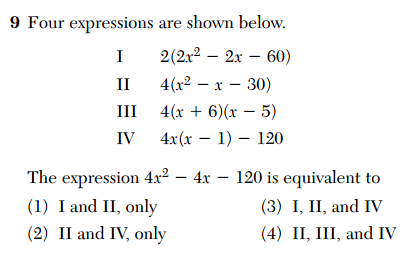
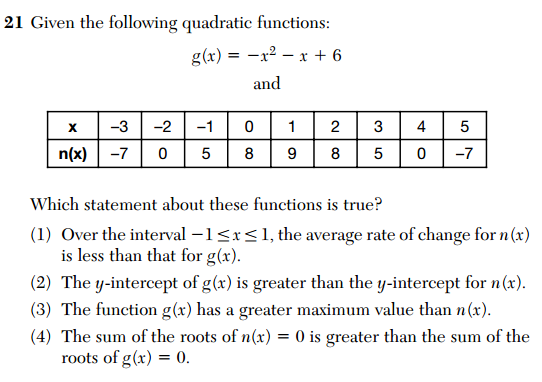
The simplest kind of multiple choice question in this style might just ask “Which of the following statements is true?” It is generally more difficult to instead identify a false statement among a set, or to correctly identify the true or false subset of statements from a set. I don’t object to these kinds of questions, but it’s worth acknowledging that this is one subtle way in which the difficultly of the exam can be tweaked.
Confusing Contexts
On each of the Common Core Algebra exams thus far, there have been real-world problems that I found very confusing. In some cases, the more I read them, the less I understood what the question was asking. Here is Question 18:
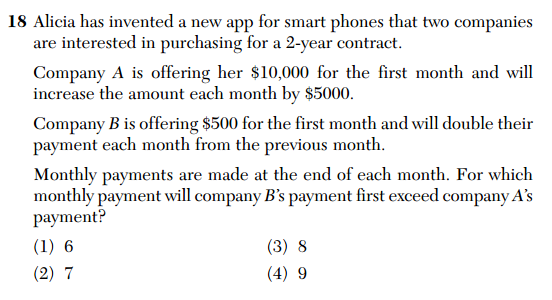
Apart from the decidedly unrealistic real-world context, I was quite confused about whether we were interested in monthly payments or total payments. I wonder if these kinds of problems confuse students, or if they have just [properly] learned to ignore the model and just figure out what the test-maker wants to hear.
Physics
We have seen some Calculus-style content moved down into this Common Core Algebra exam. Here, in Question 28, students are essentially asked to graph an antiderivative.
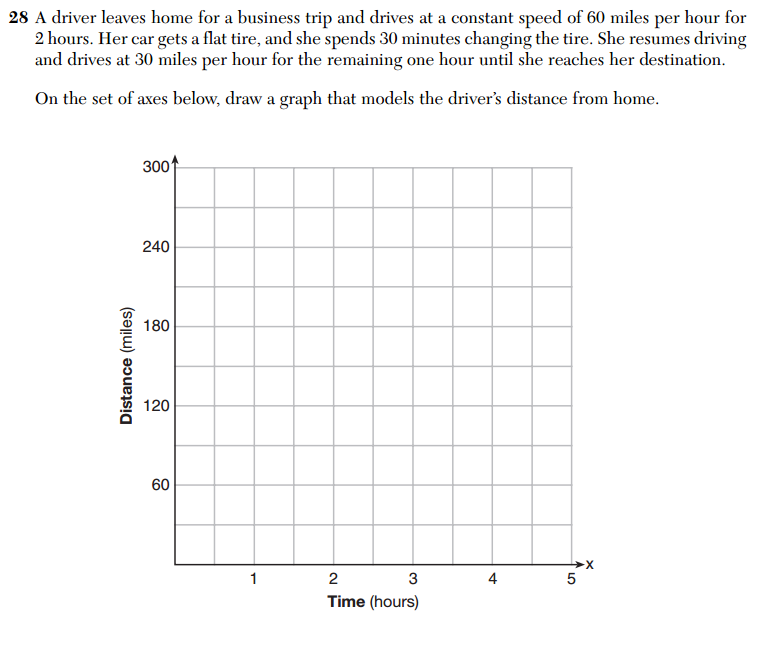 I don’t have any philosophical objections to this particular content being part of an 8th- or 9th-grader’s mathematical experience, provided it’s part of a coherent curriculum. But I do wonder about the inherent fairness of this as an 8th- or 9th-grade math exam question.
This question assesses an important concept in introductory physics. Students in schools where Physics is taught in 9th grade will have a significant advantage on this kind of problem, while other students are in danger of being rated lower on mathematical proficiency simply because they haven’t taken physics.
This is another example of the virtually infinite set of confounding variables involved in assessing learning and teaching.