 Though I would not consider myself a Pi Day enthusiast, Pi Day has become a sort of Mathematical Awareness day, and so I’ve tried to find meaningful ways to observe it with my students.
One aspect of Pi that I try to get students to appreciate is its invariance. It’s not just that Pi is the ratio of circumference to diameter in a circle; it’s that Pi is the ratio of circumference to diameter in every circle. It’s an invariant of circles. And one way I try to get students to appreciate and respect that invariance is by computing “Pi” for other figures.
For example, consider the square. The circumference of a square is simply its perimeter. You could choose to consider the red segment below, which is equal in length to a side of the square, as the square’s diameter.
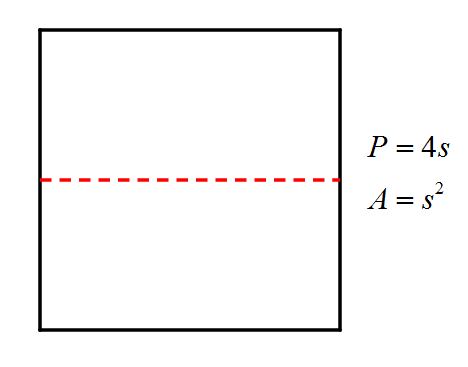
Thus, we can calculate “Pi” for a square to be

Thoughtful students may have other suggestions for the “diameter”, which can be a fun exploration in and of itself. But one way to sidestep this controversy is to simply define “Pi” in a more robust way.
Notice that, in a circle, we have

So we can define “Pi” for any plane figure to be one-fourth the ratio of the square of its perimeter to its area.
This simplifies matters, because area and perimeter are well-defined for most figures, whereas diameter is not. And it’s nice that this new “Pi” is still 4 for a square, since we have

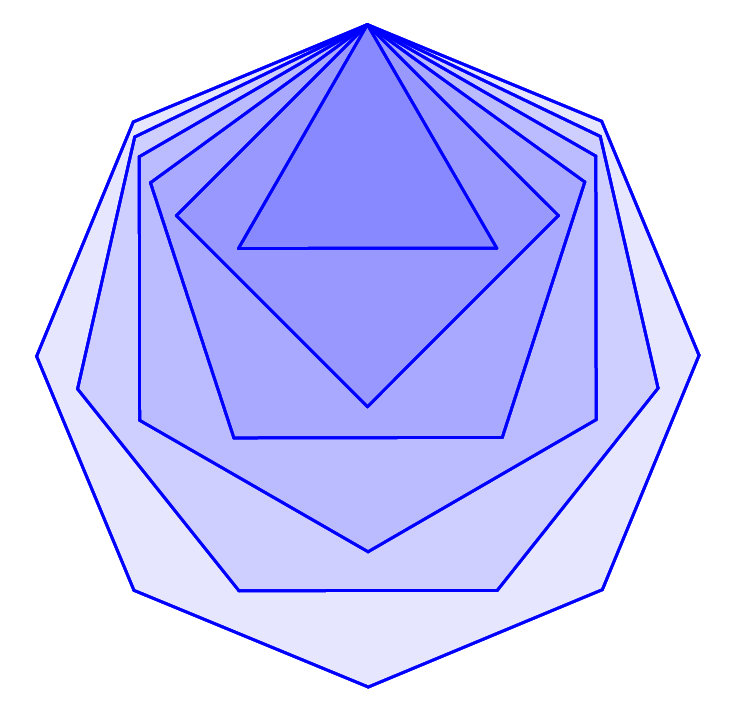
Once students have generalized the notion of “Pi”, there are several interesting directions to go. First, you can explore the value of “Pi” for other regular polygons. What is “Pi” for a regular hexagon? For a regular octagon?
Of course, something wonderful happens as you look at regular polygons with more and more sides. With some elementary geometry and trigonometry to derive the formula for the area of a regular n-gon, you can numerically explore convergence to Pi. And with some knowledge of limits, you can actually prove it converges to Pi!
You could also fix n and explore values of “Pi” for irregular n-gons. For example, set n = 4 and compare and contrast “Pi” for different rectangles, rhombuses, and parallelograms. It’s interesting to investigate which kinds of figures have “Pi” values closest to the actual value of Pi. You might even use this idea to develop a metric for equilateralness.
In one of my classes. we took our discussion of “Pi” up a dimension. With help from a Pi Day grant from Math for America, we used Zometool to explore the value of Pi for solids in 3 dimensions.
We built models of cubes, dodecahedra, icosahedra, triacontahedra, and other solids. We debated which solids had “Pi” values closest to the actual value of Pi. Then, starting from the assumption that

we calculated “Pi” for our various solids. Students had a great time with this hands-on activity!
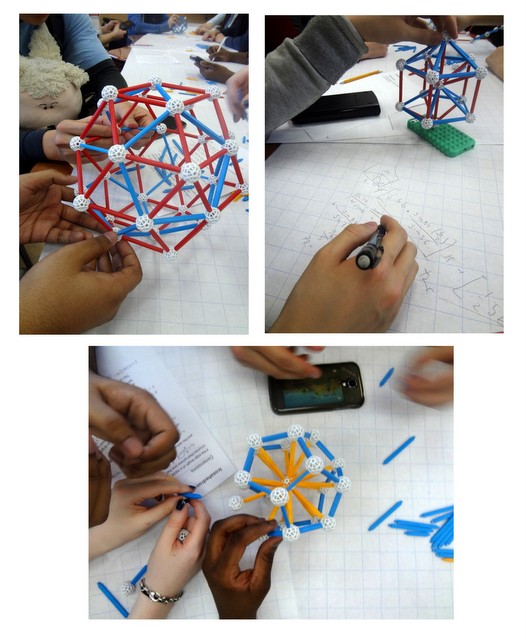
And most importantly, students came away with a better understanding of, and appreciation for, this remarkable constant.
So let’s find meaningful mathematical ways to celebrate Pi Day! Make it a Pi Day resolution.
Related Posts

 and
and 
 and directrix
