People Tell Me My Job is Easy

People tell me my job is easy.

You get summers off.

You only work nine months of the year.

You’re done at 3 pm.

You get paid to babysit.

Students at that school won’t succeed anyway, so you don’t have to do much.

Students at that school will succeed anyway, so you don’t have to do much.

Teaching advanced courses is easy. My students don’t even know the basics.

It must be easy to teach those students. Mine can’t handle that kind of work.

I wish I got to teach those students. Mine aren’t that engaged.

You just walk around asking questions. Your students are the ones doing everything.

The Surprising Simple Math Behind Puzzling Matchups — Quanta Magazine

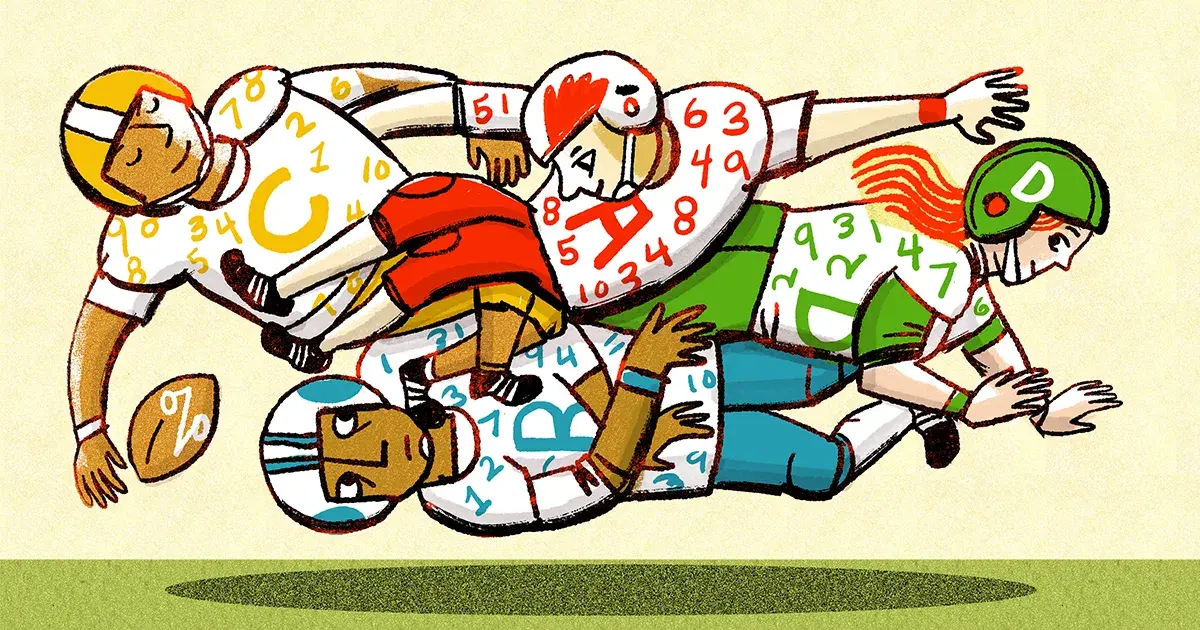
My latest column for Quanta Magazine is about one of my all-time favorite mathematical ideas: transitivity. Well, technically it’s about intransitivity, a subtly complex mathematical situation which any sports fan knows all about.

It’s the championship game of the Imaginary Math League, where the Atlanta Algebras will face the Carolina Cross Products. The two teams haven’t played each other this season, but earlier in the year Atlanta defeated the Brooklyn Bisectors by a score of 10 to 5, and Brooklyn defeated Carolina by a score of 7 to 3. Does that give us any insight into who will take the title?

Well, here’s one line of thought. If Atlanta beat Brooklyn, then Atlanta is better than Brooklyn, and if Brooklyn beat Carolina, then Brooklyn is better than Carolina. So, if Atlanta is better than Brooklyn and Brooklyn is better than Carolina, then Atlanta should be better than Carolina and win the championship.

Sports fan knows things are never this simple, and in my column I explore some of the surprising mathematical reasons why it may be the case that A is better than B and B is better than C, but C is better than A. You can read the full column for free here.

Math Photo: A Most Mathematical Building

Here are some images from Harpa, in Reykjavík, Iceland. Harpa is home to the Iceland Symphony Orchestra and the Icelandic Opera, and is one of the most mathematical buildings I have ever seen.

The face of the building is a solid wall of glass prisms whose faces are hexagons and pentagons.

Here’s a look up through the wall from below.

Different perspectives highlight the different polygons.

Whoever designed this beautiful building certainly knew the theory of pentagonal tilings!

My Tests are So Hard

Everywhere I’ve taught there have been teachers who brag about how hard their tests are. It’s always a central part of their identity as a teacher, of how they see themselves, and how they want to be seen. They proudly consider themselves more rigorous than their colleagues.

But nothing could be easier than making a test hard. You can just put more questions on it than can be reasonably handled in the allotted time. Or put problems on that haven’t been emphasized in class or practiced enough. Or problems that test edge cases and not core ideas. Or problems from the next unit. Or problems you simply haven’t prepared all students to handle.

I’ve seen teachers do all these things. It’s not rigorous. It’s lazy. You know what’s truly difficult? Writing a test that is fair, representative of core ideas, and appropriately challenging.

Taught Helplessness

I’m currently reading “The Design of Everyday Things” by Don Norman and it’s interesting to think about what the theory of product design has to say about instructional design.

For example, the author discusses how “learned helplessness” can result from poor design. A product whose functionality isn’t discoverable, and that doesn’t provide good feedback, will be frustrating to use, so users will likely give up after trying and failing a few times.

Just as I was making the connection to teaching math in my mind, the author himself brought up math instruction as a common example of “taught helplessness”: When math is presented as unintuitive, and poor or misguided feedback is given, students are likely to just give up. The problem is amplified by the linear way in math is usually taught. In many classrooms, if you don’t understand what happened yesterday, you will probably struggle to understand what is happening today.

Originally posted on Mastodon.

Follow

Get every new post delivered to your Inbox

Join other followers: